12 Things Every Fresher Must Know Before Starting Their First Job in 2026
12 Things Every Fresher Must Know Before Starting Their First Job in 2026
Your CTC isn't your salary. Your job description isn't your manager's real expectations. And not every offer that lands in your inbox is genuine.
Most fresher advice focuses on getting the interview. This guide covers what happens after — reading your offer letter properly, understanding your actual take-home pay, spotting a fake job offer before it costs you money, and the workplace basics nobody explains before day one.
A note before you read
This guide is published by RequireHire's content team, part of Veridant AI. Every point here is written to be genuinely practical, for starting your career — the goal is that your first few months are shaped by real information, not by things nobody got around to explaining.

Why This Matters More for Freshers in 2026
Many freshers enter the workforce with strong technical preparation but genuinely limited exposure to the practical, administrative side of a first job — reading an offer letter properly, understanding a payslip, or knowing what a probation period actually involves. That gap shows up as confusion in the first few months, financial surprises on the first payday, and sometimes falling for offers that turn out not to be genuine.
Why this is worth fixing before day one
None of this requires more technical skill — it's a different kind of preparation, and most of it takes less than an hour to genuinely understand once someone actually walks through it. That's what the rest of this guide does.
Being Ready Isn't Just About Technical Skill
It's understanding your compensation, knowing how to verify a genuine offer, communicating professionally from day one, and accepting the first few months are for learning, not perfection.
None of this is complicated once it's explained clearly — it's just rarely explained at all before someone actually needs it.
The rest of this guide breaks it down into 12 specific things, plus a dedicated section on spotting fake job offers.
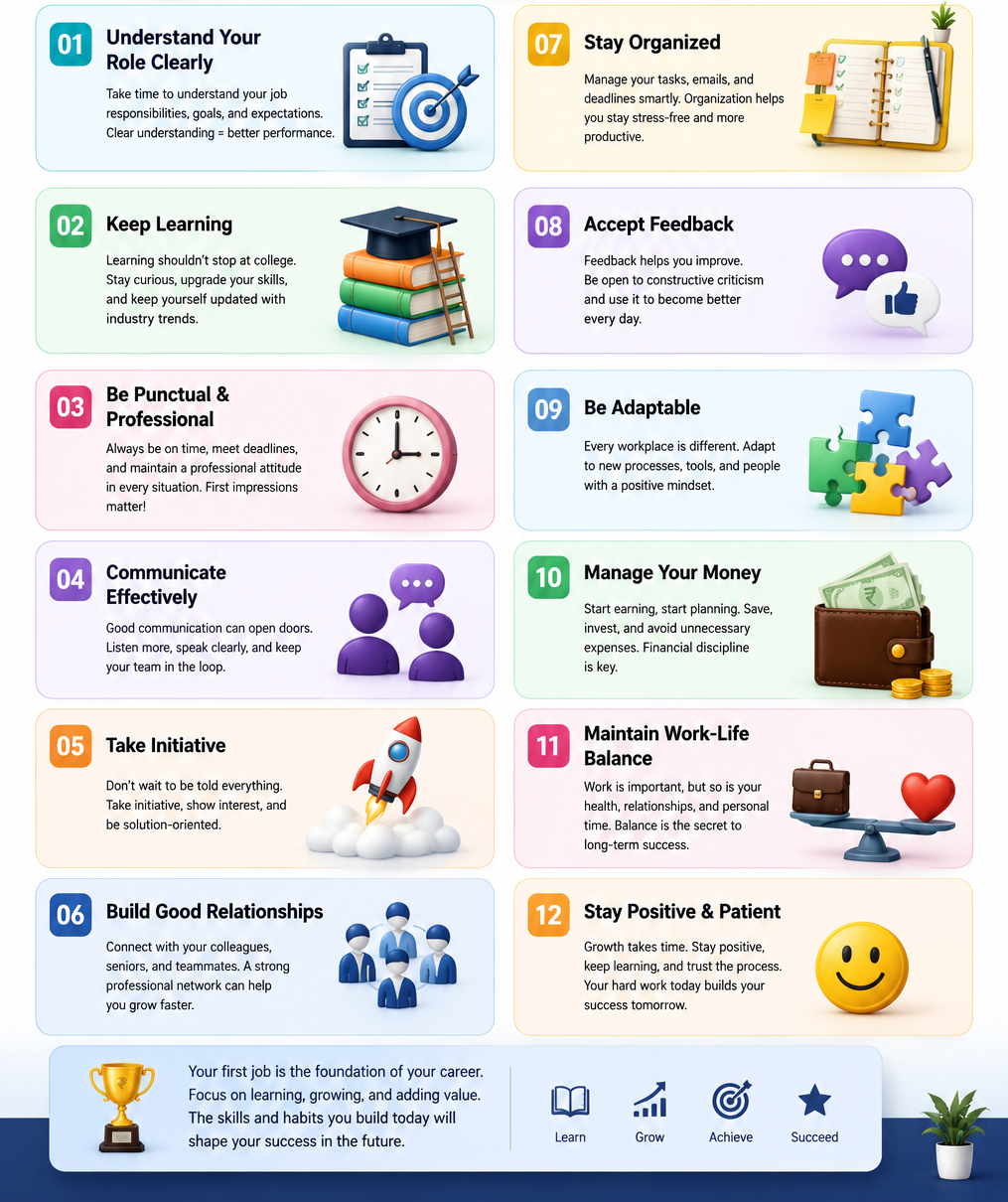
Before You Sign, Before You Start
Understand your CTC — it's not what lands in your account. CTC usually includes provident fund contributions, gratuity, insurance, and other benefits beyond your monthly pay. Ask for a clear in-hand estimate before you calculate your budget around any number.
Read your offer letter fully before accepting. The fine print matters as much as the salary line — check the notice period, any bond or service agreement clauses, and probation duration and terms.
Learn to spot a fake or scam job offer. This matters enough to get its own dedicated section further down this guide — read it before you accept anything.
Your first few months are about learning, not performing perfectly. Probation exists because both sides are still evaluating fit — treating the first 90 days as a flawless performance test creates unnecessary pressure.
Professional communication is a skill you're judged on from day one. How quickly you respond, how you phrase a question, how you handle a mistake in an email — all of it shapes perception, often before your actual work output does.
Your first salary needs a plan, not just spending. Even a small amount saved consistently from your first paycheck builds a habit that's much harder to start later — treat saving as a fixed line item, not whatever's left over.
Knowing What to Expect Doesn't Get You the Job. This Does.
Register your resume on RequireHire and let it build your candidate profile automatically — one step closer to the offer letter you'll actually need to read carefully.
For job seekers. Takes minutes, not hours.
Register Your ResumeOnce You're In
Networking starts on day one, not when you're job hunting again. The colleagues and managers you work with now become part of your professional network later — treating every relationship as disposable is a genuine missed opportunity.
Ask about growth path and feedback cycles early. Understanding how and when you'll be evaluated, and what "good performance" actually looks like at this company, matters more than the job description alone.
Your reporting manager's expectations matter more than the job description. A JD is a general guideline written before you were hired; your actual day-to-day priorities come from your manager.
Feeling behind in your first few months is normal, not a red flag. Nearly every fresher experiences this — it's not a sign you don't belong, it's the natural gap between classroom knowledge and real workplace context.
Keep learning even after you're hired. The market and the skills it values keep shifting — treating your first job as the end of learning rather than a new phase of it puts you behind within a year or two.
Document your work as you go, not just at review time. A running note of what you did, what you learned, and what changed as a result makes performance reviews, resume updates, and future interviews far easier.
Understanding CTC vs Assuming Take-Home Pay
Assuming CTC = take-home
Leads to budgeting around a number you'll never actually see in your account, and a confusing, frustrating shock on your first payslip.
Understanding the breakdown
Knowing roughly what deductions apply means your first payslip confirms what you expected, not upends it.
The honest verdict
Ask for an in-hand estimate before you accept, not after your first payslip arrives — it's a completely normal, expected question at the offer stage.
The Job Description vs What Your Manager Actually Expects
The job description
Written before you were hired, often general, sometimes slightly outdated by the time you actually start.
Your manager's actual expectations
Specific, current, and the real standard you'll actually be measured against day to day.
The honest verdict
Both matter, but when they seem to conflict, your manager's actual priorities are what to follow — clarifying that early avoids a lot of confusion later.

Your First Job Starts With One Registration, Not a Hundred Applications
Register once, and your profile is ready to apply with across every listing that fits — instead of tailoring the same resume a hundred times over.
Register NowDeciding Under Pressure vs Taking Time to Read the Fine Print
Deciding quickly
Genuine offers sometimes come with real deadlines, but pressure to decide within hours, with no room to ask questions, is itself a signal worth noticing.
Taking time to read
Even a legitimate offer with a tight deadline can usually accommodate a few focused questions before you sign.
The honest verdict
A reasonable employer expects and welcomes questions before you commit; genuine discomfort with basic questions is itself useful information.
Struggling Silently vs Normalizing the Learning Curve
Struggling silently
Assuming everyone else has it figured out and you're uniquely behind, which often isn't true and adds unnecessary stress on top of the actual learning.
Normalizing the curve
Accepting that a learning period is expected, and asking for help or clarification without treating it as a weakness.
The honest verdict
Nearly everyone experiences the same adjustment; treating it as expected rather than exceptional makes the first few months genuinely easier.
How to Spot a Fake or Scam Job Offer
With more of the job search happening online, fake offers targeting freshers specifically have become more common. A few consistent red flags are worth knowing before you're in a situation where you have to spot one quickly.
Six signs worth taking seriously
1) Any request for payment — a "registration fee," "training deposit," or "security deposit" — before you've even started work. 2) An offer that arrives with no interview, or an unusually short, informal one for a role that would normally involve more scrutiny. 3) Salary or package details that seem significantly higher than similar roles, with vague justification. 4) Communication only through personal chat apps, with no official company email domain. 5) Heavy pressure to decide or pay within hours, discouraging you from verifying anything independently. 6) No verifiable online presence for the company, or a website that looks incomplete or was clearly created very recently.
What to Actually Check Before You Accept
The email domain: confirm it matches the company's official website, not a generic personal email address.
The role details: confirm the title, reporting structure, and location match what was actually discussed.
The CTC breakdown: including an estimated in-hand figure, not just the total annual number.
Notice period and bond terms: any service agreement or exit clauses stated clearly.
Probation terms: the length, and what's actually evaluated during it.
Skip the Guesswork. Get Matched to Roles That Fit.
For job seekers. Verified employers, structured process — the opposite of a random inbox offer.
Register Your Resume
Common Mistakes Freshers Make in Their First Few Months
Assuming CTC is their monthly take-home
A budgeting shock on the first payslip is entirely avoidable with one clarifying question at the offer stage.
Not asking questions out of fear of seeming difficult
Reasonable questions about compensation or terms are standard practice, not a red flag to the employer.
Treating the first job as the end of learning
Stopping skill-building and networking the moment you're hired quietly puts you behind within a year or two.
Waiting until review time to document contributions
Specific details fade fast — reconstructing months of work from memory produces a far weaker case than a running log would.
The "My First Job Defines My Whole Career" Myth
It's easy to feel like this one decision determines everything that follows — the pressure to pick perfectly can be genuinely overwhelming before you've even started.
What the myth misses
A first job is one data point in a much longer career, not the whole story. What it teaches you about how you like to work, what environments suit you, and what skills you want to build next usually matters more than the specific title or company itself.
Why Getting This Right Early Actually Matters
What this actually changes
Getting these basics right doesn't guarantee a perfect first job, but it removes a lot of avoidable confusion, financial surprise, and risk — so the actual challenges you face in your first year are the real ones, not self-inflicted ones from missing information you were never given.
A Simple First-Salary Budgeting Framework
A commonly used starting framework splits your in-hand pay roughly three ways: essential needs, savings, and discretionary spending — with savings set aside first, not treated as whatever happens to be left over at the end of the month.
What actually matters here
The specific percentage split matters less than the habit itself — treating savings as a fixed, non-negotiable line item from your very first paycheck builds a pattern that gets significantly harder to start once spending habits are already set.

Your Roadmap, by Timeline
Before Day 1
Read your offer letter fully, confirm your in-hand salary, and prepare a few basic questions for your manager or HR contact.
First 90 Days
Focus on learning, ask questions freely, and start documenting your work as you go, not from memory later.
After 6 Months
Request feedback proactively, start building your professional network intentionally, and keep learning outside your immediate role.
Your Fresher Readiness Score
Check everything that's true for you right now, then calculate your score.
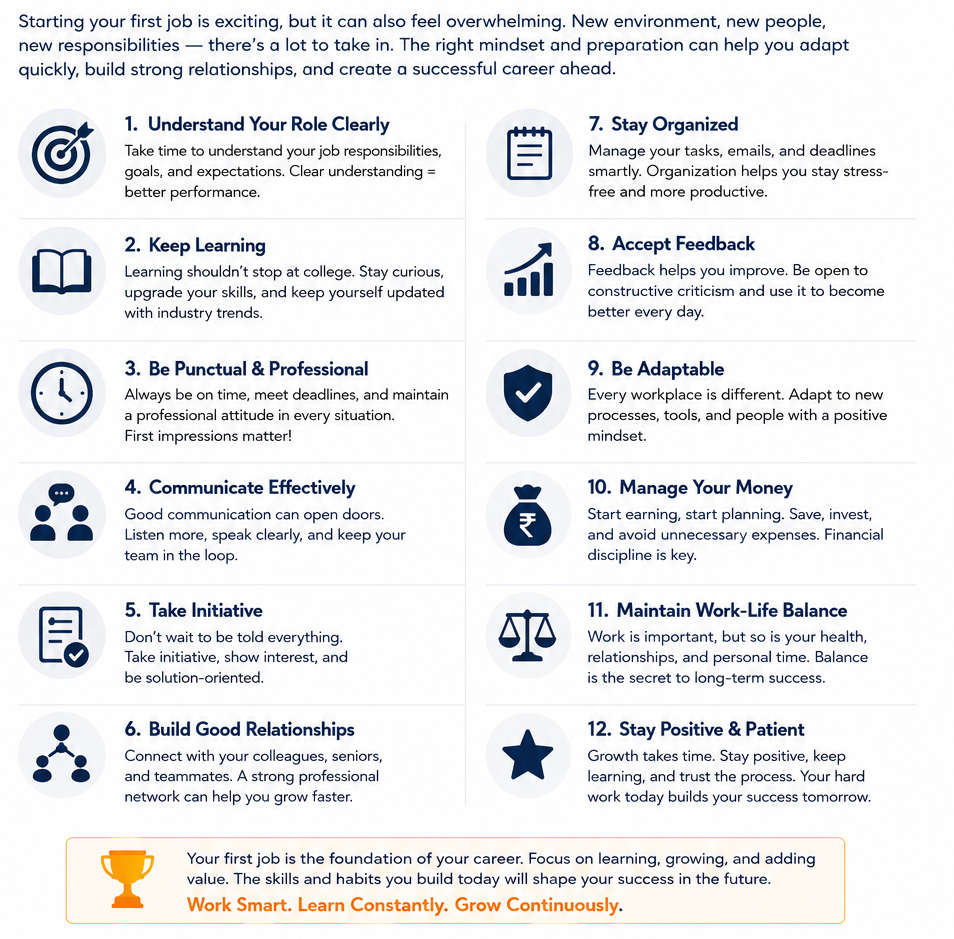
This Guide, in Numbers
Preparation Doesn't Stop at the Interview
Get matched to real, verified roles instead of applying blind.
Register Your Resume
Turning This Into a Plan: Before, During, After
Do: Apply through verified, structured channels
A consistent, verified application process is far safer than scattered applications across random links and forwards.
Don't: Trust an offer that skipped a real interview
A role with genuine responsibility rarely gets offered without any real evaluation first.
Do: Ask for the in-hand breakdown in writing
A clear written estimate protects you from confusion or disappointment once your first payslip arrives.
Don't: Pay anything to accept a job
A genuine employer pays you — not the other way around, under any framing.
Do: Start your work log in week one
A habit built from day one is far easier to maintain than one started retroactively months later.
Don't: Stop learning once you're settled
Comfort in a role is exactly when skill-building quietly slows down — keep it deliberate.
Your Final Checklist
You know your estimated in-hand salary, not just your CTC.
You've read your offer letter in full, including notice period and probation.
You know the six red flags for a fake job offer.
You have a savings habit ready for your first paycheck.
You're mentally ready for a learning curve, not expecting instant mastery.

How to Actually Get to Day One
Everything in this guide assumes you already have an offer in hand — but getting there in the first place still matters. A structured, verified job search beats scattering the same resume across dozens of random links, both for your safety and for how efficiently you actually reach a real offer.
A practical starting point
Registering your resume once builds a structured profile employers can actually find you through, rather than you finding scattered listings one at a time — the same starting point this entire guide has been preparing you to use well.
10 Questions Freshers Actually Ask About This

The Fresher Who Registers Today Is Already Closer to Day One Than the One Still Reading Job Boards
You now know what to check before you accept, how to spot a fake offer, and what actually matters in your first few months. The next step is simple — register your resume and let it start working for you.
100% for job seekers. RequireHire is a product of Veridant AI.
Ready to Practice What You Learned?
Take a free AI mock interview and get your skill score in 15 minutes. 100% free for all candidates.
Related Posts
Practice Your Interview
Get ready for your next interview with our AI-powered mock interview tool.
Start Practice Interview