How Colleges Can Improve Placement Rates Using RequireHire: A Guide
How Colleges Can Improve Placement Rates
Using RequireHire: A Guide
Every placement officer wants the same outcome: more students placed, faster, at better packages. Fewer have a clear, repeatable method for getting there. This guide breaks down exactly how colleges use RequireHire to raise placement conversion — five concrete methods, in the order that actually works.
The Details Which you should Know
- • Placement rates improve most reliably when students get structured interview practice early, not during crunch week
- • Recruiters respond to standardized, comparable readiness data — not just resumes and marks
- • A wider employer pool matters as much as better-prepared students
- • None of this replaces your placement cell's existing work; it gives your team better tools and better timing
- • RequireHire's can be , live in about 48 hours, and doesn't require new infrastructure on your end after enroll
Why Placement Rates Stall, Even at Good Colleges
unprepared for interviews
Interview Readiness
predict job performance
Marks vs. Performance
structured readiness process
Process Gap
to compare candidates
Scoring Demand
Figures summarize commonly reported placement and hiring-readiness trends from campus and industry sources as of mid-2026. Treat them as general indicators, not exact measurements.
Most placement cells aren't short on effort. They run drives, coordinate with recruiters, and push students to apply. What's usually missing is a structured way to close the gap between what a transcript shows and what a recruiter actually screens for in the first five minutes of an interview. Without that, even strong students can underperform in the room that decides the offer.
The fix this guide focuses on
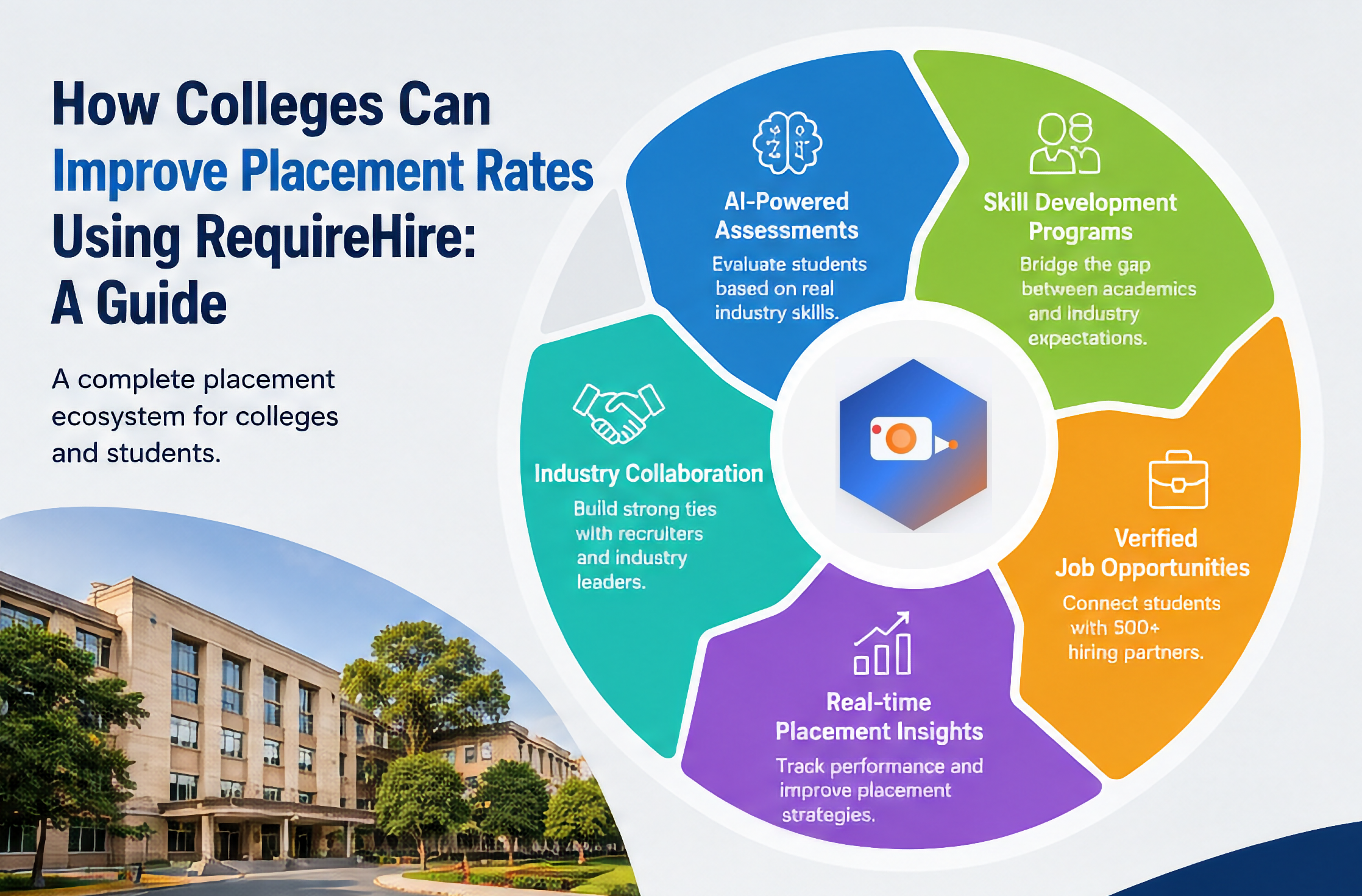
Raising a placement rate isn't one lever — it's five, applied together: structured readiness practice, Career tools for every student, cross-campus buy-in, avoiding a handful of common mistakes, and a wider employer pool. The rest of this guide walks through each one, in the order that tends to work.
What Recruiters Actually Screen For First
Before you can improve a placement rate, it helps to know exactly what's being evaluated at the first screening stage. Across sectors, recruiters tend to check for the same handful of qualities, roughly in this order:
Why this shapes Method 1, below
None of the top qualities here show up on a transcript. That's precisely the gap a structured, standardized interview process is built to close — which is why it's the first method in this guide, not an afterthought.
Give Every Student a Structured Way to Prove Readiness
Figures reflect RequireHire's current partner network and reported outcomes as of mid-2026.
What This Method Includes
- ✓A standardized AI interview every student can take, producing a structured, comparable readiness record
- ✓A placement dashboard your team can use to see performance and employer interest at a glance
- ✓A branded module that plugs into your existing placement workflow rather than replacing it
- ✓Access to a network of 500+ companies who can search readiness scores directly
- ✓Onboarding support and a dedicated contact for your placement team
What It Deliberately Doesn't Do
- ✕It doesn't guarantee 100% placement — it improves the odds, it doesn't remove the hiring decision from the employer
- ✕It doesn't replace your placement cell's relationships or judgment
- ✕It doesn't act on behalf of employer. as they are independent for making choices
- ✕It doesn't share student data with employers without the student's own consent
- ✕It doesn't make hiring decisions on your behalf — it's a tool, not a recruiter
The Process, in 4 Steps
Discovery Call
A short, no-obligation call to map your current placement process and where students are losing ground.
Custom Plan
A written plan specific to your institution, covering scope, cost, and a realistic timeline.
Setup & Integration
Basic access can be live within about 48 hours. Deeper integration with your existing portal usually takes one to two weeks.
Training & Launch
Your placement officers and faculty coordinators get hands-on training before students start using it.
Your institution keeps control of scope and student data at every step.

Equip Every Student With Career Tools
Structured practice alone helps most when students also have the tools to act on the feedback.
AI Resume Builder
Turns coursework, internships, and projects into a resume format recruiters can actually scan quickly, without students starting from a blank page.
Explore Resume Builder →AI Resume Checker
Flags weak keywords, formatting issues, and structural gaps before a resume reaches a recruiter, improving first-round clearance odds.
Discover Resume Checker →AI Cover Letter Generator
Produces a role-specific cover letter in minutes — still worth submitting, since many recruiters read it before the resume itself.
Generate Cover Letters →AI Interview Prep
Scenario-based, role-specific practice questions students can run through ahead of the interviews that actually count.
Start Interview Prep →Aptitude Test Series
Practice sets modeled on common company assessment formats across IT, consulting, finance, and manufacturing.
Practice Aptitude Tests →Daily Interview Challenge
One short situational question a day, aimed at building the kind of steady interview habit that's hard to fake under pressure.
Today's Challenge →All six tools are for every student at a partner institution.
What Changes After Applying These Methods
Every institution starts from a different place, so results vary. Here's the kind of shift placement teams commonly describe.
Engineering & Technical Colleges
Common pattern
Technical courses leave little room for structured interview coaching. These colleges most often use Method 1 to give final-year students a low-pressure way to practice explaining technical work clearly — usually the single biggest gap recruiters flag in this segment.
Business & Management Schools
Common pattern
Management programs often already run strong soft-skills training. Here, Method 1's value is usually in giving employers standardized, comparable data across a large batch, which shortens the back-and-forth with recruiters.
Multi-Disciplinary Universities
Common pattern
With students spread across many streams, placement cells often can't give every department the same level of prep. A shared platform gives every student, regardless of course, the same baseline of readiness support.
See How This Would Work at Your Institution
Book a short call to walk through what applying these methods would actually look like for your placement cell.
Is Your Placement Cell Already Doing This?
Four quick questions to see where the gaps are.
How to Roll This Out in Your First Month
Week 1: Set Up the Foundation
- → Complete the partnership agreement and activate your dashboard
- → Create administrator accounts for your placement team
- → Set AI interview focus areas to match your primary recruiting sectors
- → Add access links into your existing placement portal
Week 2: Train Your Team
- → Run a training session for placement officers on the dashboard
- → Walk faculty coordinators through interpreting readiness scores
- → Draft an internal plan for introducing the platform to students
- → Set up reporting views around the metrics you already track
Week 3: Bring Students On Board
- → Announce the rollout across departments
- → Run orientation sessions for final-year students
- → Have your first batch complete their AI interview
- → Introduce students to all six prep tools
Week 4: Open the Employer Connection
- → Share your strongest student profiles with target companies
- → Add readiness data to placement brochures and employer decks
- → Track employer engagement and callback rates
- → Hold your first review call with your RequireHire contact

Get Every Campus Team Involved, Not Just the Placement Cell
Tap each card to see how.
Placement Cell
Still the team leading the rollout, now with better data to work from.
Click to see specific benefits →
Placement Cell Benefits
- • More consistent conversion across a full cycle
- • A meaningfully lighter first-round screening load
- • Preparation planning backed by real readiness data
- • Stronger, more data-backed employer conversations
- • A dashboard that's easy to report from
Academic Departments
Faculty get a clearer read on where teaching and industry expectations diverge.
Click to see specific benefits →
Academic Department Benefits
- • Direct visibility into common industry skill gaps
- • Useful input for adjusting course content over time
- • A shared benchmark for student readiness
- • A stronger placement track record to point to
- • A channel for industry input on curriculum
Institution Leadership
Leadership gets something concrete for conversations about placement performance.
Click to see specific benefits →
Leadership Benefits
- • Clear, trackable placement metrics
- • A stronger case in accreditation and ranking reviews
- • A better story for prospective students and parents
- • A genuine point of difference vs. nearby institutions
- • No added cost at the basic tier
What Actually Changes
- ✗Placement officers spend most of their time on manual first-round screening instead of employer outreach
- ✗Students are evaluated mainly on academic marks, with no standardized way to assess interview skills
- ✗Employers receive largely generic resumes that don't set your students apart from other campuses
- ✗There's no clear data on which students need extra help, or where
- ✗The placement cycle stretches over months with fairly low conversion at each stage
- ✓AI interview practice covers first-pass readiness, freeing your team for employer relationships
- ✓Standardized scores give an objective, comparable view of student readiness
- ✓Employers see verified skill data that helps your students stand out
- ✓Dashboard data flags exactly which students need support and in what area
- ✓A tighter placement cycle, with steadier conversion at every stage
Avoid These Common Rollout Mistakes
Mistake: Waiting Until Final Year
Institutions that introduce the platform in the third year, rather than weeks before placement season, tend to see students walk into real interviews noticeably more comfortable. Fix: build it into your calendar a full year ahead of placements.
Mistake: Treating It as a Replacement
The strongest results come from pairing RequireHire with what you're already doing — mock interviews, soft-skills workshops, aptitude coaching. Fix: position it as an addition, not a swap.
Mistake: Using the Dashboard Only for Reporting
The data is most useful when it's used to spot individual gaps early. Fix: review it weekly to flag students who need targeted support, not just at the end of the cycle.
Mistake: Leaving Scores Out of Employer Conversations
Including aggregate readiness data in your placement brochure or employer pitch gives recruiters an objective reason to take your institution seriously earlier. Fix: bake it into your standard pitch deck.
Widen the Employer Pool, Not Just Student Prep
Why this method matters as much as student prep
Better-prepared students still need companies to reach. Instead of your team pitching each company individually, RequireHire's employer network works the other way: recruiters search and shortlist student profiles directly, based on readiness scores and skill match. Strong students get visibility with companies your placement cell may never have had the bandwidth to approach on its own.
Common Questions About Improving Placement Rates
Start Applying These Methods This Placement Season
Join the institutions already using RequireHire to raise placement conversion — starting with a basic tier, no upfront cost, and long-term contract.
Ready to Practice What You Learned?
Take a free AI mock interview and get your skill score in 15 minutes. 100% free for all candidates.
Related Posts
Practice Your Interview
Get ready for your next interview with our AI-powered mock interview tool.
Start Practice Interview