Java Fresher Jobs in India 2026: Entry Level Roles
Java Fresher Jobs in India 2026: Entry Level Roles Paying
The year 2026 marks a massive opportunity for Java freshers across India. From Bengaluru and Hyderabad to Tier-2 cities like Indore and even emerging hubs, companies are hiring thousands of entry-level Java developers for Spring Boot, microservices, and backend roles. This complete provides everything you need — real salaries, skills roadmap, interview tips, and how RequireHire helps you get noticed ethically.
Whether you are from a top college or a small town, this blueprint will help you land your dream job with confidence and clarity. Start building your future today.
Join RequireHire Now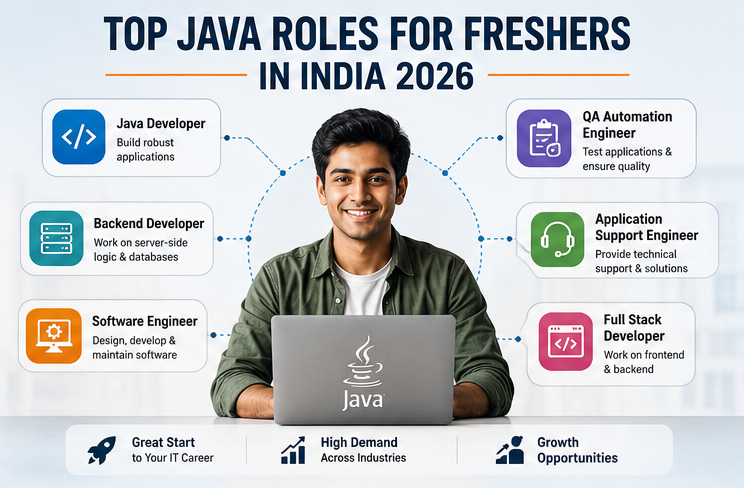
The Brutal Reality Every Java Fresher Faces in 2026
Thousands of Java freshers graduate every year filled with hope but quickly face harsh rejection. Mass recruiters demand 2+ years experience even for entry-level positions. Campus placements are limited to a few top students. In Tier-2 and Tier-3 cities like Dhanbad, unreliable internet during coding tests and location bias make the struggle even harder. Many talented freshers lose months sending hundreds of applications with no response, leading to frustration and self-doubt.
This outdated system wastes potential and delays careers. However, 2026 brings a powerful shift toward skill-first hiring that levels the playing field.
You Don’t Need Prior Experience
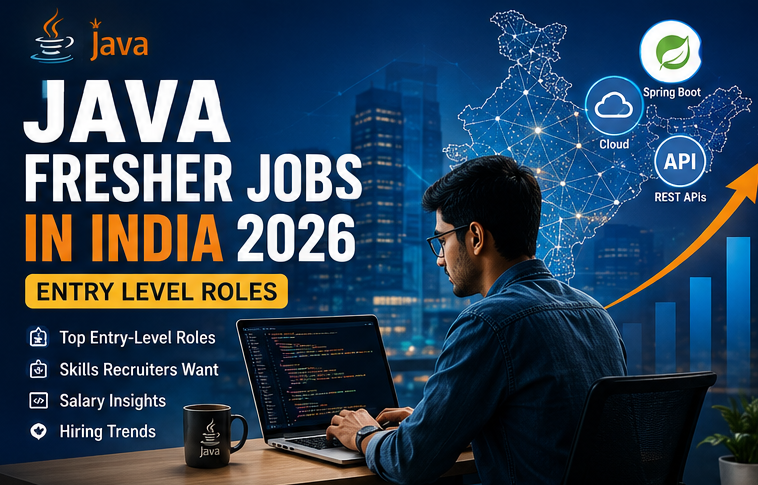
Most traditional advice is outdated. In 2026, companies prioritize verifiable skills over years of experience. A fresher with well-built, deployed Spring Boot projects and strong problem-solving ability often outperforms candidates with degrees but no practical proof. Ethical AI platforms like RequireHire are revolutionizing this by focusing purely on merit and potential.
This shift is creating genuine opportunities for freshers from all backgrounds to break into top companies without traditional barriers.
Quick Wins for Immediate Impact
If you want to bypass the crowded applicant pool and capture the attention of top-tier recruiters, you must implement immediate strategic shifts. Do not wait for the market to adjust to you. Take proactive steps today to completely reposition your professional profile and demonstrate verified competence in the enterprise Java ecosystem.
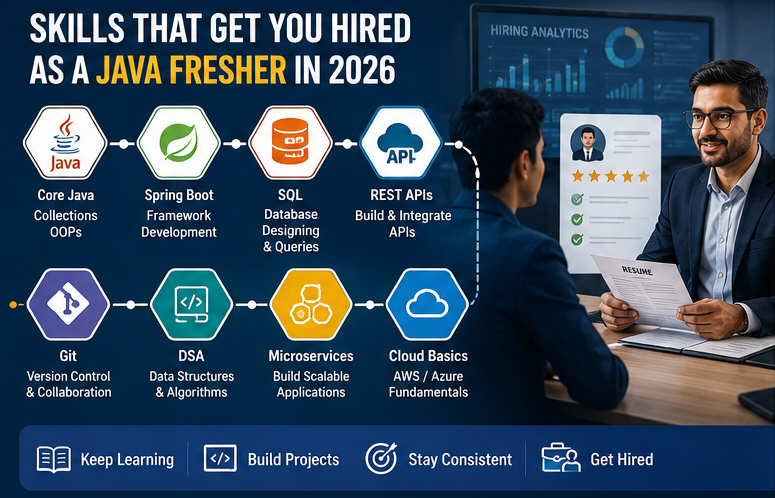
Stop listing generic skills and start building a verifiable portfolio of complex applications. Master the art of deploying robust Spring Boot microservices. Additionally, register your skills on intent-based matching platforms to gain direct visibility. These actionable quick wins will instantly elevate your resume above the noise of traditional job seekers.
- Upgrade resume to "Java Spring Boot Microservices"
- Build one massive, full-stack capstone project
- Register on RequireHire
- Find mentors on Intern2Hub
Java Fresher Interview Readiness Score 2026
2-Minute Java Readiness Assessment
Be honest with yourself. Rate your current level in these key areas that recruiters value most.
60%
Evolving Java Developer
You have a good foundation. Focus on building and deploying real projects to boost your readiness significantly.
Get Free Resume Review →The Uncomfortable Truth
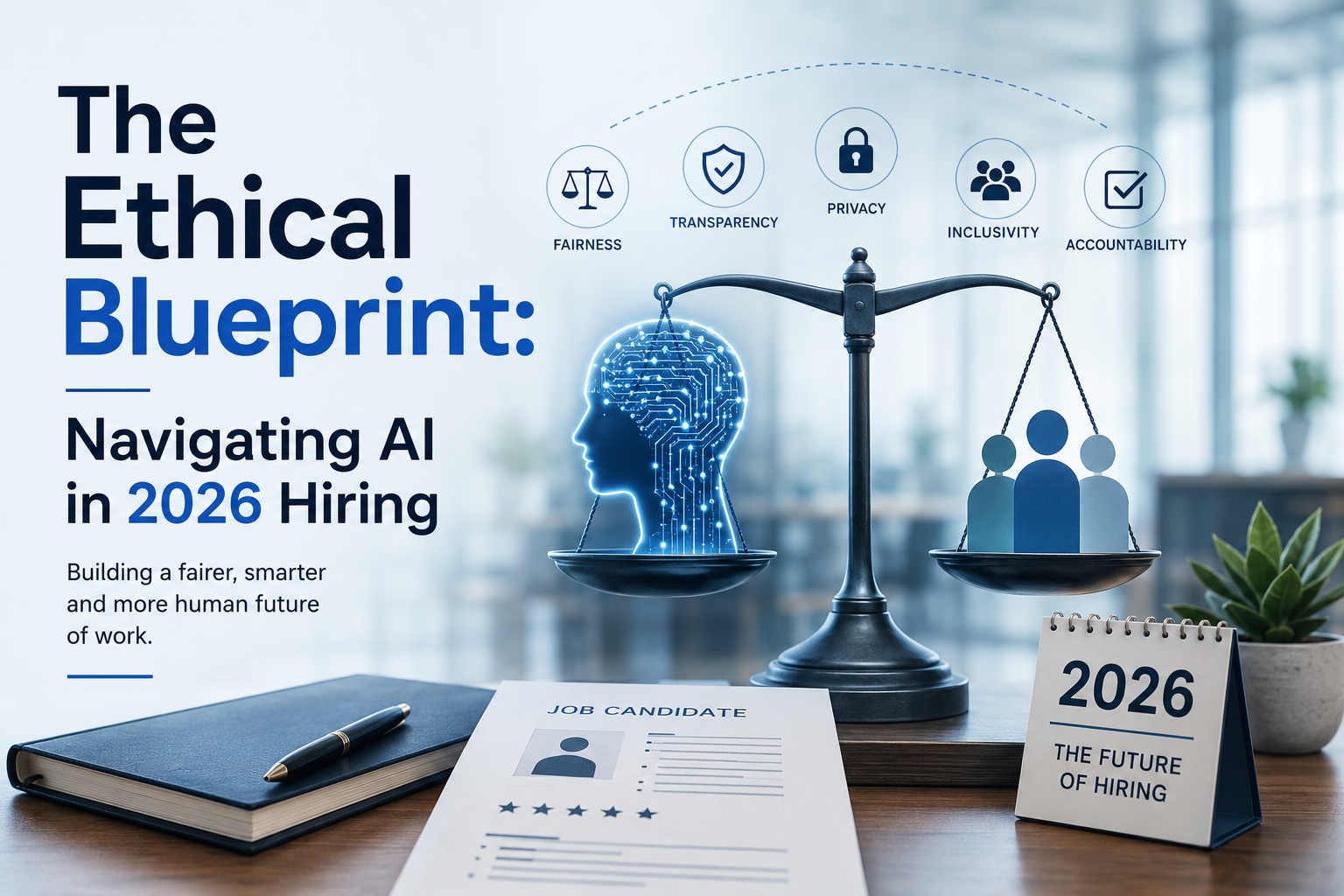
Here is the uncomfortable reality regarding your job search: your resume is actively holding you back. In this high-stakes hiring environment, managers simply do not have the time to read massive documents detailing minor college achievements. They use automated systems to scan for specific signals of verified competence. If those are missing, you fail.
The biggest mistake Indian freshers make is treating their resume like a personal biography instead of a targeted marketing asset. You must replace generic objectives with undeniable proof of work. Provide direct links to complex, deployed Spring Boot applications on GitHub. In 2026, verbal claims are cheap; verifiable evidence is absolutely everything for your career.
Anatomy of the Role
To succeed today, you must deeply understand what an entry-level Java position actually entails. The days of extended corporate training programs are largely finished. Modern enterprises and agile startups expect new hires to contribute to production codebases almost immediately. You are expected to navigate the full lifecycle, from understanding requirements to deploying scalable solutions.
Your primary responsibility will revolve around constructing robust RESTful APIs using the Spring Boot framework. You must efficiently handle complex HTTP requests, manage database transactions via Hibernate, and guarantee strict application security. Furthermore, you must write comprehensive unit tests to ensure absolute reliability before your code ever reaches a live production environment.
E-E-A-T Insights
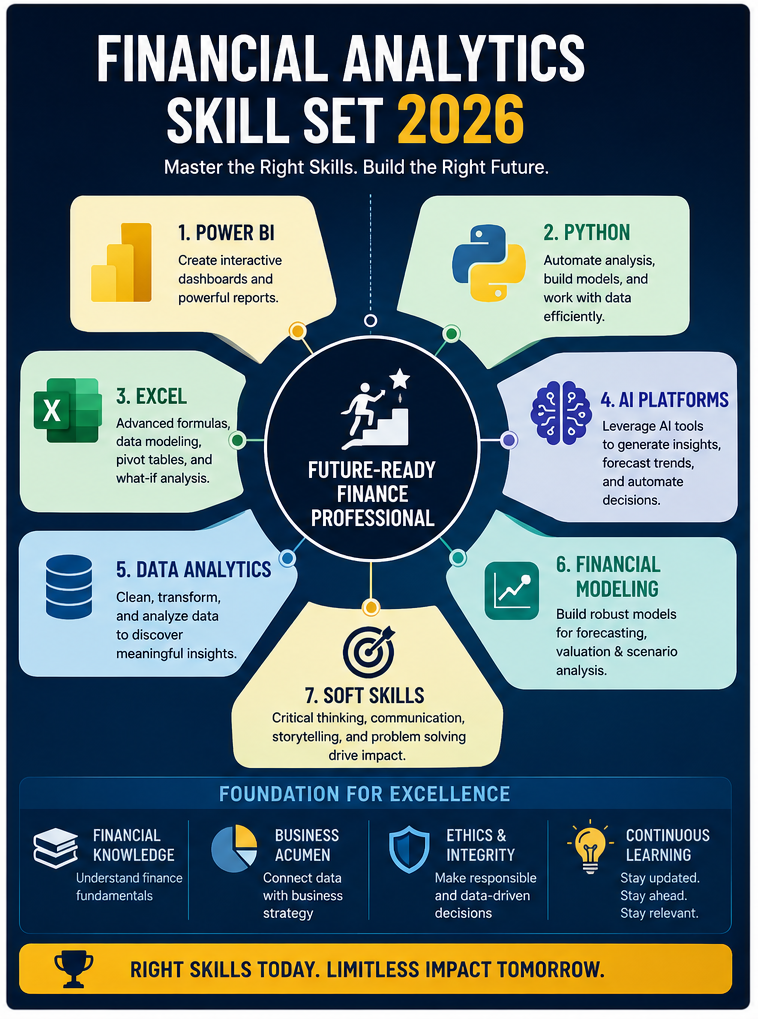
Do not just take our word for this transformation. According to recent industry surveys across major Indian tech hubs, engineering managers overwhelmingly prioritize hands-on project execution over university pedigree. They are desperately searching for freshers who can demonstrate true expertise and trustworthiness. The demand for verified Java skills remains incredibly robust and continues to grow.
This aligns perfectly with Google's E-E-A-T framework—Experience, Expertise, Authoritativeness, and Trustworthiness. Recruiters apply these exact same principles when evaluating your profile. When you present a GitHub repository containing well-architected Spring Boot microservices, you instantly establish your authority. By utilizing ethical hiring platforms like RequireHire, you transform yourself from an unknown candidate into a trusted professional.

The T+ Java Fresher Framework for 2026 Success
T+ JAVA
Horizontal Bar: Broad skills including Core Java, Spring Boot, SQL, Git, Docker and basic cloud.
Vertical Bar: Deep expertise in one domain such as fintech or e-commerce backend systems.
Java Developer
In the highly competitive environment of 2026, becoming a T-Shaped professional is an absolute necessity for career survival. The vertical bar represents your deep specialization: an absolute mastery of Java 21+ features and the Spring ecosystem. You must be fully capable of designing secure, high-performance backend services without needing constant supervision or guidance.
The horizontal bar represents your broad capability to integrate those core skills with the wider technological landscape. This includes a solid working knowledge of Docker containerization, CI/CD deployment pipelines, and essential cloud infrastructure. Most importantly, it involves seamlessly utilizing AI coding assistants to accelerate your daily workflow without compromising the overall security of the system.

Step-by-Step to Getting Hired
Navigating the complex transition from university student to employed professional requires a strict, sequential roadmap. You must begin by mastering modern foundations like Java 21, specifically focusing on virtual threads and advanced data structures. Without this highly optimized bedrock, any application you attempt to build will be fundamentally unstable in a production environment.
Once the foundation is secure, dive incredibly deep into Spring Boot. Learn to secure endpoints with JSON Web Tokens and manage relational data seamlessly. Finally, execute a massive capstone project and register your verified portfolio on RequireHire. This deliberate strategy bypasses the generic application pile and connects you directly with top-tier technical recruiters.

Decoding Specific Roles
When entering the market as a Java fresher, you will quickly encounter various distinct job titles that require targeted strategies. The most prominent role is the Backend API Engineer. In this position, your total focus remains on the server side, building the hidden engines that power massive mobile applications and processing complex business logic flawlessly.
Another highly sought-after position is the Cloud-Native Java Developer. This emerging role beautifully bridges the gap between traditional software creation and modern DevOps practices. You will utilize microservices architecture and distributed tracing on platforms like AWS. Understanding the specific nuances of these roles is critical for successfully tailoring your resume and dominating technical interviews.
Overcoming Common Objections as a Java Fresher
“No experience” is countered with strong GitHub projects and Intern2Hub certificates. Location bias is eliminated through skill verification on RequireHire. Low CGPA is overcome by focusing on practical skills and clear communication during interviews.
These strategies have helped thousands of freshers break through traditional barriers in 2026.
Curious How Top Freshers Are Cracking Java Interviews?
Don’t miss this limited-time opportunity. Master high-income Java skills with Kumar Vimal — completely FREE for a limited time only. Perform better & grow faster.
Unlock Free Mentorship Nowava Fresher Jobs 2026
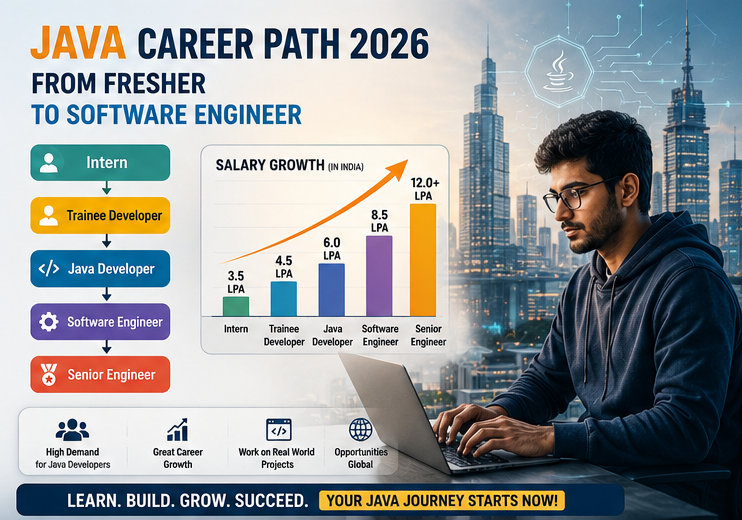
| Location | Service Companies | Product Companies |
|---|---|---|
| Metro Cities | ₹5–9 LPA | ₹7.5–12 LPA |
| Tier-2 Cities | ₹4.8–7.5 LPA | ₹6.5–10 LPA |
| Tier-3 / Remote | ₹4.5–7 LPA | ₹5.5–9 LPA |
These figures show clear growth potential based on skills and location flexibility.

Master Java Backend – Clear & Practical Learning
Learn Spring Boot, Microservices and deployment from industry expert. Perform better & grow faster. Completely FREE for limited time only.Stop constantly guessing what technical recruiters actually want to see on your resume. You can get the exact, step-by-step roadmap required to build highly scalable microservices and effortlessly pass rigorous technical rounds. Do not miss this limited-time opportunity to drastically elevate your understanding of modern enterprise systems under the guidance of seasoned industry experts.
Start Free Course Today
15. Comparison Trigger: The Cost of Inaction
In the high-velocity Indian tech landscape, standing still is functionally equivalent to moving backward rapidly. Consider the candidate who relies solely on an outdated university syllabus and submits generic resumes to massive job boards. They spend agonizing months waiting for emails that never arrive, experiencing deep frustration and mounting anxiety as the market leaves them behind.
Contrast this with the proactive candidate who aggressively upskills in Spring Boot and builds a verifiable cloud portfolio. By registering their verified capabilities on platforms like RequireHire, they bypass the generic noise entirely. They command premium starting salaries because they provide undeniable proof of work. The cost of remaining passive is simply too high today.
Value-Based Matching
The greatest inefficiency in the modern job market is a profound crisis of visibility. Thousands of brilliant freshers remain completely undiscovered because they are lost in the static of generic job portals. These massive legacy platforms treat candidates as commodities, forcing recruiters to rely on heavily flawed keyword filters that ignore actual coding competence entirely.
RequireHire was specifically engineered to destroy this systemic friction through ethical, intent-based matching. We do not want you blindly applying to hundreds of random listings. Our advanced algorithms deeply analyze your verified proof of work, intelligently aligning your exact capabilities with employers actively searching for those precise skills. Your true merit finally dictates your success.

Exposing the Academic Gap
Every engineering fresher inevitably experiences a massive cognitive dissonance upon graduation: the painful realization that rigorous academic study has failed to prepare them for enterprise reality. You may have memorized complex object-oriented theories, but if you cannot independently design and deploy a scalable microservice architecture, your immediate market value remains shockingly low for top companies.
This academic gap is widening at an alarming rate as industry technologies evolve far faster than university curricula. To overcome this massive dissonance, you must take radical, uncompromising ownership of your practical education. View your college degree merely as a foundational baseline. Your real learning, and your real value, begins when you solve complex enterprise problems.

Where the Industry is Going
To build a highly resilient career, you must skate exactly to where the technology puck is going. The trajectory of the Java ecosystem is rapidly accelerating toward unprecedented cloud-native integration. The widespread adoption of Java 21 and Virtual Threads has fundamentally altered backend development, allowing engineers to write massively scalable applications with simplified code structures.
Furthermore, the immediate future is undeniably serverless and heavily AI-augmented. The industry is aggressively shifting toward microservices deployed on Kubernetes clusters using native image compilation for instantaneous startup times. If you do not quickly adapt to these modern standards and integrate AI tools into your daily workflow, you will inevitably fall behind the professional curve.
Hundreds of Freshers Have Already Succeeded
Join free mentorship and build the confidence you need to excel in Java interviews and land great roles.
Join Free MentorshipElevate Your Tech Network
Absolute success in the modern tech industry is rarely a solo endeavor; it is deeply correlated with the overall quality of your professional network. The concept of the viral loop is highly effective: as you elevate your own technical skills, you must actively share those insights and breakthrough opportunities with your dedicated peer learning group.
When you discover a high-impact mentorship platform like Intern2Hub or an intent-based matching engine like RequireHire, sharing this knowledge creates a massive compounding effect. You suddenly have capable peers with whom you can build complex open-source projects and conduct rigorous mock interviews. Elevating the standard of your entire network inevitably accelerates your own career growth.
Your Final Strategic Decision
You have now reached the conclusion of this blueprint, possessing a distinct informational advantage over the vast majority of your peers. You fully understand the critical shift toward precision, skill-first recruitment and the absolute necessity of mastering the modern Spring Boot ecosystem. Most importantly, you recognize that your verified visibility is your most valuable asset.
However, this powerful information is entirely worthless without immediate execution. The tech industry heavily rewards proactive builders, not passive observers. The difference between perpetual frustration and securing a high-paying role is your willingness to take immediate action. Take total control of your narrative today, begin building your proof of work, and align with ethical hiring.
Critical FAQs for Java Freshers
Absolutely not. While Core Java (OOP concepts, collections, multithreading) is the essential foundation, the 2026 market demands practical application-level skills. Employers are aggressively looking for candidates who can build complete solutions, not just write isolated algorithms. If you only know Core Java, you are competing in a saturated market of beginners. You must immediately upskill to include the Spring ecosystem, particularly Spring Boot, to demonstrate that you can create deployable APIs, handle database transactions, and understand web security. Your primary goal is to conclusively prove you are an enterprise-ready developer capable of handling real-world backend infrastructure.
Generic job portals operate on a broken, high-volume model where your resume is just one of thousands, often discarded by flawed keyword-matching algorithms. RequireHire fundamentally changes this dynamic through intent-based, ethical AI matching. When you register on RequireHire, the system meticulously validates your actual skills and proof of work, connecting you directly with employers actively seeking your specific expertise. This permanently eliminates the black hole of applications, significantly reduces hiring bias, and ensures you gain meaningful visibility based entirely on your verified merit, not just how well your resume is formatted for keywords.
Data Structures and Algorithms remain critically important, but the context has shifted dramatically in recent years. While top-tier product companies still require strong algorithmic problem-solving for their initial rounds, there is a massive segment of the enterprise market that heavily prioritizes system design and framework expertise over obscure puzzle-solving. You must have a solid grasp of foundational DSA to write efficient, highly optimized code. However, you should explicitly balance that theoretical study time with building real-world, scalable projects to maximize your overall employability, showcasing both logic and practical architectural understanding seamlessly.
A strong proof of work is a verifiable, undeniable demonstration of your ability to engineer actual software. It is not a generic library management system copied blindly from a YouTube tutorial. It should be a comprehensive, full-stack application (such as an e-commerce backend or a complex financial ledger) hosted securely on a public repository like GitHub. Crucially, the code must be exceptionally clean, modular, and thoroughly tested using industry-standard frameworks like JUnit. It should include crystal-clear documentation, demonstrate proper relational database management, and ideally be deployed live on a modern cloud platform.
In 2026, AI acts as a powerful operational orchestrator, not a complete replacement for human engineers. As a junior developer, you are expected to aggressively utilize AI coding assistants to dramatically accelerate boilerplate generation, optimize routine algorithms, and identify potential bugs early in the development cycle. However, the critical tasks—understanding complex business logic, designing highly secure system architectures, and integrating complex legacy systems—still rely entirely on your human intuition and acquired expertise. AI augments your capabilities, making you faster and more efficient, but it strictly requires your continuous architectural guidance and ethical judgment.
For an entry-level candidate attempting to break into the industry, deep mastery of a single, highly demanded ecosystem is always the far superior strategy. While knowing Python or JavaScript is beneficial for a horizontal skill set later, trying to master everything simultaneously will leave you with shallow knowledge across the board, rendering you functionally unemployable. The enterprise market pays a massive premium for specialists. By focusing deeply on the modern Java stack, you position yourself as a rare expert capable of handling mission-critical, large-scale systems. Master the vertical depth first.
Securing a high-value internship requires calculated strategic visibility and verified capability. Stop relying solely on campus recruitment or cold emailing generic HR addresses, which rarely yield tangible results in 2026. You must leverage specialized platforms that aggressively focus on skill validation and elite mentorship. Platforms like Intern2Hub are meticulously designed to connect ambitious, emerging Indian talent directly with forward-thinking organizations that offer practical, high-growth opportunities. By showcasing your verified portfolio and engaging actively with industry mentors on these specific platforms, you dramatically increase your chances of securing an internship that provides real-world resume-building experience.
Modern technical interviews for backend roles have evolved far beyond simple syntax quizzes and basic definitions. You must be deeply prepared to intelligently discuss application architecture. Expect incredibly deep-dive questions on Spring Boot internals, dependency injection, and advanced security implementations like OAuth2 or JSON Web Tokens. You will likely face realistic scenarios requiring you to design a highly scalable API, discuss sophisticated database indexing strategies, and comprehensively explain how you would troubleshoot a performance bottleneck in a distributed microservices system. Practice explaining your logic clearly out loud and always be ready to defend your architectural decisions.
While formal cloud certifications (like AWS Cloud Practitioner or Microsoft Azure Fundamentals) are not strictly mandatory for freshers, they provide a massive, undeniable competitive advantage. In the 2026 market, cloud-native development is the absolute standard across the industry. Having a certification conclusively proves to the employer that you deeply understand the underlying infrastructure where your Java applications will be deployed and managed. It loudly signals that you are proactive, forward-thinking, and possess the horizontal DevOps skills necessary to operate seamlessly within a modern enterprise environment. Acquiring a basic cloud certification is highly recommended.
The financial outlook for highly skilled Java developers remains exceptionally strong and undeniably resilient. Because Java serves as the bedrock backbone of global enterprise infrastructure, companies are incredibly willing to pay significant, sustained premiums for talent that can effectively modernize, scale, and secure these critical backend systems. While generic coders may experience severe wage stagnation due to AI automation, T-Shaped Java professionals who combine deep backend expertise with cloud orchestration and AI utilization command top-tier, rapidly growing compensation. By aligning yourself with modern Java frameworks and ethical hiring platforms, you completely secure your financial future.