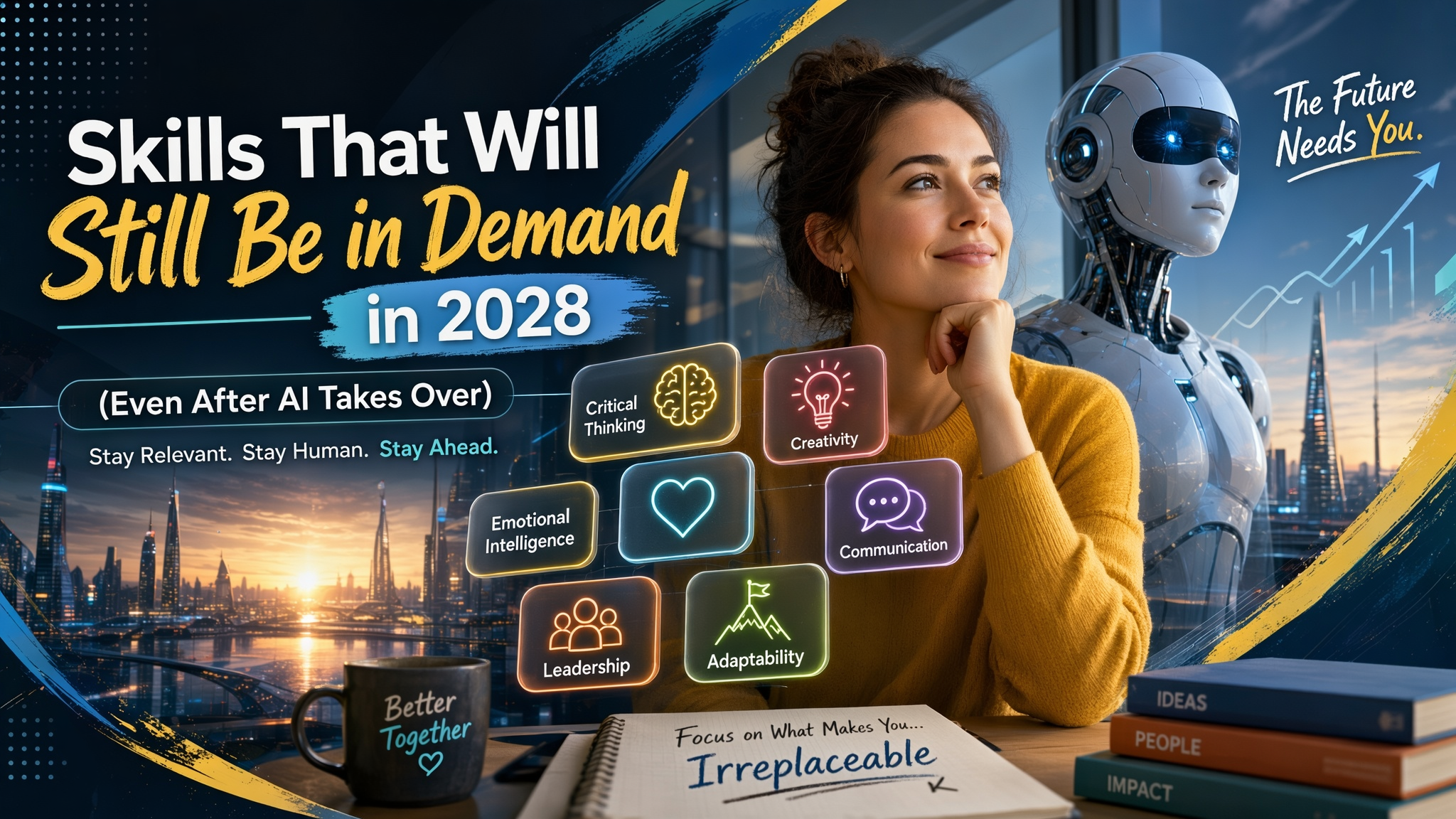
Skills That Will Still Be in Demand in 2028 (Even After AI Takes Over)
Skills That Will Still Be in Demand in 2028 (Even After AI Takes Over)
AI is changing tasks, not the value of a person who can think, explain and adapt.
This guide explains which skills tend to hold their value as AI tools spread, how to build them in ordinary weeks, and how requirehire.com helps you turn them into a visible, skill-scored profile.
A note before you read
This guide is published by RequireHire's content team for students, freshers, career switchers and working professionals who want to stay valuable as AI tools become part of everyday work. Last updated November 2026. Nobody can forecast 2028 with certainty, so this guide makes no predictions about specific jobs, quotes no salary or vacancy figures and offers no guarantees. It focuses on skills that are useful whichever way the change unfolds. To be clear about scope, requirehire.com is India's interview-first hiring platform with structured AI interviews, skill scores, mock interviews, aptitude practice and a resume check.
Why Is It So Hard to Know Which Skills Will Matter After AI Spreads?
Almost every week brings a new headline about what AI can now do. Some headlines promise a golden age, others warn of a collapse, and most readers are left more anxious than informed. When the signals are this loud and this mixed, it becomes difficult to decide what to study, which course to join or which habit to build.
The question is also usually framed as a contest: humans against machines. That framing hides a simpler pattern. Tools have always changed the shape of work. Calculators did not end the need for people who understand numbers, and spreadsheets did not end the need for people who can judge what the numbers mean. Each tool moved effort away from routine steps and towards judgment, explanation and decisions.
A more useful question is this: which skills help me do better work with AI around, and which of them can I build and prove before 2028? That question has practical answers, and you can start on them this week.
The gap this creates
Many people either panic or ignore the change. Closing that gap means understanding which parts of your work are routine, strengthening the parts that need judgment and learning to use AI as a capable assistant.
The Short Answer: Skills That Combine Human Judgment With AI Fluency Will Stay in Demand
Problem-solving, clear communication, learning agility, ethical judgment, collaboration, deep knowledge of your field and the ability to work well with AI tools are the skills most likely to keep their value.
A structured AI interview scores technical ability, communication and problem-solving, so you can see where you stand today and what to practise next.
The rest of this guide shows how to build these skills step by step, and where requirehire.com fits in.
What Is Actually Making Career Planning Feel So Uncertain?
Conflicting predictions
Experts disagree about speed and scale. When forecasts conflict, the sensible move is to build skills that work under every forecast.
Skills that age quickly
Knowledge of one tool or one interface can become outdated within a couple of years, which makes narrow preparation risky.
No honest measure of your strengths
Many people sense they are good at something but have never tested it under realistic conditions, so they cannot tell what to improve.
Fear that freezes action
Worry about the future can turn into waiting. A small weekly habit beats a large plan that never starts.
Debate this
Will AI make human skills more valuable or less valuable? Which tasks in your own work would you be happy to hand over, and which would you never want to?
Fix 1: How Do You Map Your Work to See Which Skills Matter Most?
Start with a simple page of paper. List everything you do in a typical week in your current job, your studies or the role you want. Include small tasks such as writing messages, preparing reports, answering questions, checking data, helping colleagues and making decisions.
Now mark each task in one of three ways. Routine tasks follow clear steps and repeat often. Judgment tasks need you to weigh options, handle exceptions or take responsibility for an outcome. People tasks depend on trust, explanation, persuasion or care. AI tools are generally strongest on routine tasks, so the second and third groups show where your lasting value is likely to sit.
Finally, look at the routine group and ask how an assistant could speed it up. Time saved there can be reinvested in deeper thinking and better conversations, which is exactly where people stand out. Treat this map as a living document and redraw it every few months as your work changes.
Try this week
Create your three-column task map, then circle the two judgment or people tasks you would most like to become excellent at.
Fix 2 and 3: How Do You Build Human Skills and Prove They Are Real?
Human skills grow through use, not through reading about them. Practise problem-solving on real situations: pick a small problem at work or college, write down the facts, list two or three possible solutions and explain why you would choose one. Practise communication by explaining an idea aloud to someone who is not an expert. If they follow you easily, your thinking is clear.
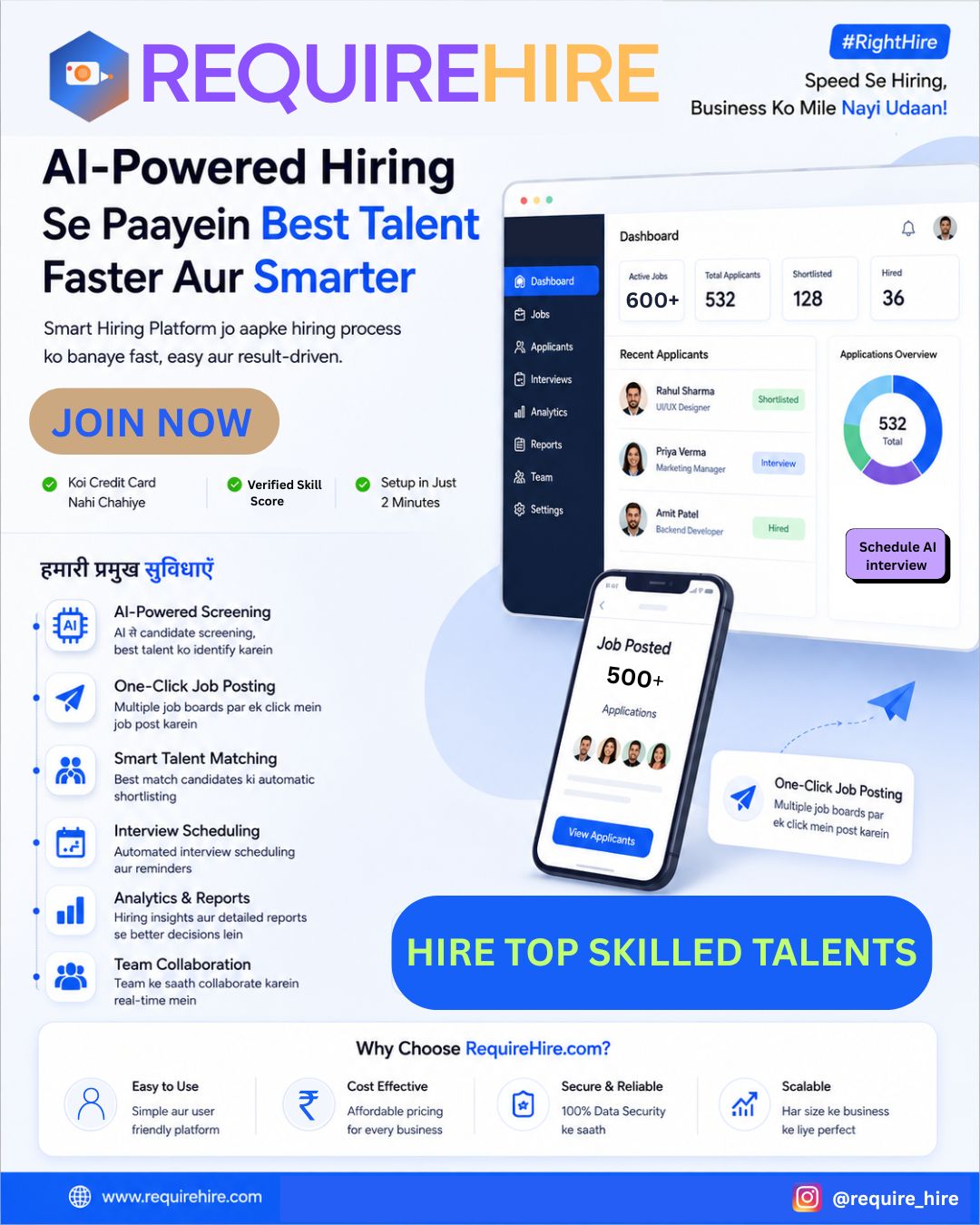
Then add proof. On requirehire.com, you can warm up with mock interviews and aptitude practice, then take a structured AI interview that evaluates technical ability, communication and problem-solving and produces a skill score. It is a starting point, not a verdict, and it shows what to practise next.
Learn to work with AI tools at the same time. Ask clear questions, give context, request reasoning and always verify what comes back. People who can direct a tool and catch its mistakes are more valuable than people who copy its answers without checking. Employers browsing the ranked pool see an anonymised profile, and your contact details are shared only if you approve a request.
The combined effect
A clear map of your work, steady practice of human skills and a measured score. Together they turn vague worry about AI into a concrete plan you can follow.
Your First AI Interview Takes Minutes. The Clarity Lasts Much Longer.
Register on requirehire.com, upload your resume and take a structured AI interview to see your baseline skill score today.
register, and it takes just a few minutes to start.
Take My First AI InterviewRoutine Task Skills vs Judgment Skills: Which Will Hold Their Value?
Routine task skills
Following fixed steps, formatting documents, copying data and producing standard reports. These are useful today, but they are also the tasks that tools handle most easily, so relying on them alone is a risk.
Judgment skills
Deciding what to do when information is incomplete, spotting what looks wrong, weighing trade-offs and owning the result. These skills grow with experience and are harder to hand to a tool.
The honest verdict
You still need routine skills as a foundation, because judgment is built on knowing the basics. The goal is to move from doing the steps to deciding which steps matter. Which part of your current work already needs your judgment?
Tool Knowledge vs Learning Agility: Which Lasts Longer?
Tool knowledge
Knowing one product or one interface well is practical and often required for a role. The downside is that tools change quickly, and detailed knowledge can expire with the next update.
Learning agility
The habit of picking up new methods quickly, asking good questions and unlearning old habits. A structured AI interview scores problem-solving and communication on the same criteria for everyone, which shows how you reason when a question is new.
The honest verdict
Learn the tools your role needs now, but invest more in how you learn. Is it better to master one tool deeply or to learn five tools lightly? Your answer may depend on your field.
Stop Guessing What You Are Good At. See Your Strengths Scored.
A structured AI interview evaluates technical ability, communication and problem-solving, so you know what to practise next.
See How Scoring Works
Competing With AI vs Working With AI: Which Mindset Pays Off?
Competing with AI
Trying to beat a tool at speed or volume is a contest most people will lose, and it can leave you tired and anxious without improving your work.
Working with AI
Using a tool for first drafts, checks and ideas while you supply context, judgment and accountability. Practice for this is self-paced on requirehire.com, so there is nothing to book.
The honest verdict
The strongest position is to be the person who knows what to ask, how to check the answer and how to explain the result. Should schools and employers test AI skills directly? Many people disagree, and it is worth forming your own view.
Hidden Skills vs Proven, Visible Skills: Which Gets Noticed?
Hidden skills
You may be capable in many ways, but if nobody can see it, opportunities depend on chance. Claims on a resume are easy to write and hard to compare.
Proven, visible skills
A skill-scored profile that employers browsing a ranked pool can find, with contact details shared only after you approve.
The honest verdict
Evidence travels further than claims. A consent-first profile shows your readiness while you keep learning. Would you trust a score more than a certificate, or the other way round?
Four Questions to Test Whether Any Skill Is Worth Building
Is it useful across many roles and tools, not just one?
Does it rely on judgment, trust or creativity that a tool cannot supply alone?
Can I practise it weekly and measure my progress?
Can I show evidence of it, such as a score, a project or a clear example?
What RequireHire Gives You to Build and Prove Your Skills
Structured AI interview scoring: your answers are evaluated for technical ability, communication and problem-solving, so you can see exactly where to improve.
Mock interviews and aptitude practice: rehearse answering questions aloud and test your reasoning, without a separate cost.
One-time profile and resume check: build your profile from a single resume upload, then use the resume check to present your education, skills and achievements clearly.
A visible, skill-scored profile: employers browsing a ranked pool can discover you, so your preparation is seen and not hidden.
Consent-based privacy: employers see an anonymised profile, and your contact details are shared only after you approve.
Prepare Today. Stay Valuable Tomorrow.
Employers browse ranked candidate pools on requirehire.com. Your skill-scored profile can be there, with contact details shared only after you approve.
Register on RequireHire
Which Mistakes Do People Make When Preparing for an AI-Shaped Job Market?
Chasing every new tool
Learning a new tool each week without building underlying skills leaves you busy but not stronger. Choose depth first.
Trusting AI output blindly
Tools can sound confident and still be wrong. Check facts, numbers and reasoning before you rely on any answer.
Ignoring communication
Good ideas that cannot be explained rarely travel. Practise speaking and writing clearly, every week.
Treating a score as a verdict
A score is a starting point, not a judgement of you. Use it to choose what to practise next, and ignore anyone who promises guaranteed jobs.
The "Soft Skills Are Optional, Only Technical Skills Count" Myth
It is a common belief: technical ability is the real currency, and communication, teamwork and judgment are pleasant extras. The belief is understandable, because technical skills are easier to list and to test.
What this misses
As tools take over more routine technical steps, the visible difference between people often lies in how well they frame a problem, explain a result and work with others. Technical depth still matters, because you need it to guide and check AI tools. The practical lesson is to treat technical and human skills as partners, and to build both. Hiring and selection decisions always belong to the organisations that make them.
What Actually Changes When You Build Skills With Evidence?
Consider two colleagues who start with the same degree. One reads every headline and changes plans each month. The other draws a task map, practises explaining decisions aloud, checks every AI-generated answer and retests each quarter. A year later, the second colleague has a clearer picture of strengths, a habit that compounds and evidence to show. Neither has a guarantee, but one is far better prepared for whatever 2028 brings.
Evidence also changes conversations. Instead of saying you are a good problem-solver, you can describe how you approached a real problem and point to a score that supports it. Which would you find more convincing if you were the one hiring?
The shift, in plain terms
Before: scattered worry about AI, no clear view of your strengths and learning that follows headlines. After: a map of your work, a baseline skill score, a weekly practice habit and a profile that shows your progress. None of this promises a job. It gives you a calmer, more confident way to prepare, and the freedom to adjust as the market changes.
What Does a Future-Ready Skill Profile Look Like?
A task map, showing which parts of your work need judgment and people skills.
A weekly practice habit, covering problem-solving and speaking your reasoning aloud.
A baseline skill score, so you know your starting point and your next focus.
A current resume and profile, so your growth is visible whenever an opportunity appears.

Your Starting Point, by Situation
Final-year student
Take a baseline AI interview early, practise explaining projects aloud and use AI tools to study while checking every answer yourself.
Fresher in a first job
Use mock interviews to find weak spots, volunteer for tasks that need judgment and retest every quarter to see improvement.
Career switcher
List the transferable skills you already have, practise explaining them clearly and use aptitude practice to build confidence in the new field.
Experienced professional
Redraw your task map, hand routine work to tools where it is safe, mentor others and keep a scored profile current.
Your Future Skills Readiness Score
Tick everything that is true for you right now, then calculate your score.

This Guide, in Numbers
Your Skills Deserve a Clearer Starting Point
Register once on requirehire.com to see how AI interviews and skill scoring work for your own profile.
Turning This Into a Plan: Before, During, After
Do: Map your tasks and take a baseline interview
Your map and a starting score show where to focus.
Don't: Plan around headlines
Predictions change often. Build skills that hold up either way.
Do: Practise aloud and track your scores
Spoken practice builds the clarity that every role rewards.
Don't: Skip the fundamentals
Good judgment rests on knowing the basics of your field.
Do: Retest and refresh every quarter
Choose one new skill each quarter and update your resume.
Don't: Stop learning once you feel safe
Skills fade without use, so keep growing wherever you are.
Your Final Checklist
You have a written map of your tasks and know which need judgment and people skills.
You use AI tools as an assistant and verify what they produce.
You have a baseline skill score and know your strongest and weakest areas.
Your resume and profile are current, so your progress is visible.
You know exactly how your contact details are shared with employers.
10 Questions People Actually Ask About Skills in the Age of AI

Future-Ready Careers Are Rarely Luck. They Are Built, One Practised Skill at a Time.
You now have a plan: map your work, strengthen the skills that need judgment, learn to work with AI and prove your progress with evidence. Register on requirehire.com, take your first AI interview and start building the skills that will still matter in 2028. It takes only a few minutes to begin.
100% for job seekers, always.
Ready to Practice What You Learned?
Take a free AI mock interview and get your skill score in 15 minutes. 100% free for all candidates.
Related Posts
Practice Your Interview
Get ready for your next interview with our AI-powered mock interview tool.
Start Practice Interview