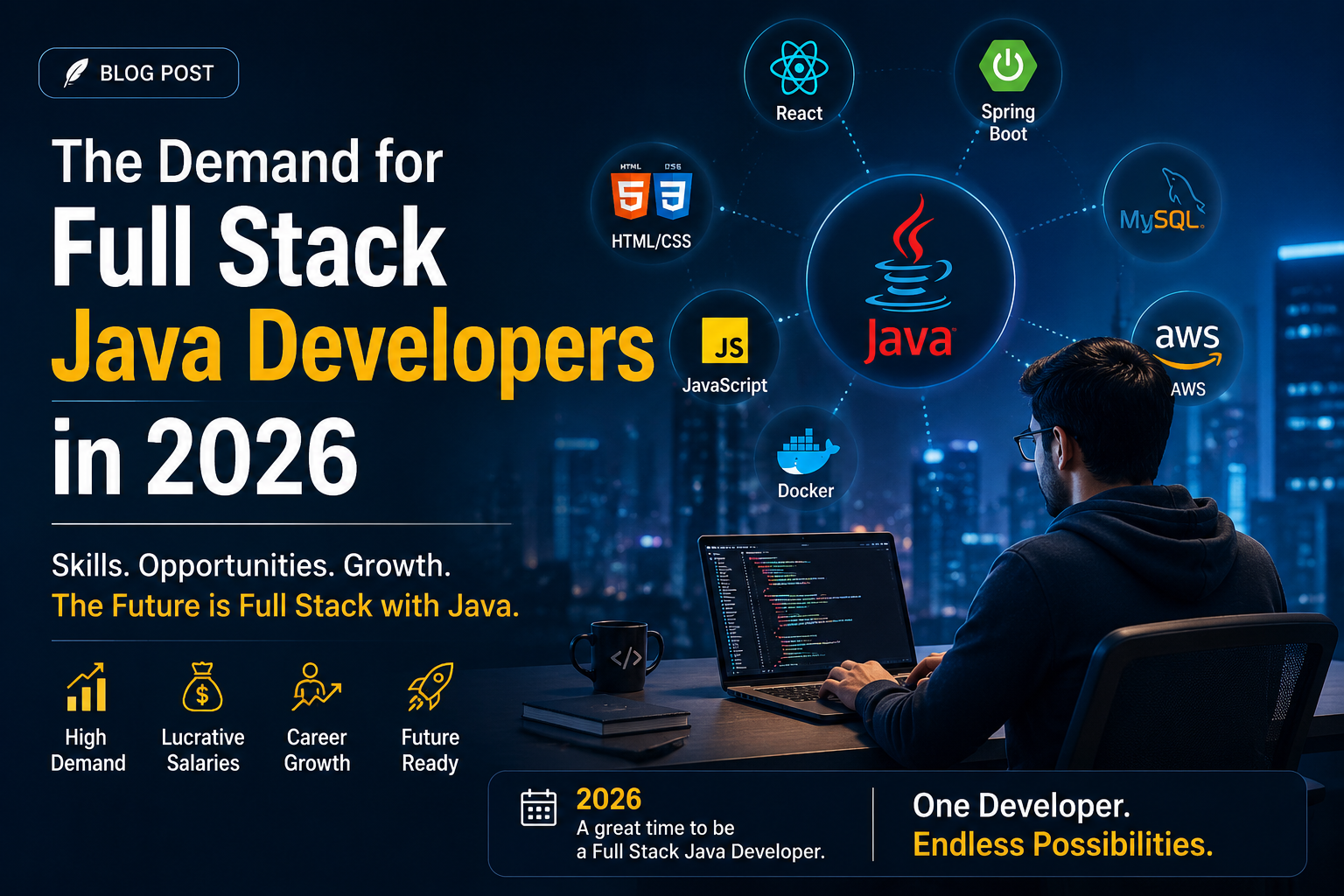
The Demand for Full Stack Java Developers in 2026
The Demand for Full Stack Java Developers in 2026
Why enterprises keep hiring for it, what "full stack" actually requires beyond Java, and how to prove you're ready.
Java isn't the newest language in the room, but 99% of organizations still run it somewhere, and enterprise, banking and fintech hiring keeps leaning on it. This guide breaks down exactly where full-stack Java demand is real, what employers pair it with, and ends with a personal interview-readiness score.
A note before you read
This article is published by the RequireHire team, an AI interview-first hiring platform used by 500+ companies hiring across India. Every statistic here is attributed to its original source — the TIOBE Index, Stack Overflow's 2025 Developer Survey, Azul's 2026 State of Java Survey, and 2026 salary data . Where we mention our own product, we link to the real, live page so you can check it yourself.
Why This Question Is Worth Asking Properly in 2026
use Java
Azul State of Java, 2026
used it in 2025
Stack Overflow, 2025
run Spring Boot
Framework surveys, 2026
to power AI
Azul State of Java, 2026
Java ranked on the TIOBE Index in July 2026, behind Python, C and C++ — not the flashiest position for a language search-interest ranking. But TIOBE measures search interest, not enterprise reliance. Azul's 2026 State of Java Survey, run by Dimensional Research across 2,039 qualified respondents on five continents, found 99% of organizations actively use Java, and roughly seven in ten reported that more than half their applications run on Java or the JVM.
The pattern this reveals
Popularity indices and enterprise reliance are answering different questions. A language can lose search-interest ground to Python while remaining the backbone of banking, insurance and government systems that no one is casually rewriting. That gap is exactly why "full stack Java developer" remains one of the more durable job titles in Indian IT hiring — provided the "full stack" half is taken as seriously as the Java half.
The Short Answer, Upfront
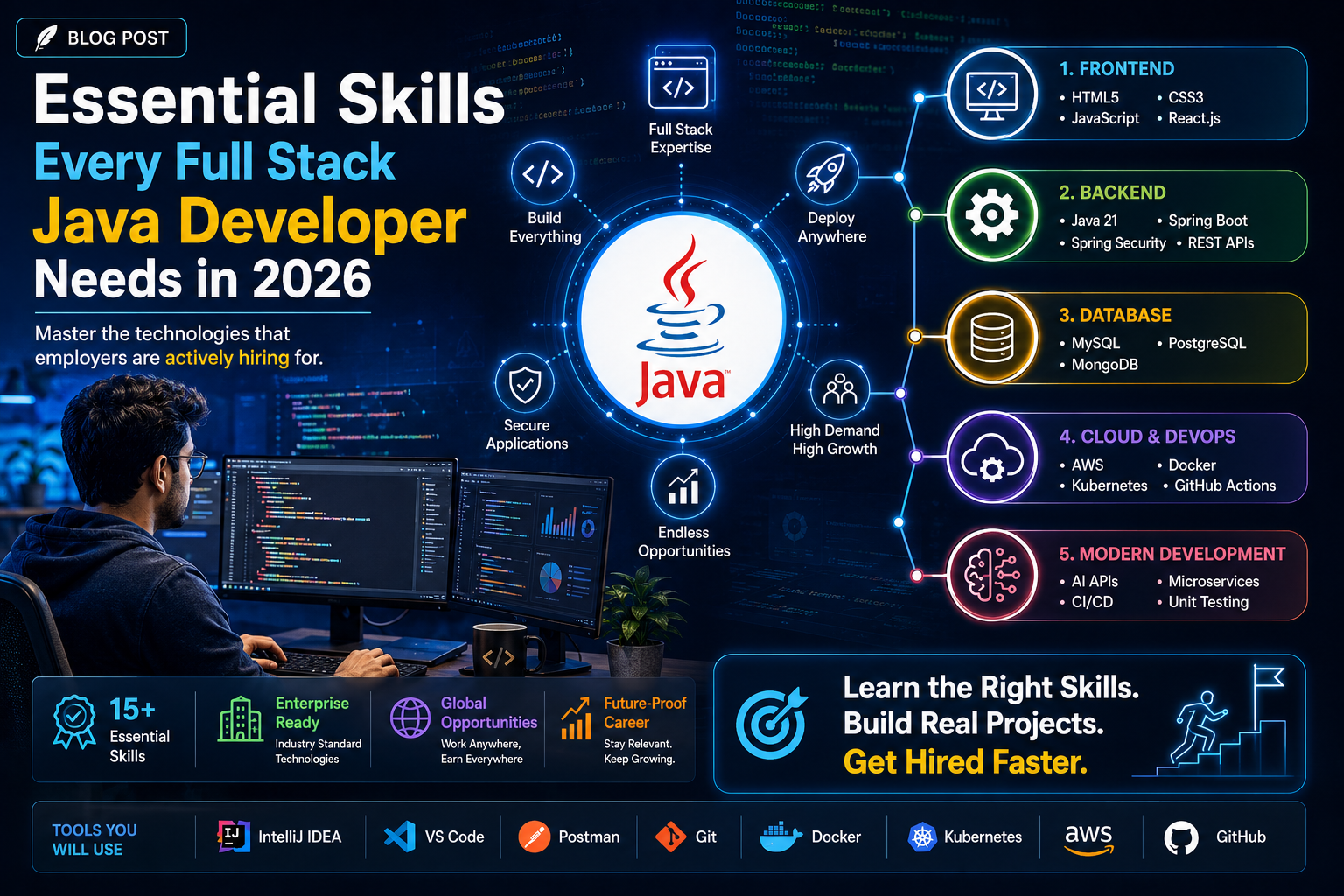
Yes — demand for full stack Java developers remains strong and durable in 2026, especially in enterprise, banking, insurance and fintech hiring. But "full stack" means more than core Java.
Spring Boot, a frontend framework, SQL, and basic cloud or DevOps familiarity are expected alongside Java, not instead of it. Almost no real full-stack job posting lists "Java" as the only requirement — the missing companion skill, not the language itself, is usually the actual gap.
The rest of this guide breaks that answer down by companion skill, by company type, and by experience level — and ends with a personal readiness score so you know exactly where you stand.
What "In Demand" Actually Means Here
"In demand" is doing a lot of work in this question, so it needs a definition before any comparison is fair. In this guide, a skill set is "in demand" for a full-stack Java role if a realistic job posting for that role, at a realistic Indian employer, would not add a second hard requirement on top of it.
Why company type matters more than the language itself
"Full stack Java developer" is not one job. A Java developer at a bank, a Java developer at a fast-growing product startup, and a Java developer maintaining a legacy government system are tested on almost entirely different companion skills — modern Spring Boot and cloud fluency for one, process discipline and Java fundamentals at scale for another. Any honest answer to "is Java in demand" has to be scoped to company type, which is exactly how this guide is organised.
Where Full Stack Java Delivers the Most Value
Banking, insurance & financial services
Core banking, trading systems, fraud detection and regulatory reporting overwhelmingly run on the JVM. Azul's enterprise vertical data rates Java reliance in financial services and insurance as "very high" — the deepest, most durable Java footprint of any industry.
Government, telecom & healthcare
Citizen-facing portals, billing systems, and EHR or HL7/FHIR integration layers lean heavily on Java for the same reasons as banking: reliability, long operational life, and a large existing Java-fluent talent pool that regulators trust.
Spring Boot microservices at product companies
Roughly 60% of enterprise Java applications now run on Spring Boot, and product companies increasingly hire specifically for Spring Boot plus microservices experience over generic "core Java" knowledge alone.
Legacy modernization projects
A meaningful share of enterprise Java hiring is modernization work — migrating Java 8 codebases to Java 17 or 21, or moving COBOL and legacy .NET systems onto Java. This niche pays well because it combines Java depth with real migration judgment.
Where Core Java Alone Isn't Enough
The frontend still needs a real framework
Browsers only execute JavaScript natively. No amount of Java skill changes that, so a title actually labelled "full-stack" still expects working React, Angular, or at minimum solid JavaScript or TypeScript for the client side.
Cloud and DevOps basics are now assumed
Docker, basic Kubernetes awareness, and familiarity with AWS or Azure show up in the large majority of current full-stack postings, even at traditionally conservative enterprise employers.
The modern Java version gap
Azul's 2025 data found Java 8 usage still at 23%, down from 40% in 2023, but employers increasingly expect comfort with Java 17 or 21 features — virtual threads, records, pattern matching — that Java 8 codebases simply don't have.
A coding round regardless of framework fluency
Most Indian companies, from IT services giants to product startups, still screen with a DSA-focused coding round independent of how well a candidate knows Spring Boot. Framework fluency doesn't replace algorithmic problem-solving in an interview.
Which Side of This List Are You Actually On?
A structured AI interview is a fast, way to find out where your Spring Boot and full-stack skills already meet the bar — and where they don't yet.
For job seekers. Used by 500+ companies hiring across India.
Start Your AI Interview
Java vs Python — Enterprise & Product Hiring
Java's case
Azul's 2026 survey found 99% of organizations actively use Java, with roughly 70% running more than half their applications on Java or the JVM — concentrated overwhelmingly in banking, insurance, government and telecom, sectors where a rewrite is rarely worth the operational risk.
Python's case
Python leads the TIOBE Index at 18.94% as of July 2026 and dominates AI/ML and data workloads, with 57.8% of professional developers reporting Python use in Stack Overflow's survey against 30.3% for Java.
The honest verdict
The two rarely compete for the same role. Enterprise architects increasingly run a polyglot stack — Java anchoring the transactional core, Python anchoring data and ML pipelines — and Azul's 2026 data shows 62% of enterprises already using Java to run AI in production, even while Python still leads model training. A full-stack Java developer who understands this split is more valuable than one who treats it as a rivalry.
Full-Stack Java vs Backend-Only Java — Why the Frontend Still Matters
Backend-only Java's case
Spring Boot can fully power a production backend — REST APIs, authentication, business logic, database access via JPA or Hibernate — and that alone is a complete, hireable specialization at most enterprise employers.
Full-stack's case
Browsers only execute JavaScript natively. No amount of Java skill changes that, so any role actually labelled "full-stack" will expect working React, Angular, or solid JavaScript/TypeScript for the client side, regardless of how deep the Java goes.
The honest verdict
"Full-stack Java developer" is a real, hireable, and well-paid title, but it does not mean Java-only — it means Java, usually via Spring Boot, on the backend and a working frontend framework on the client. A candidate who only writes Java is a backend developer, not a full-stack one, and job descriptions that say "full-stack" will test both sides.
Java + SQL — Not a Rivalry, a Pairing
Full-stack Java roles are structurally data-heavy, particularly given Java's concentration in banking, insurance and fintech. Nearly every Spring Boot backend talks to a relational database through JPA or Hibernate, which makes SQL — schema design, joins, indexing, query performance — one of the most consistently tested companion skills alongside Java itself.
Why this is the pairing to prioritize first
SQL isn't competing with Java for interview time — it's assumed alongside it. A full-stack Java developer who can design a clean schema and write an efficient join is solving the exact kind of production problem — a slow report, a locked table, a bad index — that shows up constantly in real enterprise Java work, not just in interviews.
Java vs C++ — Where the Managed Runtime Wins, and Where It Doesn't
Java's case
Virtual threads in Java 21, Generational ZGC's sub-millisecond garbage-collection pauses, and GraalVM native image have closed real gaps that used to favour C++ or Go on startup time and concurrency. For most enterprise and full-stack work, Java's productivity and ecosystem now outweigh C++'s manual memory management.
C++'s case
Ultra-low-latency trading systems, embedded firmware, and game engines still need the direct memory control C++ provides, and no amount of JVM tuning fully replaces that for genuinely hard real-time constraints.
The honest verdict
Unless you're specifically targeting systems-level, embedded, or high-frequency-trading roles, modern Java on 17 or 21 is the more efficient use of your learning time for full-stack and enterprise work. The runtime arguments that used to favour C++ or Go are measurably weaker than they were even five years ago.

Java vs Kotlin & Go — The Scarcity Premium
Kotlin runs on the same JVM as Java and interoperates directly with it, but sits at 9.4% professional use against Java's 30.3% in Stack Overflow's survey — real demand, but a smaller, more specialized pool concentrated in Android and select backend teams. Go, at 14.1% professional use, is showing up mostly in new microservices and cloud infrastructure rather than replacing established Java systems.
Should a Java developer bother learning Kotlin or Go?
Not as a replacement — as a specialization, once Spring Boot and core Java are genuinely solid. Kotlin and Go are common second languages for Java developers moving into Android or cloud-native infrastructure roles respectively — niches that are smaller but often better paid precisely because fewer developers cover them.
See What Java Roles Are Actually Open Right Now
Search live full-stack Java developer roles across India instead of guessing from theory.
Search Java Developer Jobs on RequireHire
Freshers vs Experienced — Does the Answer Change?
Freshers: the project stack matters more than raw syntax
At the fresher level, companies have no work history to evaluate a candidate on, so a portfolio does the convincing. Industry salary trackers consistently show a wide gap between a fresher who knows only core Java and basic Spring Boot, and one who has added React, REST APIs, MySQL, Git, and two or three deployed projects — the second profile routinely commands a noticeably higher starting offer with identical years of experience.
Experienced: Spring Boot and architecture depth take over
Past two or three years, the question shifts from "does this person know Java" to "how deep is their Spring Boot, microservices, and cloud experience" — and product companies and Global Capability Centres typically pay meaningfully more than service companies for the same depth, as GCC hiring has been expanding fast in India through 2026.

Enterprise & Fintech — The Domain With No Real Rival
If there's one domain where "Java is still the default" comes closest to literally true, it's regulated, high-reliability enterprise software. Azul's enterprise vertical data rates financial services and insurance as carrying "very high" Java reliance for core banking, trading systems, fraud detection and regulatory reporting, with government, healthcare and telecom close behind for citizen portals, EHR platforms and billing systems.
The one companion skill this domain still demands
Even here, SQL and a working understanding of transactional data integrity are treated as part of the job, not an optional extra. Increasingly, Java developers on these teams are also expected to understand where their applications' AI-assisted features — via Spring AI or LangChain4j — call out to a model, even if they never train one themselves.

Startups & Product Companies vs IT Services — Different Hiring Bars
Product companies & startups
Product-first employers such as Razorpay, Swiggy and Atlassian often hire for a specific modern stack — Spring Boot plus React plus cloud-native deployment — and lean on live coding or system-design rounds that test real architecture judgment over memorized syntax.
IT services & enterprise employers
Large services firms such as TCS, Infosys, Wipro, Persistent Systems and Capgemini run enormous, process-driven Java hiring pipelines for banking, insurance and government clients, hiring in bulk with more structured, standardized interview loops.
The honest verdict
Which pipeline you land in changes what "full stack" is actually tested against more than the company's overall size does. Product-company interviews weight modern framework fluency and design judgment more heavily, while enterprise IT services pipelines weight process discipline and Java fundamentals at scale.
The "Full-Stack Means Just Very Good at Java" Myth
A common misconception is that a "full-stack Java developer" title mostly measures how deep someone's core Java knowledge runs. Stack Overflow's survey complicates that: Java's "admired" rating sits at 47.6%, but only 17.9% of developers say they actually want to keep working with it — a real gap between how widely Java is used and how enthusiastically developers choose it.
What that gap actually means for hiring
In practice, full-stack Java job listings test Spring Boot fluency, REST API design, a relational database, a frontend framework, and increasingly Docker or basic cloud familiarity — the same well-rounded profile this guide keeps describing, not a Java-trivia depth contest. Employers care less about how much Java you've memorized and more about whether you can ship a working feature end to end.
Salary Reality — Full Stack Java in India
The pattern the numbers show
2026 data,India average for a Full Stack Java Developer at ₹5.55 LPA. Product companies and Global Capability Centres consistently pay more than service companies for comparable experience, and that gap widens with seniority — GCC salary increments are projected at 10.4% in 2026, the highest of any segment. The premium doesn't come from knowing Java alone; it comes from the pairing: Spring Boot depth, a frontend framework, and increasingly cloud or DevOps familiarity on top of it.
Practice Explaining Your Stack Before an Interview Asks You To
RequireHire's Daily Challenge gives you one structured interview-style question a day, with AI feedback.
Try the Daily ChallengeWhat Real Full-Stack Java Job Postings List Together
Rather than a single "average" job posting, here's the typical companion-skill pattern by seniority and specialization, based on how Indian full-stack Java listings are commonly structured in 2026:
Core Backend: Java + Spring Boot + Hibernate/JPA + Git
Data Layer: MySQL or PostgreSQL + query optimization + schema design
Frontend: React or Angular, or at minimum solid JavaScript/TypeScript
Cloud & DevOps: Docker + basic AWS/Azure + CI/CD awareness
Senior/Microservices: REST or gRPC microservices + a message queue (Kafka/RabbitMQ) + system-design fluency
Your Companion Skill Roadmap, by Goal
Goal: Enterprise / Banking Track
Deepen Spring Boot and SQL first, then modern Java (17/21) features, then basic cloud exposure — this is the path most IT-services hiring pipelines reward.
Goal: Product / Startup Full-Stack
Add Spring Boot and REST APIs, then React or Angular in real depth, then Docker and Git-based CI/CD workflows.
Goal: Microservices / Cloud-Native
Add Spring Boot microservices plus Docker/Kubernetes basics, then a message queue such as Kafka, then a cloud platform — AWS or Azure — in depth.
Goal: Legacy Modernization Specialist
Build comfort reading Java 8 codebases, then hands-on Java 17/21 and Spring Boot 3/4 migration experience — a smaller, well-paid niche as enterprises keep modernizing.
Your Full-Stack Java Interview-Readiness Score
Check everything that's true for you right now, then calculate your score.
The 2026 Full-Stack Java Market, in Numbers
Numbers Are Useful. A Real Interview Is Better.
See how your specific Java + companion-skill combination holds up in a structured, AI interview.
Start AI InterviewTurning This Into a Plan: Resume, Interview, Learning
Do: Name the full stack, not just Java
"Java (Spring Boot) + React + PostgreSQL" tells a recruiter more in five words than "Java Developer" alone. Pair every technology you list with the project context it was used in.
Don't: List Java alone and hope
A bare "Java" skill line with no frontend, database, or project evidence reads as backend-only or unfinished to an experienced screener, regardless of how strong your actual Java is.
Do: Prepare for the SQL and system-design questions
Given how consistently SQL and architecture questions appear alongside Java in interviews, assume any full-stack round may include a schema-design or query question, and prepare accordingly.
Don't: Assume Spring Boot fluency covers DSA rounds
Comfort with Spring Boot is not the same as algorithmic problem-solving speed. Most Indian interview loops, service-based or product-based, still include a coding round independent of your framework knowledge.
Do: Pick one frontend framework and finish a real project
React or Angular, paired with your Spring Boot backend on a deployed, explainable project, beats sampling three frontend frameworks superficially.
Don't: Chase every new framework trend
Kotlin and Go command real salary premiums, but only for developers already strong in core Java and Spring Boot. Adding a new language before your fundamentals are solid usually backfires in interviews.
10 Questions People Actually Ask About This
Java Got You Started. Let's See What Finishes the Job.
Whatever your readiness score came out to, the next step is the same: get in front of a real, structured interview and find out exactly where you stand with companies actually hiring full-stack Java developers in India right now.
for candidates. Rated 4.8/5 by users on the platform.
Ready to Practice What You Learned?
Take a free AI mock interview and get your skill score in 15 minutes. 100% free for all candidates.
Related Posts
Practice Your Interview
Get ready for your next interview with our AI-powered mock interview tool.
Start Practice Interview