25+ Career Options After BA, B.Com & B.Sc in 2026: The Complete Stream-Wise Guide
25+ Career Options After BA, B.Com & B.Sc in 2026: The Complete Stream-Wise Guide
Your degree just ended. It didn't hand you a single path — it opened about thirty of them. Here's the real map, not the three "obvious" options everyone tells you about.
Most "career options after graduation" lists repeat the same five suggestions and stop there. This guide goes deeper — 30+ real paths organized by stream, a framework for actually choosing between them, and what separates a graduate who picks well from one who drifts into whatever's easiest.
A note before you read
This guide is published by RequireHire's content team, part of Veridant AI. It's written to be a genuine map, not a sales pitch for any single path — exam-based, professional, and private-sector options all get an honest look, including their real time commitments and trade-offs. Use it to widen your view of what's actually possible, then dig deeper into whichever 2-3 options genuinely interest you.

Why This Decision Genuinely Matters More in 2026
Graduation used to funnel most students toward a small, well-worn set of next steps — a government exam, an MBA, or whatever job happened to be available. Today's graduate genuinely has more doors open: digital-native careers that didn't exist a decade ago, skill-based entry points that don't require a specific degree name, and a wider spread of exams and certifications than ever before.
Why more options isn't automatically easier
More choice also means more room for decision paralysis, and switching direction a year into a wrong choice has a real cost — restarted preparation, lost time, and lower confidence the next time around. A clearer initial map, covering paths you might not have considered, matters more now precisely because there are more of them to consider.
There's No Single "Best" Option — But There Are Low-Regret Moves
The honest answer depends on your specific interests, risk tolerance, and appetite for further study — not on which degree you happen to hold.
But three moves are genuinely low-regret for almost anyone: build one real, demonstrable skill through a project or internship, keep a backup plan alive rather than betting everything on one path, and don't assume your degree name rules out fields it doesn't obviously connect to.
The rest of this guide breaks down 30+ specific options by stream, plus a framework for actually choosing between them.
How to Actually Choose Between These Options
Before scanning the lists below, answer these four questions honestly — they'll narrow 30 options down to a handful worth exploring further.
Stable and exam-based, or faster-moving?
Government and PSU paths trade a longer preparation timeline for structure and stability; private-sector paths trade some stability for faster entry and quicker feedback.
Willing to commit years to a qualification?
CA, CS, Law, and actuarial paths ask for multi-year commitment before real payoff — worth it only if the field genuinely interests you, not just because it sounds prestigious.
Genuine interest, or the "default" option?
Be honest about whether you're drawn to a path or just picking it because it's what your degree "usually" leads to — the difference shows up fast once you're actually doing the work.
What's your realistic backup?
If your first choice doesn't work out in 12-18 months, what's the next move? Having an answer ready removes a lot of the fear from committing to a first choice at all.
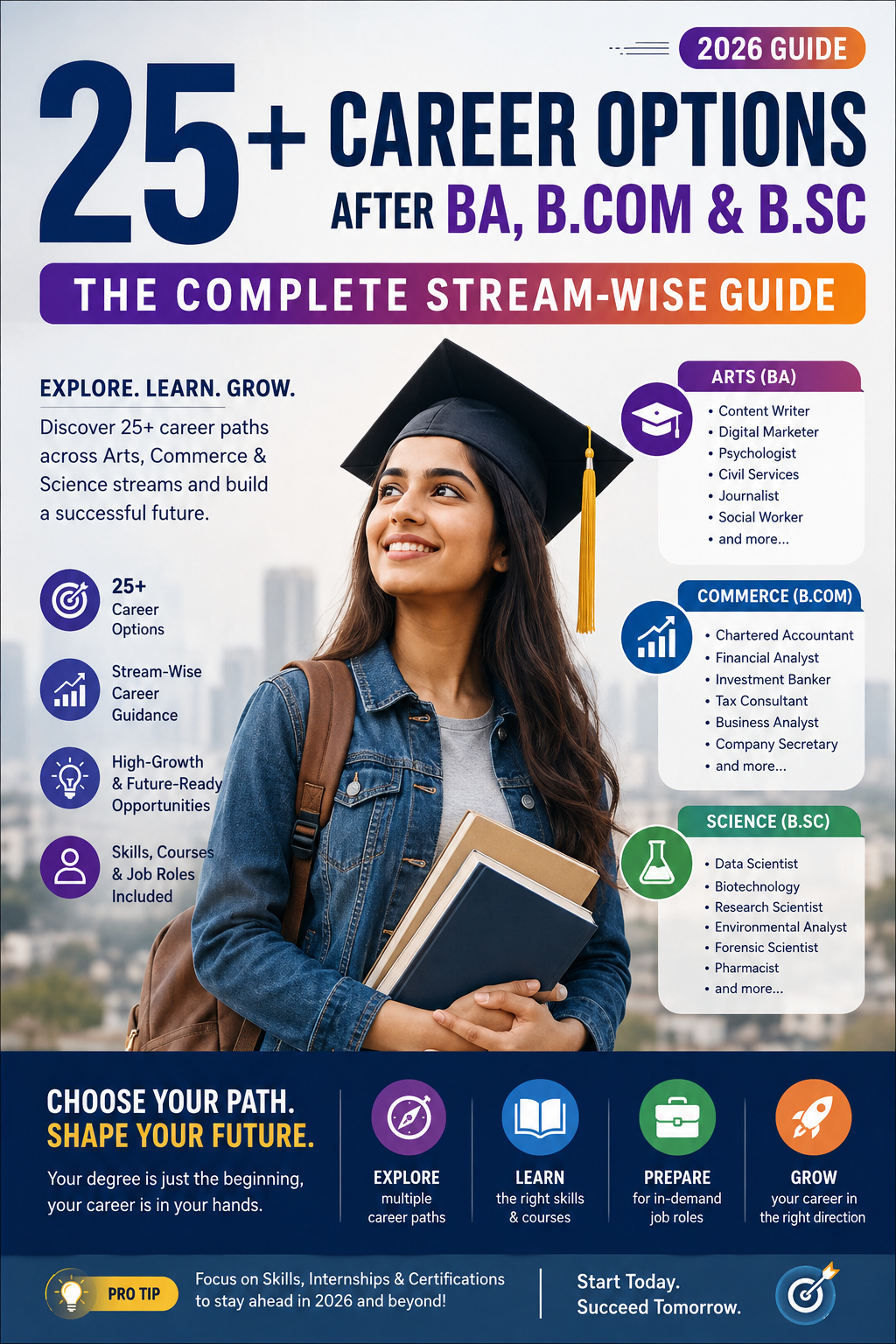
Career Options After BA
Content Writing / Copywriting. Turns strong language and research skills into a career writing for brands, publications, or agencies — one of the fastest fields to build a public, shareable portfolio in.
Digital Marketing. Combines communication skills with tools like social media, SEO, and content planning — a natural entry for graduates comfortable with trends and audience behaviour.
Human Resources (HR). A strong option especially for Psychology or Sociology graduates, drawing directly on understanding people and organisational behaviour.
Journalism & Mass Communication. For graduates who want to report, edit, or produce content professionally, usually strengthened by a postgraduate diploma in journalism.
Civil Services (UPSC / State PSC). One of the most common paths for History, Political Science, or Geography graduates, since these subjects overlap directly with the exam syllabus.
Teaching. School-level teaching (with a B.Ed) or private tutoring — a strong fit if you're confident explaining your specific subject to others.
Social Work / NGO Sector. Suits Sociology or Social Work graduates drawn to community-facing, mission-driven work over purely corporate roles.
Law (via LLB). A well-established three-year path after a BA into legal practice, corporate law, or judiciary services, particularly natural for Political Science or History graduates.
Psychology & Counselling-Adjacent Roles. For Psychology graduates, a postgraduate qualification opens roles in counselling, HR, or organisational psychology.
Public Relations & Corporate Communications. A close cousin to journalism and content, focused on managing how an organisation communicates externally.
You've Got 30 Options. Employers Only See the One You Apply For.
Once you've picked a direction, register your resume on RequireHire and it builds your candidate profile automatically — so employers hiring for that exact path can actually find you.
For job seekers. Takes minutes, not hours.
Register Your ResumeCareer Options After B.Com
Chartered Accountancy (CA). The classic B.Com-adjacent path — a rigorous multi-year qualification via ICAI leading to roles in auditing, taxation, and financial advisory.
Company Secretary (CS). Focused on corporate governance and compliance, pursued through ICSI alongside or after a B.Com degree.
Cost & Management Accountancy (CMA). A similar structure to CA but focused on cost control and management accounting, pursued through ICMAI.
Banking (PO / Clerk). Government and private bank exams are one of the most direct, high-volume routes into a stable career for B.Com graduates.
Financial Analyst / Investment Roles. For graduates comfortable with numbers and markets, often strengthened by certifications in financial modelling or analysis.
Tax Consultant / GST Practitioner. A practical, in-demand specialisation built directly on B.Com coursework in taxation and accounting.
MBA (Finance, Marketing, or HR). A widely chosen next step toward management roles, typically after 1-2 years of work experience or straight after graduation.
Insurance Sector Roles. Underwriting, claims, and advisory roles that draw directly on B.Com's numerical and analytical foundation.
Stock Market / Equity Research. For graduates genuinely interested in markets, entry-level research roles are realistic, often alongside certifications like NISM.
Government Accounts & Finance Jobs. Roles filled through exams like SSC CGL in accounts, audit, and finance-linked government departments.
Career Options After B.Sc
Data Analyst / Junior Data Scientist. Especially for Statistics, Mathematics, or Computer Science graduates, one of the fastest-growing entry points, usually built through a short, focused course in Excel, SQL, and Python.
Lab Technician / Research Assistant. A direct application of B.Sc coursework in labs, hospitals, or research institutions, especially for Chemistry, Biology, or Biotechnology graduates.
Higher Studies (M.Sc / PhD / Research). For graduates drawn to deep subject expertise, postgraduate study opens research, academic, and specialist industry roles.
Teaching (School or College, via B.Ed). A subject specialisation combined with a B.Ed is a strong, stable path into school-level science or math teaching.
Pharmaceutical & Biotech Industry Roles. Quality control, R&D, and regulatory roles suited to Biology, Chemistry, and Biotechnology graduates.
Environmental Science & Sustainability Roles. A growing field spanning corporate sustainability, government environmental bodies, and NGOs.
IT / Software Roles (with upskilling). Computer Science or IT graduates can move into junior developer or QA roles by building the same kind of applied project experience technical fresher roles look for.
Government Science & Technical Roles. Positions in bodies focused on space, defence research, or forestry, generally accessed through specific competitive exams tied to a science background.
Quality Control / Quality Assurance. A structured, process-driven role suited to graduates comfortable with precision, documentation, and testing protocols.
Actuarial Science. For Mathematics or Statistics graduates, a demanding but well-defined path through actuarial exams into insurance and risk-focused roles.
Stop Researching Careers. Start Getting Found for One.
Whichever path from this list fits you, employers still need to find you first. Registration builds your profile automatically from your resume.
Register NowTaking a Job Now vs Further Studies First
Taking a job now
Builds income and real-world experience immediately, but can make it genuinely harder to find time and energy for further study once work and other responsibilities pile up.
Further studies first
Delays income, but M.Com, M.Sc, an MBA, or a professional qualification can open higher-ceiling roles, and is often easier to complete before other commitments pile up.
The honest verdict
Neither is universally right. The real question is whether the further study genuinely adds a capability you need for the role you want, or whether it's mostly a comfortable delay while you avoid deciding.
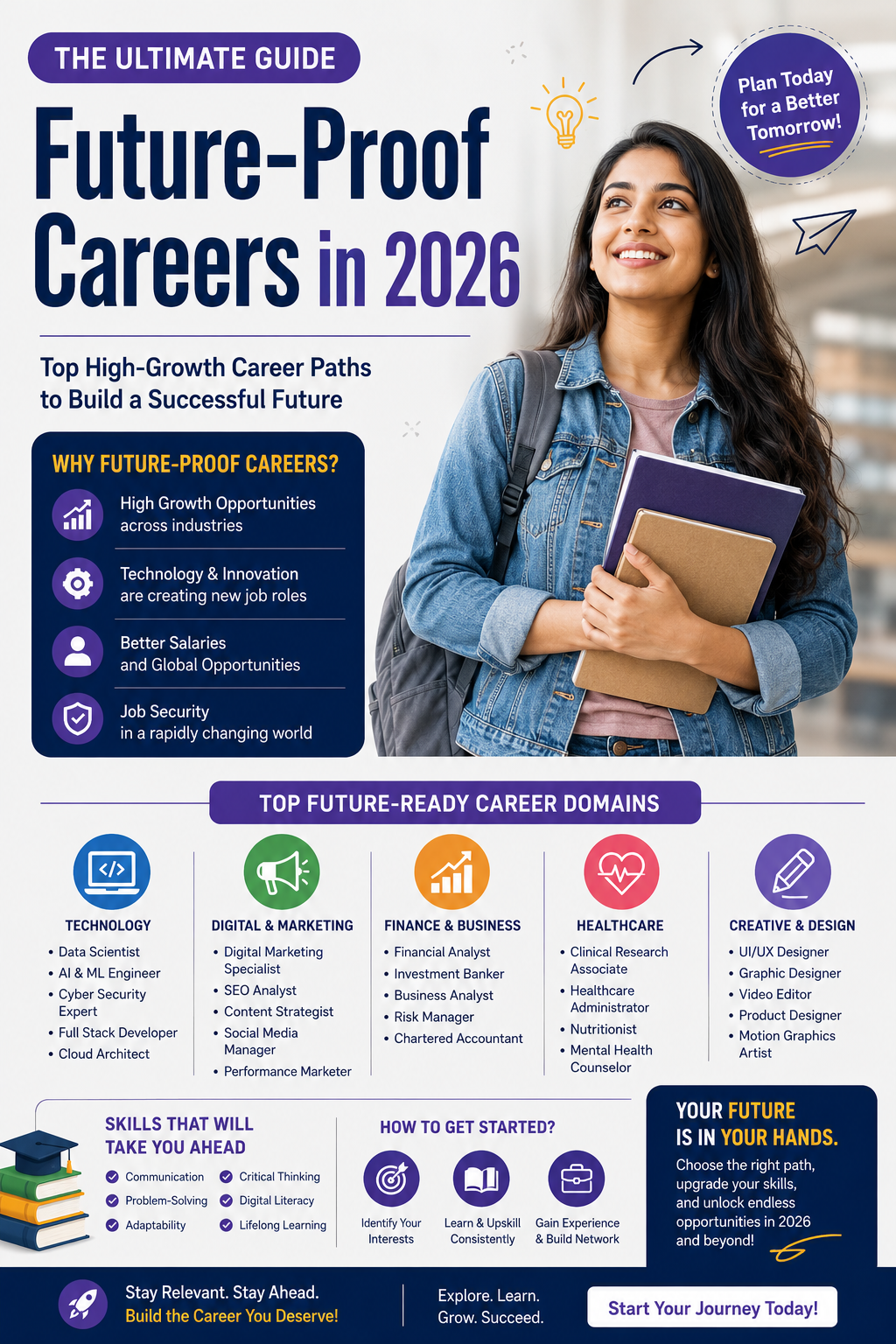
Government & PSU Jobs vs Private Sector
Government / PSU
Stability and a structured career path, at the cost of a long, competitive exam-preparation timeline with real risk of not clearing it on your first attempt.
Private sector
Faster entry and more direct, immediate reward for demonstrated skill and initiative, at the cost of generally more variable job security.
The honest verdict
Plenty of graduates hedge sensibly — building a private-sector skill or role while preparing for a government exam part-time — rather than treating it as strictly either-or from day one.
Your Next Step Isn't Another List — It's One Application
For job seekers. Register once, and your profile is ready to apply with across relevant roles.
Register Your ResumeStaying in Your Core Field vs Switching Fields
Staying in your degree's natural field
Faster to explain in an interview, and makes direct use of what you actually studied — the path of least resistance, in a good way.
Switching to an unrelated field
Fully possible with the right skill-building, though it requires actively proving the switch with a project or certification, since the degree alone won't signal fit in an unrelated area.
The honest verdict
Neither path is inherently better. What actually matters is having a genuine, specific reason for whichever direction you pick, backed by at least one piece of real proof, rather than the direction itself.
A Certification Alone vs a Certification Plus Real Experience
Certification alone
Shows you were exposed to a topic, but not what you can actually do with it — increasingly common enough on resumes that it barely stands out on its own.
Certification plus real experience
The same certification, backed by one completed project or internship where you actually applied it — evidence, not just a claim.
The honest verdict
This holds true across nearly every option in this guide, from digital marketing to data analysis — a certificate is a fine starting point, not a finish line.
Career Paths Genuinely Open to All Three Streams
Some paths simply don't care whether you hold a BA, B.Com, or B.Sc — they're open by design:
Digital Marketing: BA, B.Com, and B.Sc graduates all enter this field regularly, since it rewards demonstrated skill over degree background.
An MBA: accepts graduates from any stream, provided your entrance exam scores are competitive.
General government exams (like SSC CGL): many posts are open to any graduate, regardless of stream.
Teaching: possible in any subject specialisation with a B.Ed, regardless of your original degree.
Entrepreneurship: starting something of your own has never required a specific degree — just an idea and the willingness to build it.
Content Creation: a genuinely stream-agnostic path, built on consistency and a real audience rather than a credential.
Common Mistakes Freshers Make Choosing a Career
Picking a path because your friends are
A path that's genuinely right for a friend isn't automatically right for you — the same exam or field can suit very different people for very different reasons.
Assuming further study is automatically "safe"
A postgraduate degree only helps if it genuinely builds something the role you want actually requires — otherwise it's often just a comfortable delay.
Ruling out fields outside your exact degree name
Dismissing digital marketing because you studied B.Com, or data analysis because you studied BA, closes doors that are actually still open with the right skill-building.
Preparing for an exam with zero backup plan
Betting everything on a single competitive exam for 2-3 years, with nothing else building in parallel, is a genuinely high-risk approach worth reconsidering.
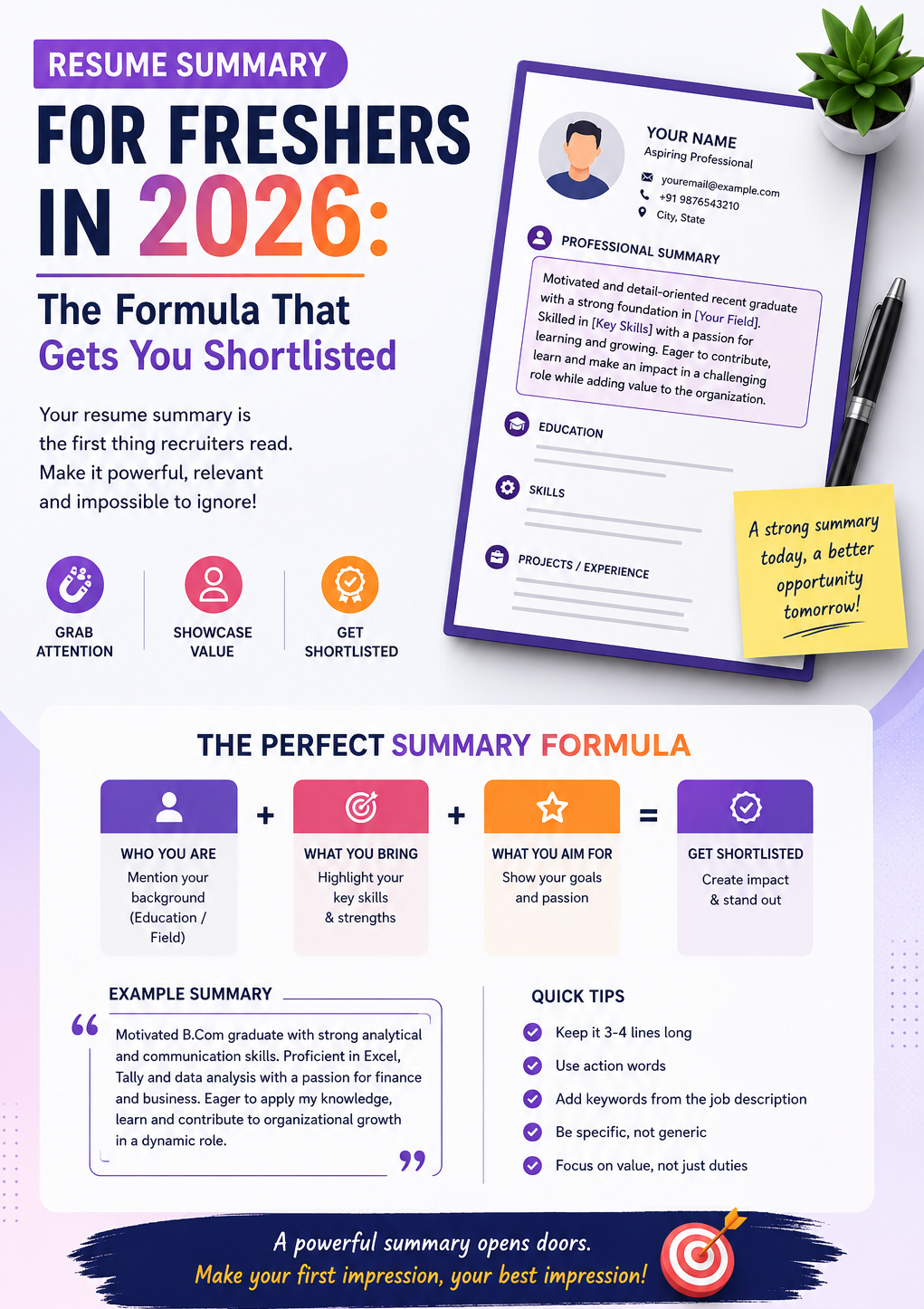
The "My Degree Limits My Options" Myth
It's an easy assumption to make: a BA feels like it points toward humanities-adjacent work, a B.Com toward finance, a B.Sc toward a lab. In practice, the boundaries are far softer than they feel.
What actually limits options
A BA doesn't lock someone out of marketing. A B.Sc doesn't lock someone into a lab. A B.Com doesn't require Chartered Accountancy. What actually limits options isn't the degree name — it's not building any demonstrable skill or experience outside classroom study. The degree sets a starting point, not a ceiling.
What Actually Matters, Whichever Path You Pick
The pattern across all 30 options
Whether you're preparing for a competitive exam, pursuing a professional qualification, or applying for a private-sector role, the same underlying pattern holds: demonstrated initiative — a project, an internship, genuine focused preparation — carries more weight than the degree name alone. The specific path matters less than actually doing something real within it.
Skills Worth Building, Regardless of Which Path You Pick
Clear communication
Written and spoken — useful in an exam interview, a job interview, and every single option on this list.
Basic digital & AI tool fluency
Comfort using everyday tools productively for research, writing, and analysis, regardless of your specific field.
One genuinely completed project
Something real you can describe in detail — the single strongest piece of proof, whichever path you're pursuing.
Basic comfort with numbers
Even outside B.Com or B.Sc, a working comfort with data and numbers strengthens almost any career path.
Your Next Step, by Situation
Final-year student, still undecided
Start exploring 2-3 options from this list through a short internship or small project before you graduate — real exposure beats guessing every time.
Recent graduate wanting a government job
Build a realistic exam-preparation timeline, and pair it with a private-sector backup plan rather than betting everything on one attempt.
Recent graduate wanting private sector, fast
Pick one option, build one real skill or project around it this month, and start applying — momentum matters more than a perfect first choice.
Considering further study
Check whether it's genuinely necessary for the specific role you want, not just the default next step everyone else seems to be taking.

Your Career Clarity Score
Check everything that's true for you right now, then calculate your score.
This Guide, in Numbers
Thirty Options Are Only Useful Once You Pick One
Once you've narrowed it down, get your resume in front of employers hiring for it.
Register Your Resume
Turning This Into a Plan: Before, During, After
Do: Narrow 30 options down to 2-3
Use the four framework questions honestly rather than trying to evaluate every option with equal depth.
Don't: Wait for total certainty before starting
Certainty usually comes from doing, not from more research — pick a reasonable direction and start testing it.
Do: Build one real piece of proof
A project, an internship, or genuine exam preparation you can actually describe in detail.
Don't: Abandon your backup plan entirely
Keep it alive in the background, even while focused on your first choice — it costs little and protects a lot.
Do: Set an honest 12-18 month checkpoint
A real deadline to assess progress prevents both giving up too early and persisting indefinitely without evidence.
Don't: Treat a course-correction as failure
Adjusting direction with real information beats staying somewhere out of pride alone.
Your Final Checklist Before You Commit
You've narrowed 30+ options down to 2-3 genuine contenders.
You understand the real time and effort each contender actually requires.
You have a realistic backup plan, not just a single bet.
You've identified one concrete first step you can take this week.
Your resume reflects your chosen direction, not a generic default.

10 Questions Graduates Actually Ask About This
The Graduate Who Registers Today Gets Seen Before the One Still Deciding
You now have a real map of what's actually possible after BA, B.Com or B.Sc — not just the three options everyone repeats. The next step is simple: pick a direction, and get your resume in front of the employers hiring for it.
100% for job seekers. RequireHire is a product of Veridant AI.
Ready to Practice What You Learned?
Take a free AI mock interview and get your skill score in 15 minutes. 100% free for all candidates.
Related Posts
Practice Your Interview
Get ready for your next interview with our AI-powered mock interview tool.
Start Practice Interview