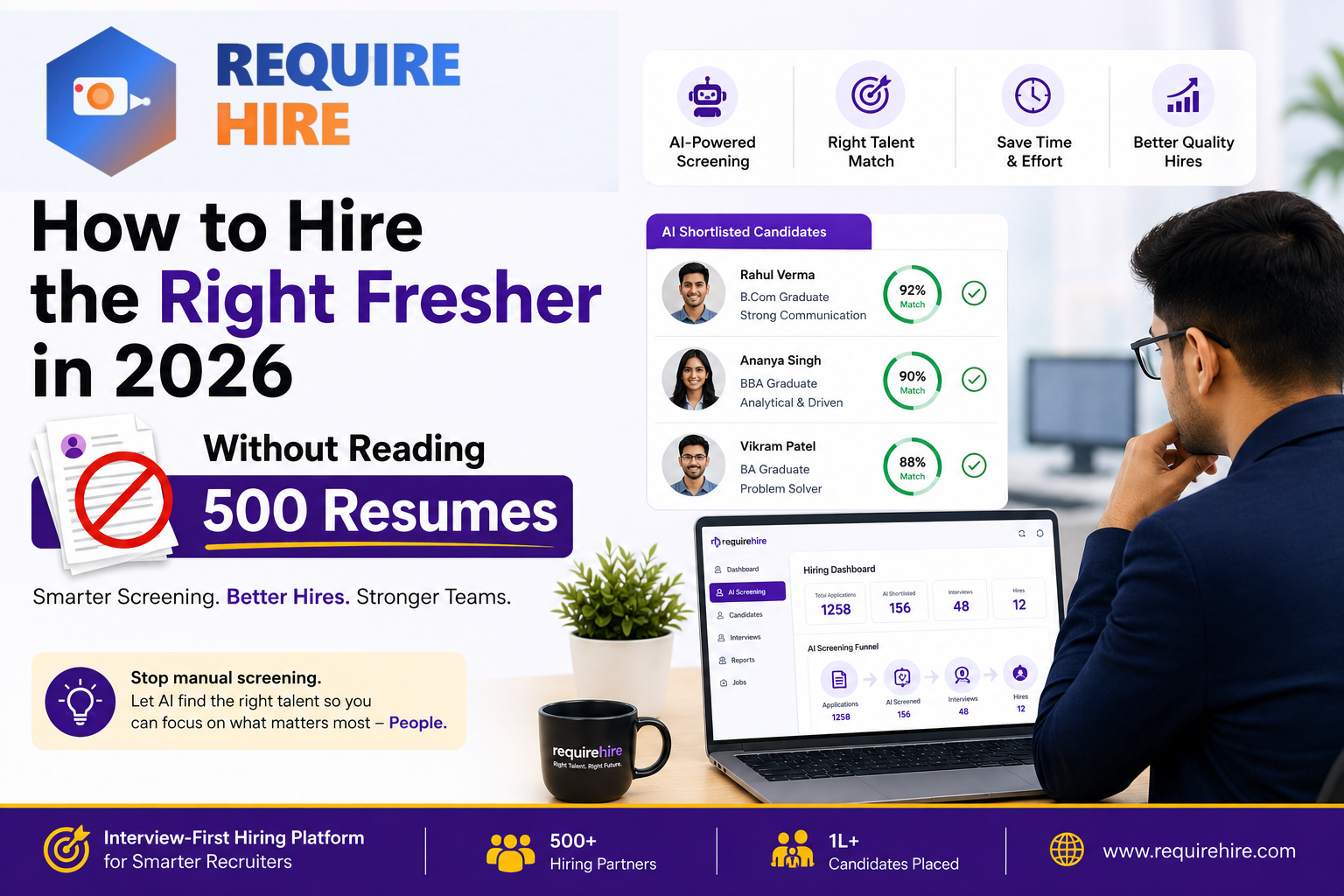
How to Hire the Right Fresher in 2026 Without Reading 500 Resumes
How to Hire the Right Fresher in 2026 Without Reading 500 Resumes
Post one fresher role. Get hundreds of applications. Somewhere in that pile is the right hire — here's how to actually find them without losing a week to it.
Most fresher hiring processes are broken in the same place: too many applications, not enough hours to read them all carefully, and a screening method that filters on resume formatting instead of actual ability. This guide breaks down exactly why manual screening fails at scale, what actually predicts a good fresher hire, and how RequireHire build in process that gets you a shortlist Resume in days, not weeks.
A note before you read
This guide is published by RequireHire's content team, part of Veridant AI. It's written for anyone who's ever posted an entry-level role and watched the applications pile up faster than anyone can reasonably review them . Everything here is reasoned from how fresher hiring actually breaks down at volume, not from a single "best practice" checklist.
Why Fresher Hiring Specifically Breaks Down at Volume
Entry-level roles have the widest possible eligibility bar — no specific years of experience required, no narrow niche skill to filter on upfront — which means nearly every graduate who's even qualified applies. That's exactly why fresher postings routinely draw far more applications than senior roles, while most companies, especially smaller ones, don't have a proportionally larger recruitment team to match.
The pattern this creates
Faced with hundreds of applications and limited hours, HR teams default to shortcuts: skimming resumes for a few seconds each, filtering hard on college name or CGPA, or simply reviewing whoever applied first. None of these shortcuts actually measure whether someone can do the job — they just make an unmanageable pile feel manageable.
The Fix Isn't Reading Faster — It's Screening Differently
Structure your screening around what a candidate can actually demonstrate — before a human ever needs to open a resume file.
Instead of manually filtering a raw applicant pile down to a shortlist, flip the order: put every candidate through the same consistent, structured evaluation first, and only spend detailed human review time on those who've already shown they're worth it.
The rest of this guide breaks down exactly why the old order fails, what actually predicts a good fresher hire, and how to rebuild your process around it.
What the 500-Resume Pile Actually Costs You
Hours that don't come back
Manually reviewing hundreds of resumes, even at a few seconds each, adds up to real hours someone could have spent on literally anything else that moves the business forward.
A role that stays open longer
Every extra day spent on applications is a day the position stays unfilled, work goes uncovered, and strong candidates have more time to accept a competing offer.
Inconsistent standards
Resume #20 gets a more careful read than resume #400 reviewed at the end of a long day — the bar quietly shifts even when no one intends it to.
Good candidates missed entirely
A genuinely capable candidate whose resume simply doesn't format or word things impressively can get filtered out in a five-second skim, with no chance to show what they can actually do.
Why Manual Resume Screening Fails at Fresher-Hiring Volume
A resume represents freshers unevenly. A genuinely strong college project can read flat on paper, while a weaker one dressed up in confident language can read impressively — the format rewards writing skill, not necessarily the underlying work.
Volume forces speed, and speed forces shortcuts. Faced with hundreds of applications, reviewers naturally start skimming for keywords or filtering by college name, since there simply isn't time to read every line carefully.
Reviewer fatigue changes the bar during the day. The same person reviewing application #20 and application #400 isn't applying quite the same standard, even with the best intentions.
A resume can't show communication or reasoning. The two qualities that matter most for a fresher without a work history are exactly the ones a static document can't demonstrate.
It doesn't scale. Double the applicant volume and you roughly double the review time, with no improvement in accuracy — the process gets slower and worse at the same time.
Criteria shift between reviewers. Two similarly qualified candidates can get very different outcomes purely based on who happened to review their application and what mood they were in.

Stop Reading Resumes. Start Reviewing Shortlists.
When candidates register on RequireHire, they're automatically screened through AI interviews and skill-based scoring before their profile ever reaches your inbox — so what you review is already ranked, not raw.
This is the exact link your applicants would use to enter that process.
See the Registration FlowResume-First Screening vs Interview-First Screening
Resume-first
Every candidate's resume gets manually reviewed before anyone talks to them — slow, inconsistent, and filters heavily on document formatting rather than actual capability.
Interview-first
Every candidate gets a structured, consistent interview before a human reviews anything, so what reaches an HR inbox is already scored and ranked on how they actually responded.
The honest verdict
Interview-first flips the funnel. Instead of spending hours filtering paper to decide who's worth talking to, every candidate starts at the same structured evaluation, and human time only gets spent on those who've already demonstrated they're worth it.
Filtering vs Skill-Based Filtering
Pedigree-based
Filtering by college name, degree, or CGPA is fast, but misses capable candidates from less prestigious institutions and doesn't actually test whether someone can do the job.
Skill-based
Evaluating what a candidate can actually demonstrate — communication, reasoning, relevant knowledge — regardless of where they studied.
The honest verdict
It is capability at best, and using it as a hard filter for fresher roles specifically excludes exactly the kind of overlooked, high-potential candidates who could turn out to be genuinely valuable hires.
Manual HR Review vs AI-Assisted Pre-Screening
Manual review of every application
Accurate when done carefully, but doesn't scale, and quality degrades as volume and fatigue increase throughout a hiring drive.
AI-assisted pre-screening
Every candidate gets a consistent, structured first-round evaluation instantly, and HR only reviews the candidates who've already cleared that bar.
The honest verdict
This isn't about replacing human judgement — it's about applying human judgement only where it matters most, on a shortlist instead of an unsorted stack.

Your Next Fresher Hire Starts With One Link, Not One Resume Pile
Share this exact link with applicants — it's where they upload their resume and enter structured AI interview screening automatically.
Get the Registration LinkA Slow Multi-Week Process vs a Streamlined One
Weeks-long process
The role stays open longer, good candidates accept other offers while waiting, and the eventual hire has already cost the company in lost productivity from the vacancy.
Streamlined process
Candidates are evaluated within days, strong candidates don't have time to disappear into another company's pipeline, and the role fills faster without lowering the bar.
The honest verdict
Speed and thoroughness aren't actually opposing goals here — a structured process is both faster and more consistent than a manual one, because the bottleneck was never how carefully you read, it was how much reading the old process required in the first place.
What Actually Predicts a Good Fresher Hire
Without a work history to lean on, most of the traditional predictors of hire quality simply don't exist yet for a fresher. What's left is what they can demonstrate right now, under a structured evaluation.
Clear communication
How someone explains an idea under a live or AI-assisted interview tells you far more than how they format a bullet point.
Real-time reasoning
Whether a candidate can think through an unfamiliar question matters more than whether they memorised a textbook answer.
Evidence of initiative
A small, genuinely completed project or internship they can describe in detail says more than a long list of claimed skills.
General learning ability
For a fresher, how quickly they pick things up often matters more than what they already happen to know on day one.
How to Build a Faster Fresher Hiring Process
Define what actually matters, before you post the role. Two or three specific things you're genuinely evaluating for, not a long generic wish list.
Move structured evaluation before manual resume review, not after. Let every candidate demonstrate something before anyone spends time reading their document.
Use consistent criteria for every candidate. The same standard applied to candidate #1 and candidate #400 is what actually makes screening fair and accurate.
Let performance surface candidates, not resume polish. Rank by how someone actually did on your structured evaluation, not by how confidently their document reads.
Spend detailed human review only on the shortlist. This is where your judgement is actually most valuable — not spread thin across hundreds of applications.
Common Mistakes Companies Make Hiring Freshers
Filtering by college before ever hearing them speak
College name is a weak proxy for capability — using it as a hard filter quietly excludes strong candidates you never got the chance to evaluate properly.
Letting the process drag on for weeks
Strong candidates rarely stay unemployed for long — a slow process quietly filters for whoever's still available at the end, not necessarily who's best.
Using a senior-hire process for an entry-level role
Multiple rigorous interview rounds designed for a leadership hire are usually overkill, and slow down entry-level hiring without meaningfully improving accuracy.
Not defining "good" before reviewing a single application
Without a clear sense of what actually matters for the role, screening decisions end up inconsistent and hard to explain even to yourself afterward.
The Screening Happens Before It Reaches You
By the time a candidate profile lands in your inbox, they've already been through structured AI interview screening — that process starts here.
See How It Starts
The "More Resumes = Better Candidates" Myth
A bigger applicant pool feels like more choice, and it's tempting to assume that more applications simply means a better chance the ideal candidate is somewhere in the pile. Past a certain point, though, volume mostly means more noise — more time spent filtering, more fatigue, and a higher chance a genuinely strong candidate gets lost in the shuffle rather than found.
What actually improves outcomes
It's not the size of the pile that determines hire quality — it's the quality of the screening method applied to it. A smaller pool evaluated with a consistent, structured method reliably outperforms a huge pool skimmed under time pressure.
What Actually Changes When You Fix This
The shift, in plain terms
Before: HR spends days on first-pass resume review, the role stays open for weeks, and screening criteria quietly shift depending on who's reviewing and how tired they are by the fiftieth application. After: every candidate gets the same structured first evaluation, HR reviews a ranked shortlist instead of a raw pile, and the role fills faster without lowering the bar. Nothing about the underlying candidates changed — only how efficiently the good ones get found.
What to Actually Look For, Beyond the Resume
Structured communication: can they explain something clearly when asked, not just when it's rehearsed?
Genuine initiative: a specific project, however small, that they can describe in real detail.
Reasoning under an unfamiliar question: how they think through something they haven't prepared for in advance.
Consistency: does what's on paper match what they say and how they say it when asked to elaborate?
Your Starting Point, by Situation
Small business hiring its first few freshers
Prioritise a fast, structured process from day one — you likely don't have a dedicated recruitment team to absorb the manual triage burden.
Growing SME with regular fresher hiring
Standardise your screening criteria across roles and reviewers, so hire quality doesn't depend on which manager happens to be reviewing that week.
Running a seasonal or campus hiring drive
Structured pre-screening matters even more at this scale, given the sharp, short-term spike in applicant volume campus drives typically bring.
Filling one urgent role right now
Skip manual resume triage entirely and route every applicant straight into structured evaluation — it's faster per candidate, not just at scale.
Your Fresher Hiring Process Efficiency Score
Check everything that's true of your current process, then calculate your score.
Which Roles This Approach Helps Most
Structured, skill-based screening helps wherever application volume is high relative to your review bandwidth — which describes most fresher and entry-level hiring, across a wide range of categories:
IT & technical roles: where technical reasoning matters as much as listed tools and languages.
Banking & finance: where communication and numerical reasoning are core to the role itself.
Healthcare support: where patient-facing communication skills are just as important as technical knowledge.
Government-adjacent & administrative: often drawing very high application volumes for structured, process-driven roles.
Business, HR & marketing: where interpersonal and communication skills are the primary thing worth screening for.
This Guide, in Numbers
Your Shortlist Should Be Ready Before You Are
See exactly how candidates enter the screening process, starting with resume registration.
See the Registration FlowTurning This Into a Plan: Before, During, After
Do: Write down what "good" looks like
Two or three specific, evaluable qualities beat a long, vague wish list every time.
Don't: Copy the senior-hire process by default
Check whether every round you're planning is actually necessary for an entry-level decision.
Do: Apply the exact same criteria to every candidate
Consistency is what actually makes screening fair and defensible, not just faster.
Don't: Let fatigue quietly change your standard
If you notice yourself skimming faster later in a review session, that's a signal to build in structure, not push through.
Do: Spend your real time on the shortlist
This is where careful human judgement genuinely adds value — not spread thin across hundreds of raw applications.
Don't: Let the shortlist sit unreviewed
A fast screening process only helps if the follow-through matches — a stalled shortlist loses candidates just as surely as a slow resume review does.
The Real Cost of Getting This Wrong
A bad fresher hire costs more than the screening time saved by rushing through applications — training investment, team disruption, and eventually having to restart the entire search from zero. But an overly slow, overly cautious process has its own cost: good candidates simply accept another offer while you're still deciding.
Why this isn't actually a trade-off
"Hire fast" and "hire carefully" feel like opposing goals, but they're not — a structured process is both faster and more consistent than a manual one, because the real bottleneck was never how carefully you read each resume. It was how much reading the old process required in the first place.
10 Questions Hiring Managers Actually Ask About This
While You're Reading Resume #247, Someone Else Already Hired Theirs
You now know exactly why manual resume screening breaks down and what actually predicts a good fresher hire. The next step is simple: get your applicants into a structured process instead of an inbox. This is the exact link candidates use to register their resume and start AI interview screening.
RequireHire is a product of Veridant AI.
Ready to Practice What You Learned?
Take a free AI mock interview and get your skill score in 15 minutes. 100% free for all candidates.
Related Posts
Practice Your Interview
Get ready for your next interview with our AI-powered mock interview tool.
Start Practice Interview