Why BA, B.Com, B.Sc, BBA & BCA Students Need Real Skills in 2026
Why BA, B.Com, B.Sc, BBA & BCA Students Need Real Skills in 2026
A degree gets you in the room. In 2026, skills are what get you hired — here's exactly which ones matter, and how to build proof of them before graduation.
India's employability has climbed to 56.35% in 2026, yet 92.8% of students still say they want more practical, hands-on exposure. That gap between studying a subject and being able to apply it is exactly what's reshaping hiring for BA, B.Com, B.Sc, BBA and BCA students this year. This guide breaks down which skills actually move the needle for each stream, and the most direct way to build proof of them.
A note before you read
This article is published by RequireHire's & Intern2Hub's content team, both part of Veridant AI. Every statistic here is sourced from the India Skills Report 2026, the World Economic Forum's Future of Jobs Report, and the Career Outlook Report — named wherever used. Hiring practices vary by company and sector, so treat this as a general map of where the market is heading, not a guarantee for any single employer.

Why "Just Getting a Degree" Stopped Being the Whole Plan
employability, 2026
India Skills Report, 2026
practical exposure
India Skills Report, 2026
to hire freshers
TeamLease Outlook, HY1 2026
reskilling by 2030
World Economic Forum
Two things are true about India's job market at the same time in 2026. Employability is genuinely rising — the India Skills Report 2026 puts national employability at 56.35%, up from 46.2% just four years earlier. And yet the same report finds 92.8% of students still want more practical exposure than their degree alone gave them. That's not a contradiction; it's the actual shape of the problem. Colleges are producing more subject-knowledgeable graduates than ever, while employers keep asking for evidence of what a candidate can actually do with that knowledge.
The pattern this reveals
Employer intent to hire freshers has climbed to 73% in the first half of 2026, according to the Career Outlook Report — so demand for freshers isn't the bottleneck. The bottleneck is proof. For BA, B.Com, B.Sc, BBA and BCA students specifically, that means the degree is still the entry ticket, but the skills you can demonstrate alongside it now decide who actually gets shortlisted.
The Short Answer, Upfront
Yes — real, demonstrable skills are now a genuine requirement for BA, B.Com, B.Sc, BBA and BCA students in 2026, not an optional add-on to a degree.
This doesn't mean your degree stopped mattering. It means the degree now needs company — at least one skill you can actually apply, and at least one piece of real-world proof that you've applied it. That combination, not the degree alone, is what closes the gap between studying a subject and being hired for it.
The rest of this guide breaks that down by exactly which skills matter for each stream, how they get built, and ends with a personal skill-readiness score so you know precisely where to start.
What the "Skill Gap" Actually Means for These Five Streams
"Skill gap" gets used loosely, so it's worth being precise. It doesn't mean BA, B.Com, B.Sc, BBA and BCA students lack intelligence or effort. It means there's a consistent mismatch between what a curriculum tests — recall, theory, exam performance — and what a workplace actually needs on day one: applying that knowledge to a messy, real, unscripted situation with a deadline attached.
What the data says the gap actually looks like
The India Skills Report 2026 points to persistent concerns around communication, problem-solving, teamwork and critical thinking, even as technical readiness improves nationally. In other words, the gap isn't usually about one missing hard skill — it's the absence of a track record showing you can put any of your knowledge to work under real conditions.
Why Building Real Skills Now Genuinely Changes Your Outcomes
Skills compound the way credits don't
A course you finish sits in a transcript. A skill you actually use gets sharper every time you use it again — so the earlier you start applying something, the more layered and specific it becomes by the time you graduate.
It turns classroom knowledge into something usable
B.Com theory on financial statements, BA coursework on communication, B.Sc lab methods — all of it becomes far more valuable the moment it's applied to one real task, because that's when you find out what you actually understand versus what you can only recite.
It gives you something specific to say in an interview
"I studied marketing" and "I ran a social content calendar for six weeks and grew engagement on two posts" answer very different questions — only one of them survives a follow-up question.
It's adjustable in a way a fixed syllabus isn't
A curriculum gets revised on a multi-year cycle. What you choose to practise can shift within a semester the moment you notice a skill is showing up more often in job postings in your field.
What Happens When Skill-Building Gets Left for "Later"
A resume that reads well until a question is asked
Listing "communication skills" or "problem-solving" without a story behind them holds up fine on paper, and falls apart the moment an interviewer asks "tell me about a time you did that."
Trying to build a track record during placement season
Attempting your first real project or internship in the same weeks as interviews and exams compresses something that should have taken a semester into a few rushed weeks — with everyone else scrambling for the same limited slots at the same time.
A gap that widens rather than stays the same
Tools, employer expectations and even which skills count as "in demand" keep shifting year to year — a skill set left untouched for two years isn't just outdated, it's fallen further behind than it was when you last looked at it.
Mistaking activity for progress
Attending every webinar, watching every tutorial, and collecting every certificate feels productive, but none of it becomes proof of skill until it's actually applied to a real task with a real outcome.
Don't Let Skill-Building Wait Until Placement Season
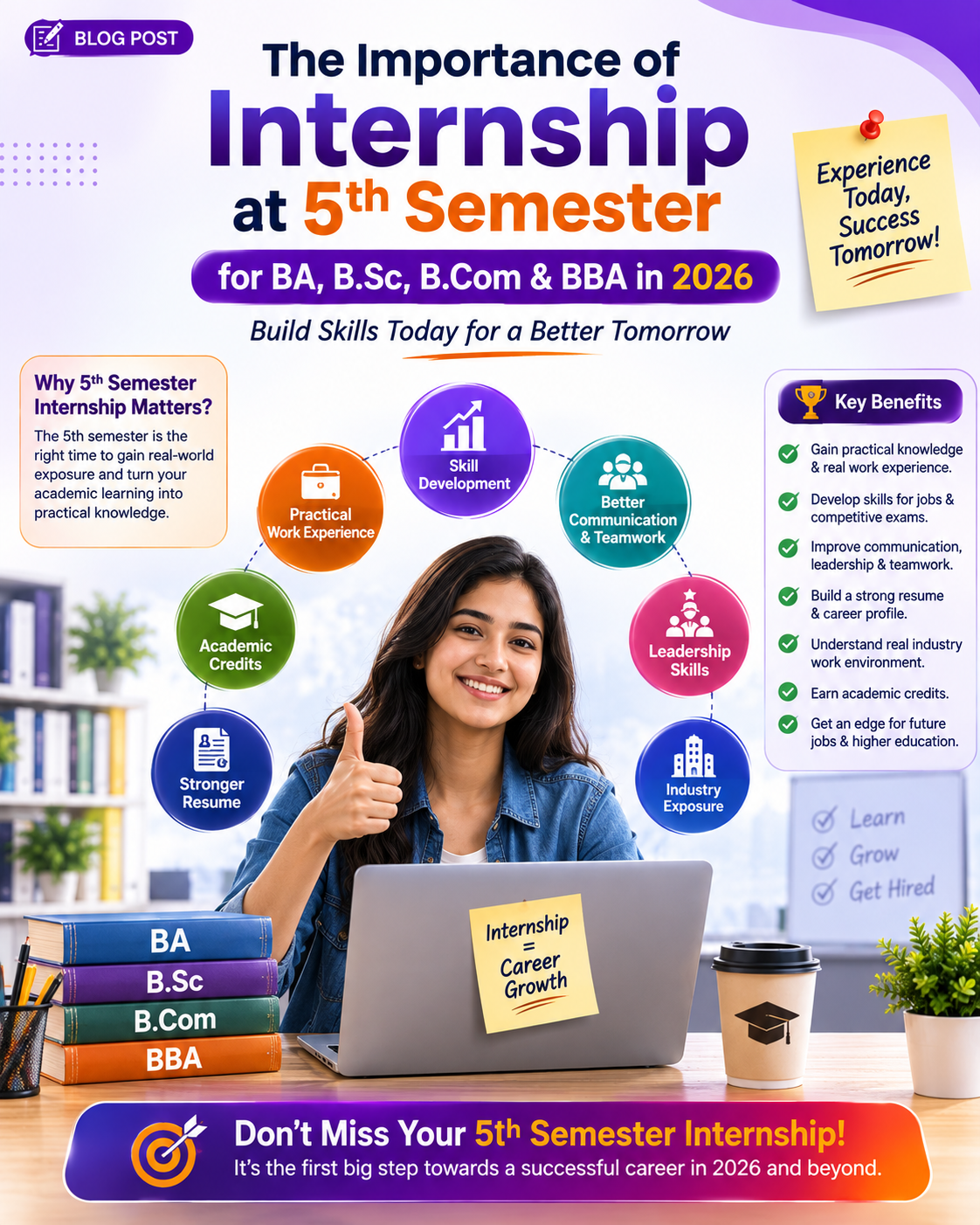
Internships on Intern2Hub cover Business Development, Accounts & Finance, HR, Content & Digital Marketing, Education & Teaching, and technical domains — a real, low-pressure way to start building proof this semester.
Registration for students. Verified employers. A dated certificate at the end.
Explore InternshipsDegree Alone vs Degree + Applied Skills
Degree alone
Gives you subject knowledge and a credential that opens the first door, but on its own gives an employer no direct evidence of what you can actually do with that knowledge under real, unscripted conditions.
Degree + applied skills
Same subject foundation, backed by at least one project, internship, or real task where that knowledge was tested — and survived contact — with a messier, real-world version of the problem.
The honest verdict
Employers aren't rejecting degrees — the India Skills Report 2026 still shows Computer Science and IT graduates leading employability at 80% and 78%. What's changed is that the degree is no longer read as sufficient proof by itself. This isn't really a choice between the two options; the safer bet is your degree, plus at least one applied skill, well before your final year.
Building Skills Early vs Waiting Until Final Year
Starting in your 2nd or 3rd semester
Leaves room to try something, get it wrong, adjust, and try again before any of it counts toward your career — and each subsequent semester can build on what the last one taught you.
Waiting until final year or placement season
Compresses skill-building into the exact weeks you're also handling exams, interviews and job applications — with a much steeper cost if your first attempt at a project or internship doesn't go smoothly.
The honest verdict
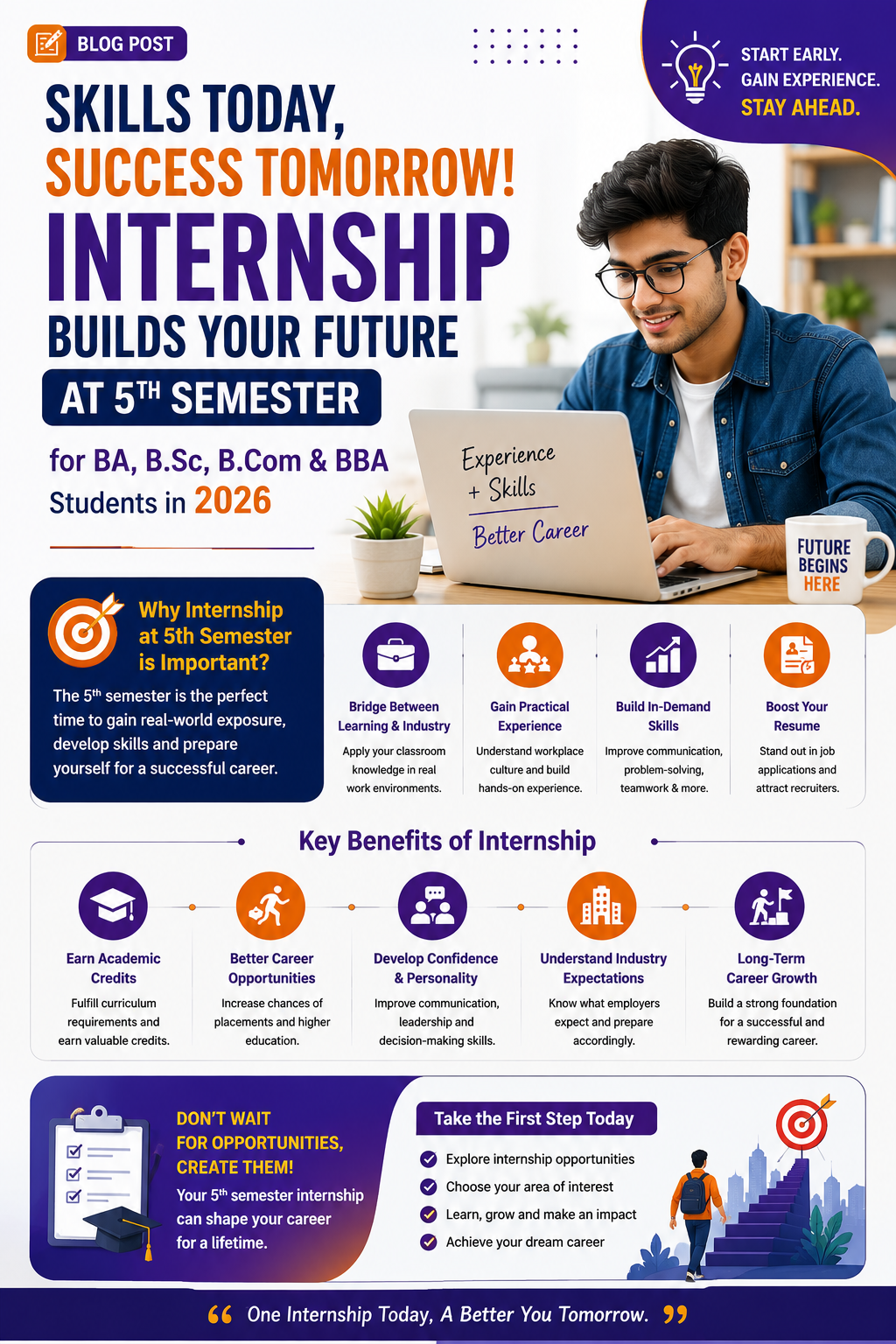
There's rarely a good reason to delay — and several good reasons, mainly timetable pressure and placement prep, not to. Even one focused internship or project completed a year before you graduate gives you time to build on it, rather than scrambling to create it from scratch under deadline.
Technical & Digital Skills vs Durable Human Skills
Technical & digital skills
AI-tool fluency, spreadsheet and data handling, domain-specific software — these are usually what gets a resume shortlisted in the first place, and they keep shifting as tools change.
Durable human skills
Communication, problem-solving, teamwork and adaptability — the India Skills Report 2026 flags these as persistent gaps even as technical readiness climbs nationally, and they're what make a shortlisted candidate someone a team actually wants to keep.
The honest verdict
This isn't really an either-or choice, and treating it as one is a common mistake. The data points to both mattering at once — technical fluency gets you noticed, durable human skills are what convert that notice into an offer, and later, into being kept on. Building only one half of the pair leaves the other half exposed.
See Which Skills Are Actually in Demand in Your Domain
Browse verified internships across Business, Finance, HR, Marketing, Teaching and technical domains, and see firsthand what real employer work actually asks of you.
Browse InternshipsCourse Certificates Alone vs Applied, Project-Based Proof
Course certificates alone
Show you were exposed to a topic, but not what you did with it — and a resume stacked with unused certificates has become common enough that it barely stands out to a recruiter anymore.
Applied, project-based proof
A completed task, internship, or project with a specific, describable outcome — this functions as evidence, where a certificate on its own only functions as a claim.
The honest verdict
Courses aren't a wasted step — they're a fine starting point for learning the basics of a skill. The mistake is treating the certificate as the finish line. Pair it with one real attempt at using that skill, and it stops being a claim on paper and becomes something you can actually walk an interviewer through.
BCA vs BA / B.Com / B.Sc / BBA — Same Pressure, Different Skill Stack
The underlying expectation — proof of applied skill, not just a transcript — is identical across all five streams. What differs is the specific stack. BCA sits closer to a technical track: recruiters typically expect applied programming ability, some familiarity with version control tools like Git, and enough understanding of how software actually gets built to work alongside a development team from day one. BA, B.Com, B.Sc and BBA students are usually evaluated on a different set: communication, financial or data literacy, and coordination skills specific to their domain.
Where the two tracks actually meet
In practice, most workplaces now expect some crossover — a BCA student who can also explain their work clearly to a non-technical manager stands out, and a B.Com or BBA student who's comfortable with basic data tools and AI-assisted workflows stands out equally. The stream sets your starting point, not your ceiling.
How Employers Are Actually Scoring Freshers in 2026
Project-based hiring rose 38% in the past year, according to the India Skills Report 2026, and the Career Outlook Report describes the same shift from the employer side: recruiters are increasingly evaluating what a candidate has built, what problem they solved, and what the outcome was — rather than which subjects appear on a marksheet.
What this changes about how you should prepare
If proof-of-work is genuinely what's being scored, then the highest-value thing you can do before your final year isn't one more certificate — it's one completed, describable piece of real work in your domain. That single shift in priority is what the rest of this guide is built around.
Which Skills Map Best to Each Stream
Every stream benefits from AI-tool fluency and clear communication as a baseline. Beyond that, five domain-specific stacks stand out:
BA: structured writing and research, content creation across digital formats, and comfort using AI tools for drafting and editing — not replacing the thinking, just speeding up the output.
B.Com: practical accounting and GST literacy beyond textbook theory, spreadsheet fluency including formulas and pivot tables, and basic comfort with common accounting or bookkeeping software.
B.Sc: structured data and lab documentation, translating technical findings into plain language for a non-specialist audience, and basic statistical or data-analysis tools.
BBA: business communication and presentation skills, basic market research methods, and coordinating a task across a small team, since most entry roles start with exactly that.
BCA: applied programming through a completed project rather than syntax alone, basic version control with Git, and the ability to explain a technical decision to a non-technical teammate.
How These Skills Actually Get Built
A skill sharpens through a specific loop: attempt a real task, get feedback on it, adjust, then repeat. Watching a tutorial or finishing a course covers the "learning what to do" part, but skips the feedback loop entirely — there's no supervisor, client, or teammate reacting to your actual output. That loop is what separates knowing about a skill from being able to use it under pressure.
A practical way to use this information
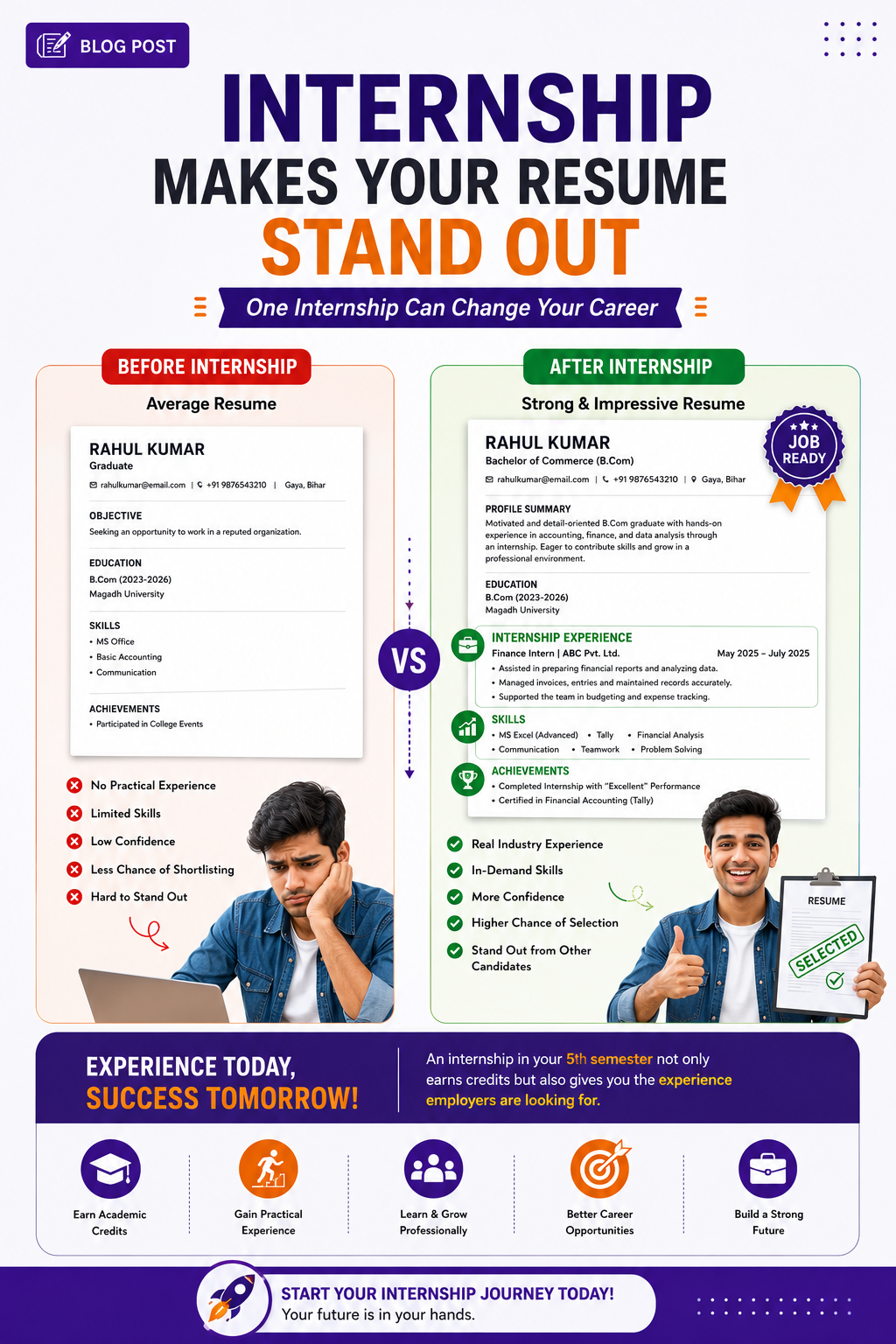
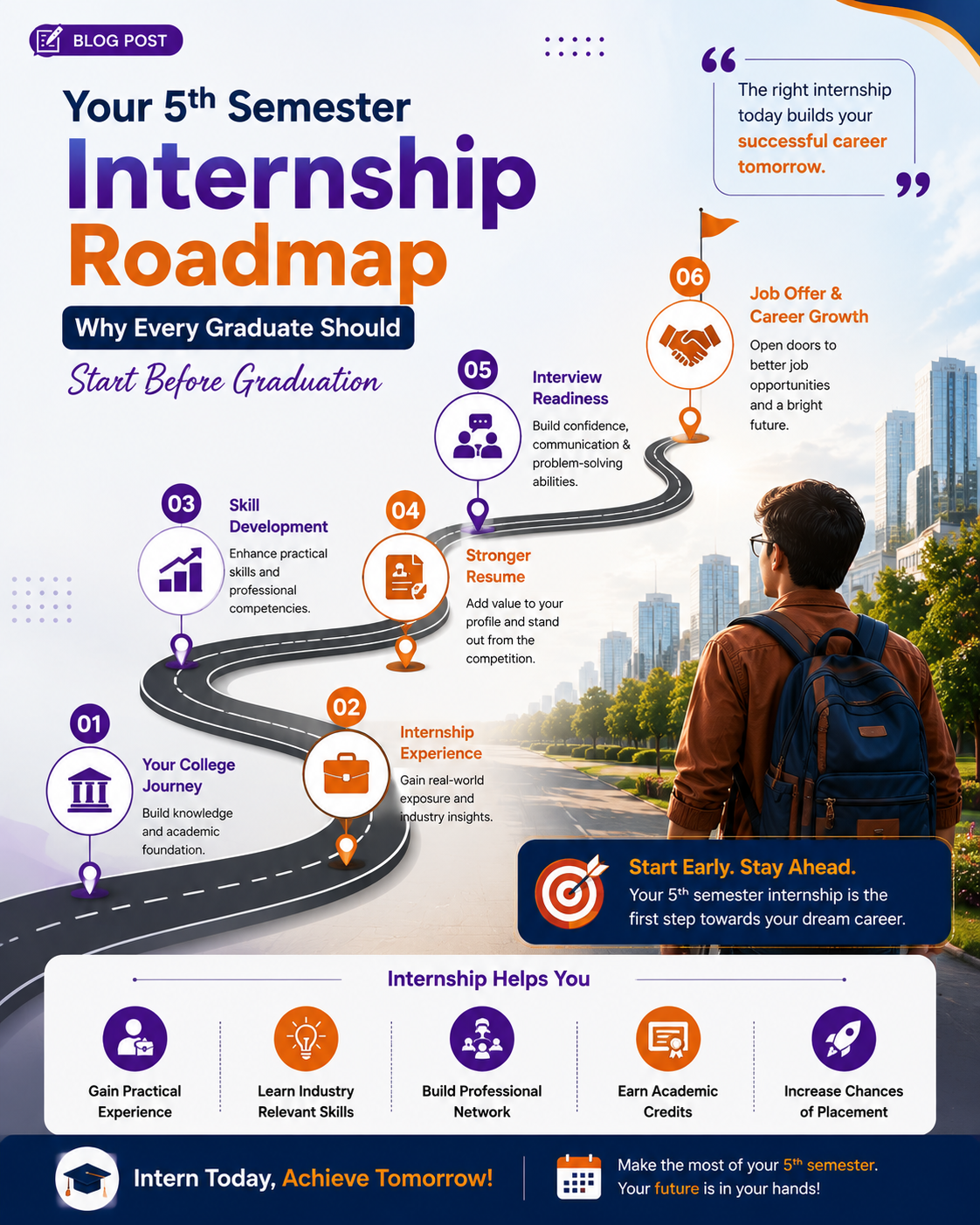
For a student without a job yet, an internship or a live project is usually the most direct way to get that repeated feedback loop, at a manageable pace alongside coursework. Rather than trying to learn a skill fully before applying it, start with one real placement in your domain and let the feedback from actual work sharpen the skill as you go.
The "My Degree Will Be Enough" Myth
It's a reasonable assumption on the surface — a degree is a real, substantial achievement, and it's natural to expect it to speak for itself. The trouble is that even degrees widely seen as more prestigious or "safe" aren't immune to this shift.
What the numbers show instead
The India Skills Report 2026 recorded MBA graduate employability falling from 78% to 72.76% in a single year, and engineering (BE/B.Tech) employability easing slightly from 71.5% to 70.15% — both credentials with strong pedigree, both softening anyway. The report ties this to an industry shift toward applied, cross-domain expertise over credentials alone. If that pattern holds even for MBA and engineering graduates, assuming any single degree is self-sufficient is a risk worth taking seriously for BA, B.Com, B.Sc, BBA and BCA students too.

The Real Impact — What the Data Shows
The pattern the numbers show
Commerce graduates posted the sharpest employability gain of any non-technical stream in 2026, and the India Skills Report ties it directly to more applied, industry-relevant exposure — the same mechanism that's available to BA, B.Sc, BBA and BCA students through real internships and projects, not just to whichever stream happens to be trending a given year.
Start Building That Proof This Semester
Registration for students. A one-time enrolment secures your placement and unlocks a certificate track once you're selected.
Register on Intern2HubWhat Counts as Proof of Skill in 2026
Not every activity translates into something you can defend in an interview. Here's what actually holds up:
A specific completed task: what you did, and what changed as a result — not a general description of a skill.
A work sample or portfolio: an actual report, design, piece of code, or campaign — real output, not just a claim about having the skill.
A certificate tied to real work: from an internship or applied course, carrying more weight than a certificate for passively watching content.
A reference who can speak to specifics: someone who actually supervised the task, not just someone who knows your name.
A resume line with an outcome: "built X" or "reduced Y," rather than "responsible for X" — a subtle rewrite that changes how the line reads entirely.
You don't need all five for every skill. Even one or two of these, done well, moves a skill from a resume claim to something you can genuinely defend.

Your Skill-Building Roadmap, by Stream
BA Students
Pick one content or research-heavy internship — writing, communications, or education-adjacent — and treat every piece you produce as a portfolio item, not just a task to finish.
B.Com Students
Prioritise an Accounts & Finance internship with real reconciliation or reporting work — it builds directly on your core papers and translates cleanly into BFSI-track roles later.
B.Sc Students
Look for a data-adjacent or Education & Teaching internship — both let you practise turning technical understanding into something a non-specialist can follow.
BBA Students
A Business Development or HR internship applies management theory to real client, market, or people-management work — pick whichever matches the specialisation you're leaning toward.
BCA Students
Take on one real project you can push to a repository and explain end-to-end — what it does, why you built it that way, and what you'd change next time.
Your 2026 Skill Readiness Score
Check everything that's true for you right now, then calculate your score.
The 2026 Landscape, in Numbers
Numbers Are Useful. Starting Is Better.
See exactly which internships are open in your domain, right now, on Intern2Hub.
Explore InternshipsTurning This Into a Plan: Before, During, Proof
Do: Pick 2-3 skills, not fifteen
Start with your stream's baseline expectation plus one broadly useful skill like AI-tool fluency — trying to learn everything at once usually means finishing nothing.
Don't: Wait for the "perfect" starting point
A smaller, real internship or project you start this month beats a more impressive one you keep planning to start next semester.
Do: Keep a simple log of what you actually did
A few lines a week — what you worked on, what you learned, what you'd do differently — turns into interview material you'd otherwise forget by placement season.
Don't: Stay in passive-learning mode
Ask for one task you own outright as early as possible — it's what separates genuine practice from simply observing someone else work.
Do: Rewrite your resume line with an outcome
Turn "assisted with marketing tasks" into "drafted and scheduled six weeks of social content" — specific and verifiable beats vague and impressive-sounding.
Don't: Let proof sit unused after you finish
Save the work sample, ask for the reference, and update your resume within a week of finishing — memory of specifics fades fast once you move on to the next thing.
10 Questions Students Actually Ask About This
A Degree Opens the Door. Real Skills Are What Walk You Through It
Whatever your readiness score came out to, the next step is the same: browse real internships across Business Development, Finance, HR, Content, Teaching and technical domains, and turn what you're studying into proof a transcript alone can't provide.
Registration for students. Intern2Hub is a product of Veridant AI.
Ready to Practice What You Learned?
Take a free AI mock interview and get your skill score in 15 minutes. 100% free for all candidates.
Related Posts
Practice Your Interview
Get ready for your next interview with our AI-powered mock interview tool.
Start Practice Interview