10 Reasons Freshers With Internship Experience Get Hired First
10 Reasons Freshers With Internship Experience Get Hired First
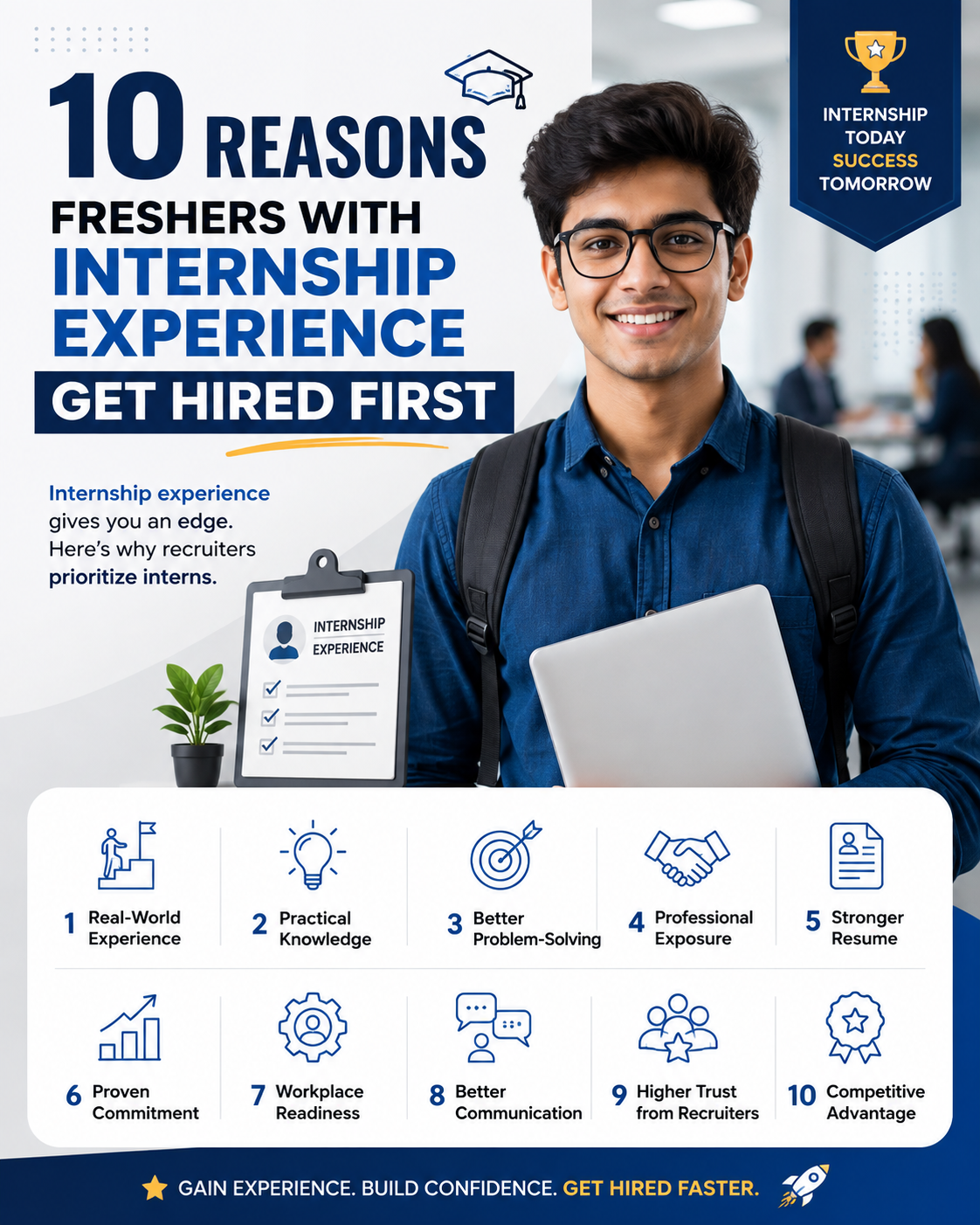
Two freshers apply for the same job. One has a degree. The other has a degree and a real internship behind them. This is exactly why the second one usually gets the call back.
Every fresher hits the same wall: job postings ask for experience you haven't had a chance to build yet. An internship is the most direct, accessible way to break that cycle — before your first "real" job search even begins. Here are 10 concrete reasons it's worth doing, and exactly how to get the most out of one.
A note before you read
This guide is published by Requirehire & Intern2Hub's content team, part of Veridant AI. Everything here is written from direct, practical reasoning about how hiring actually works for freshers — not to talk you into something, but to lay out honestly why internship experience helps, what makes one genuinely worth your time, and how to avoid wasting it that teaches you nothing.
Why This Matters More Than It Used To
A degree used to be the main signal employers relied on. Increasingly, it's treated as the entry ticket, not the deciding factor — what candidates have actually done with their knowledge carries more and more weight in who gets shortlisted, who gets asked back for a second round, and who gets the offer. That shift hits freshers hardest, because a first job search is exactly the moment you have the least "done" to point to.
The pattern worth understanding early
An internship is the most direct way to build that "done" column before you need it for a full job application. It's lower-stakes than a job, more flexible around your academic schedule, and specifically designed to let you learn while contributing — which is exactly the combination a fresher needs.
The Short Answer, Upfront
Yes — a genuine internship gives freshers a real, practical advantage that a degree alone doesn't provide.
Not doing one doesn't disqualify you from getting hired. But doing one well — with a real task, real feedback, and something specific to show for it — puts you meaningfully ahead of a fresher whose only evidence is a transcript.
The rest of this guide breaks down exactly why, what to watch out for, and how to make sure your first internship actually delivers on that promise.
The Fresher Catch-22, Named Honestly
Almost every fresher runs into the same frustrating loop: job listings ask for experience, but you can't get experience without a job. It's a genuinely unfair-feeling situation, and it's not a personal failing — it's just how entry-level hiring has always worked, and it catches nearly everyone at the same stage.
The way out of the loop
An internship is the one thing specifically designed to sit between "no experience" and "job-ready experience." It doesn't ask you to already have a track record — it gives you one. That's the entire reason internships exist as a category, and it's why they're the most practical first move for almost any fresher.

Why Internship Experience Actually Matters
It closes the gap between what you studied and what a job actually needs
A degree gives you theory, frameworks, and foundational knowledge — but very few classrooms replicate the pace, ambiguity, and real stakes of an actual workplace. An internship is where you first apply what you've learned to a live situation, with a real deadline and a real outcome. That's exactly the gap employers care about most.
It gives you something specific to say in an interview
"I studied marketing" and "I planned and posted six weeks of content for a real brand" are very different answers. Internship experience hands you concrete stories with a beginning, a challenge, and an outcome — the kind of answer that survives a follow-up question, unlike a rehearsed line about your coursework.
It helps you find out what you actually want, before you commit to it full-time
It's far cheaper to discover you don't enjoy a particular kind of work during a short internship than after accepting a full-time offer. Internships let you test a role, a team, or a domain in a low-stakes way, so your first big career decision is based on real experience, not guesswork.
It builds habits no classroom fully teaches
Meeting a deadline that affects someone else's work, communicating clearly with a supervisor, adapting when priorities shift midweek — these are workplace habits that only really form through doing the work, not through reading about it. They're also exactly what a first full-time job expects you to already have.
It builds a professional network before you urgently need one
The people you work alongside during an internship — a supervisor, a teammate, even a client — become part of your professional network. Building that network before you desperately need a reference or a lead is far easier than trying to build it from scratch in the middle of a job search.
Reading These Reasons Won't Get You Experience. Doing an Internship Will.
Intern2Hub lists real internships across Business Development, Accounts & Finance, HR, Content & Digital Marketing, and Education & Teaching — built for freshers who are ready to stop reading about experience and start building it.
Registration for students. Verified opportunities. A dated certificate at the end.
Explore InternshipsWhy the Advantage Compounds Over Time
It builds genuine confidence, not rehearsed confidence
There's a real difference between confidence built from practicing answers and confidence built from having actually done the work once. The second kind holds up under pressure, because it's backed by something real, not just preparation.
It gives your resume a specific story instead of a generic skill list
Almost every fresher's resume claims "strong communication skills" or "good with numbers." An internship gives you a specific example to back that claim up with — which is what actually separates one resume from a hundred similar-looking ones.
It shows you what a workplace is really like, before your first real job does
Office dynamics, how decisions actually get made, how much guidance to expect and when to figure things out yourself — an internship is a low-stakes preview of what full-time work will feel like, so your first real job isn't a series of surprises.
It can turn into a direct opportunity, or a reference that opens other doors
Organizations often prefer bringing on interns who performed well into a fuller role, since they already know the person and their work. Even where it doesn't lead directly to that, a genuine supervisor reference from a completed internship carries real weight later.
It compounds — your first internship makes the next opportunity easier
Once you have one internship behind you, the next one, and eventually your first job, all get easier to land. You have real experience to point to, a stronger resume, and a clearer sense of what you're looking for. The hardest part is almost always just getting started.
With Internship Experience vs Without
With a genuine internship behind you
Concrete stories for interviews, a real reference, comfort with basic workplace dynamics, and a resume with specific evidence rather than a list of claimed traits.
Without any internship experience
Relying entirely on academic record and interview performance alone, with nothing concrete to point to when a panel asks "what have you actually done with what you learned?"
The honest verdict
Not having an internship doesn't rule you out — plenty of freshers get hired without one. But it does mean carrying more weight on interview performance alone, in a room where other candidates may have something concrete to show. A genuine internship shifts that balance meaningfully in your favor.
Starting Early vs Waiting Until Final Year
Starting in an earlier semester
Leaves room to try something, learn from it, and still have time to build on it — a rough first attempt can be followed by a stronger second one, well before you're actually job hunting.
Waiting until final year
Compresses your only shot at internship experience into the exact weeks you're also handling exams, placement prep, and job applications — with no time left to try again if it doesn't go well.
The honest verdict
There's rarely a good reason to wait once you're able to start. Earlier attempts cost you less if they don't go perfectly, and give you more time to turn one internship into a genuine track record before you actually need it.
Stop Guessing Which Domain Fits You — Go Find Out
The only way to know if a domain genuinely suits you is to actually try it. Browse real internships across Business, Finance, HR, Marketing, and Teaching, and see what fits.
Browse InternshipsTreating It as a Formality vs Treating It as Real Work
Doing the minimum to get a certificate
Produces exactly what that approach suggests — a piece of paper and nothing specific to talk about when someone later asks what you actually did.
Treating it like a genuine job
The same hours produce a specific project you can describe in detail, a supervisor willing to vouch for your work, and real proof of what you're capable of.
The honest verdict
The certificate looks the same either way. What differs entirely is what's actually behind it — and that difference is exactly what shows up, or doesn't, in your next interview.
One Longer Internship vs Multiple Short Ones
One longer internship
Lets you go deeper into a single role, take on more responsibility as trust builds, and walk away with one strong, detailed story and a solid reference.
Multiple shorter internships
Lets you explore different domains before committing, and demonstrates adaptability across different teams and working styles.
The honest verdict
Neither path is universally better — it depends on whether you already know your direction or are still exploring it. The one option that consistently costs you is spending months deciding between the two while doing neither.
What Makes an Internship Actually Worth Your Time
Not every internship delivers on what this guide has been describing. Before committing your time to one, check for these four things:
A real task you can own: something with a clear start and finish, not just miscellaneous errands with no defined outcome.
A supervisor who gives feedback: someone actually reviewing your work, not just assigning it and disappearing.
Documentation at the end: a certificate and, ideally, a reference you can actually use later.
Genuine exposure to how the work gets done: not just isolated tasks, but a sense of how your work fits into a larger process.
A quick warning sign
If an opportunity can't offer any of the four things above, be cautious about how much you'll genuinely get from it — a placement that exists only on paper won't give you the proof-of-work this entire guide has been about.
Which Domain Fits You Right Now
Business Development: good if you enjoy talking to people, spotting opportunities, and thinking about how organizations grow.
Accounts & Finance: a natural fit if numbers, accuracy, and structured processes genuinely interest you.
HR: suits anyone drawn to people, organizational behaviour, and helping teams function well.
Content & Digital Marketing: a strong option if you enjoy writing, storytelling, or creating things people actually engage with.
Education & Teaching: worth exploring if explaining things clearly and helping others learn comes naturally to you.
How to Actually Get the Most Out of It
Ask for a real task in week one: don't wait to be handed something meaningful — ask what you can own outright.
Keep a simple log: a few lines a week on what you did and learned turns into interview material you'd otherwise forget.
Ask for feedback proactively: don't wait for a formal review — a quick "how did that go, what would you change" gets you faster, more useful input.
Request your certificate and reference before your last day: it's far easier to get this while you're still there than to chase it weeks later.
Your First Internship Is One Registration Away
Registration for students. A one-time enrolment secures your place and unlocks a certificate track once you're in.
Register on Intern2HubCommon Mistakes Freshers Make With Internships
Staying passive and waiting to be told what to do
An internship rewards initiative — asking for work, not just waiting for it, is often what separates a forgettable intern from a memorable one.
Never asking for feedback
Without feedback, you can complete an entire internship without actually improving at anything — feedback is where the real learning happens.
Letting it end without documentation
Finishing without a certificate or reference means real work was done that you can no longer easily prove — always secure this before you leave.
Choosing by name recognition alone
A well-known name with no real responsibility teaches you less than a smaller opportunity where you actually own something meaningful.
The "I'll Get Experience Once I Get a Job" Myth
It's a tempting piece of logic: why build experience now when a job will teach you everything you need anyway? The problem is that this reasoning quietly assumes getting that first job is easy — and it usually isn't, precisely because most jobs are looking for some evidence you can already do at least part of the work.
What this assumption misses
An internship isn't a on the way to your first job — it's often the thing that gets you there faster, by giving you the exact evidence that first job is asking for. Waiting for the job to teach you what the internship could have taught you first usually just means a longer, harder job search.

What Actually Changes Once You Have This Behind You
The shift, in plain terms
Before: a resume built entirely on academics, and interview answers that lean on hypotheticals — "I would approach it like this." After: a resume with one specific, real accomplishment, interview answers built on something you actually did, a person willing to vouch for your work, and a clearer sense of what kind of role you're actually looking for. None of this requires a perfect internship — it just requires one done with genuine effort.
What to Walk Away With, Every Time
A completion certificate: dated, with the organisation's details and internship period clearly stated.
A specific work sample: a report, a piece of content, a spreadsheet you built — actual output, not just a description of what you did.
A supervisor reference: someone who can speak to specifics if a future employer calls to check.
A one-paragraph story: what you did, what you learned, and what changed as a result — write it down while it's fresh.
 v
v
Your Next Step, by Situation
Still studying, with time before graduation
Start now, even with something small. You have room to try, learn, and build on it before you're actually job hunting — that's the biggest advantage you have right now.
Recently graduated, applying for jobs now
A focused internship can still run alongside your job search — it strengthens every application you send out while you search, rather than delaying it.
Considering a different field than your degree
An internship is the lowest-risk way to test that shift before committing to it fully — you'll know quickly whether it's the right direction.
Taking a gap year or break
An internship turns that time into something you can point to later, rather than a gap you have to explain away in an interview.
Your Internship Readiness Score
Check everything that's true for you right now, then calculate your score.

This Guide, in Numbers
The Advantage Goes to Whoever Starts First
See exactly which internships are open in your domain, right now, on Intern2Hub.
Explore InternshipsTurning This Into a Plan: Before, During, After
Do: Pick one domain and commit to it
Trying to explore five domains at once usually means finishing none of them well — pick one that genuinely interests you and start there.
Don't: Wait for the "perfect" opportunity
A smaller, real internship you start this month beats a more impressive one you keep planning to apply for next semester.
Do: Treat every task like it matters
Even a small task done well builds the reputation and reference you'll want by the end.
Don't: Stay quiet if you're unsure what to do
Asking a clarifying question reads as engagement, not incompetence — staying silently confused helps no one.
Do: Update your resume within a week
Write down what you did while it's fresh — specific details fade fast once you move on to the next thing.
Don't: Let the relationship end with the internship
A short thank-you message to your supervisor keeps the door open for a reference or reconnection later.
10 Questions Freshers Actually Ask About This
The Fresher Who Starts Today Is Already Ahead of the One Who Waits
You've now read exactly why internship experience matters. The only thing separating you from having it is a single registration. Browse real opportunities across Business Development, Finance, HR, Content, and Teaching, and turn potential into proof.
Registration for students. Intern2Hub is a product of Veridant AI.
Ready to Practice What You Learned?
Take a free AI mock interview and get your skill score in 15 minutes. 100% free for all candidates.
Related Posts
Practice Your Interview
Get ready for your next interview with our AI-powered mock interview tool.
Start Practice Interview