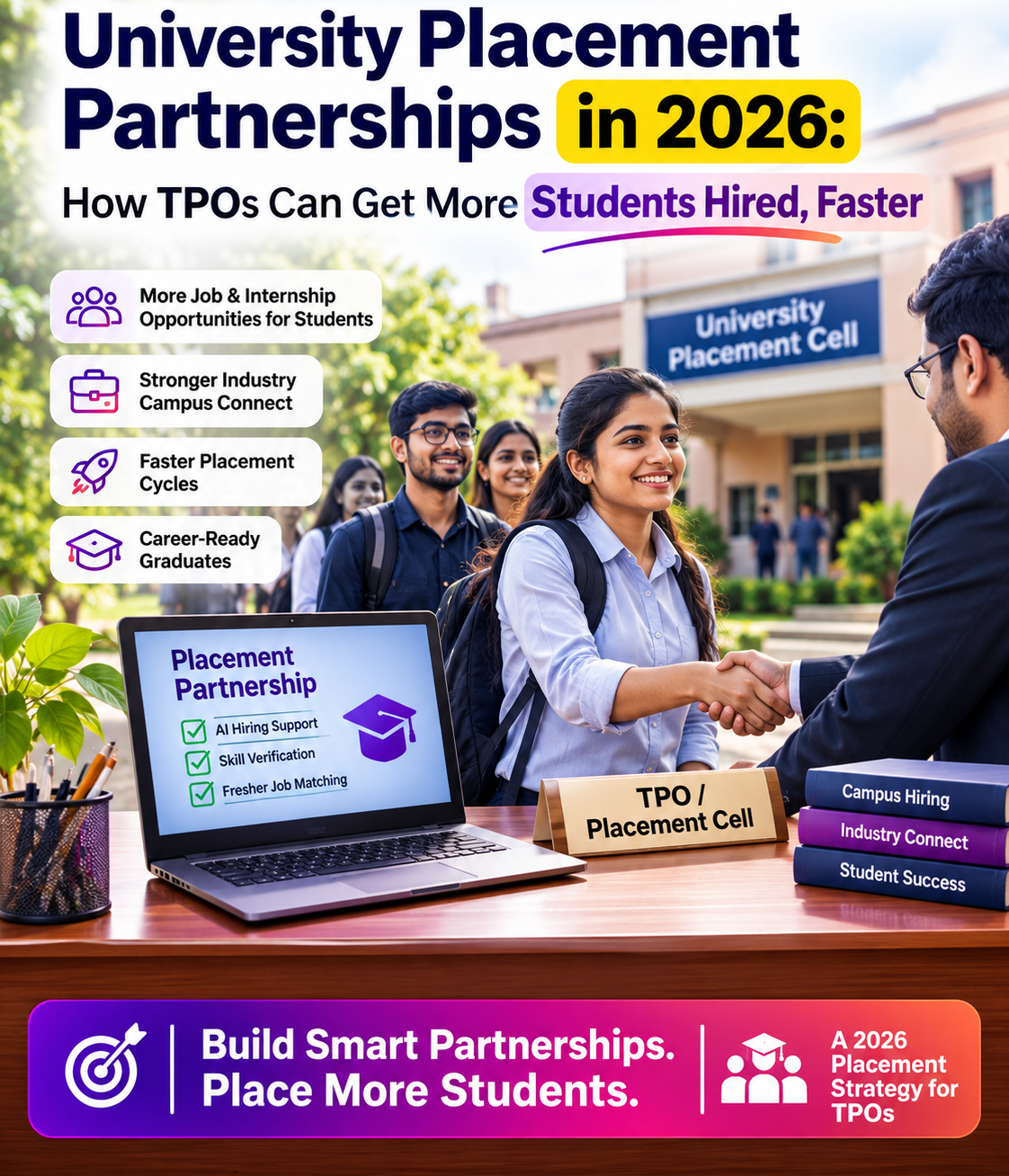
University Placement Partnerships in 2026: How TPOs Can Get More Students Hired, Faster
University Placement Partnerships in 2026: How TPOs Can Get More Students Hired, Faster
More colleges competing for the same recruiters. More students expecting faster outcomes. The same spreadsheets and WhatsApp groups running the whole process.
Boosting placement outcomes isn't really about running more employer visits or working longer hours. This guide breaks down the real structural gaps limiting most placement cells in 2026 — and how structured registration, readiness scoring, and wider employer reach actually fix them.
A note before you read
This guide is published by RequireHire's content team, part of Veridant AI. It's written for anyone running a placement cell with more students to place than hours in the week — a Training & Placement Officer, a career services team, a faculty coordinator doing this alongside teaching. None of what follows requires replacing the employer relationships you've already built; it's about removing the manual work that keeps you from building more of them.
Why Placement Cells Are Under More Pressure in 2026
More colleges are competing for the attention of the same pool of recruiters, students increasingly expect faster and more transparent placement outcomes, and most placement cells are still running the process the way they did years ago — spreadsheets, WhatsApp coordination, physical resume collection — while both student volume and hiring pace have increased around them.
The gap this creates
The distance between manual capacity and what's actually needed has widened. A placement cell built to manually coordinate 200 students doesn't scale cleanly to 800, and the fix usually isn't "work harder" — it's changing what actually has to be done by hand in the first place.
Fix Three Structural Gaps, Not Your Working Hours
Boosting placement outcomes isn't about more employer visits or longer hours — it's about fixing three structural gaps.
How students get registered and screened at scale, how your placement cell actually knows who's ready, and how outcomes get tracked so the whole process improves year over year.
The rest of this guide breaks each of those down into specific, practical fixes.
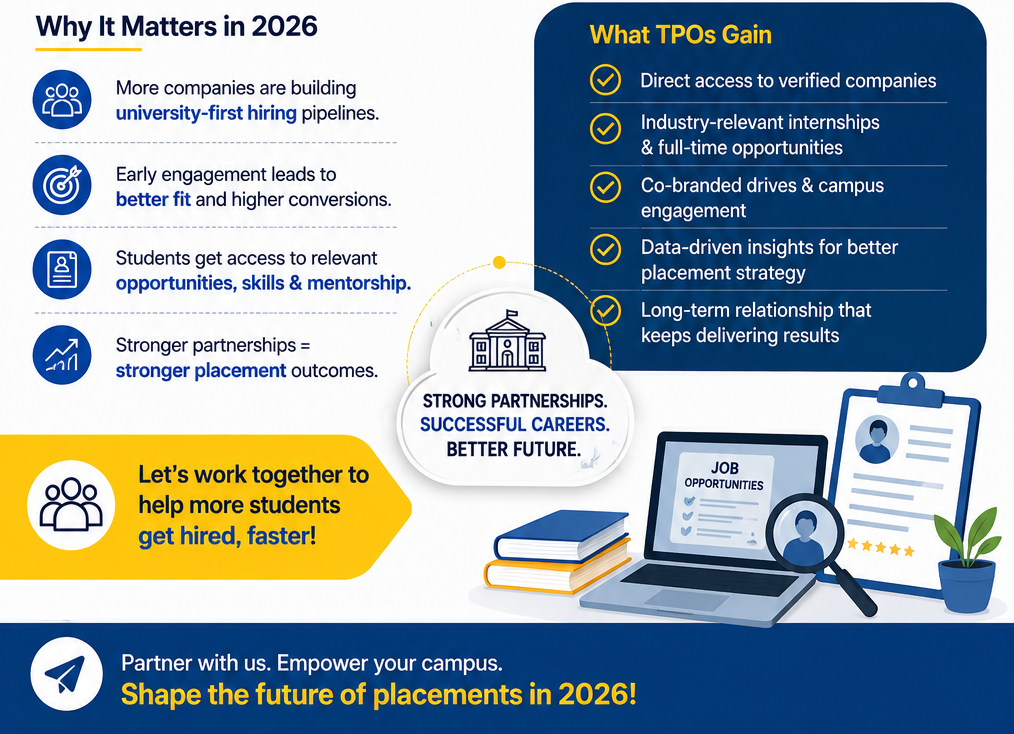
What Every Placement Cell Is Actually Up Against
A limited employer network relative to student volume
Most placement cells maintain relationships with a set list of recruiters, which caps opportunities regardless of how many students actually need placement.
No clear visibility into who's actually ready
Without a structured way to assess readiness, placement cells often rely on CGPA or gut feeling, which misses real gaps like communication or interview performance.
Manual coordination overhead
Collecting resumes, tracking who applied where, and following up individually consumes hours that could go toward building employer relationships instead.
Fragmented tracking across branches and years
Placement outcomes often live in scattered spreadsheets, making it hard to spot real patterns or report accurately to leadership when asked.
What Structured Registration Actually Changes
Instead of collecting resumes one at a time — over email, WhatsApp, or physical submission — an entire batch can be registered together, with each student's profile built automatically the moment they submit their resume, rather than a placement cell manually re-entering the same details student by student.
Why this removes the heaviest manual burden
Bulk registration — batch upload, unique college codes, self-registration via a shared link — turns hundreds of individual coordination tasks into one process the placement cell sets up once. That's hours back, every single placement season.
What Readiness Scoring and Wider Reach Actually Change
A structured readiness assessment gives a placement cell an actual number to point to — not a guess — for who's ready to sit in front of a recruiter and who needs more preparation first. And because screening happens through AI interviews rather than only the placement cell's own outreach, students get exposed to employer opportunities beyond whatever recruiters the college has personally built relationships with over the years.
The combined effect
Instead of every student being treated the same regardless of readiness, and every opportunity being limited to the college's own network, a placement cell can focus its limited employer-facing time on students who are genuinely ready, while the platform itself extends reach beyond local relationships.

Your Students' Placement Journey Starts With One Link, Not One Resume at a Time
Share this exact registration link with your batch — each student builds their profile from their resume and enters AI interview screening automatically, without your placement cell handling data entry for every single one.
For students. Takes minutes per student, not hours for your team.
See the Registration FlowManual, One-by-One Registration vs Bulk, Structured Registration
Manual, one-by-one
Collecting resumes via email or in person, one student at a time, with no consistent structure across submissions.
Bulk, structured
Registering an entire batch together, with each student's profile built automatically and consistently from their resume.
The honest verdict
The manual version doesn't just take longer — it scales worse the bigger your batch gets. Bulk registration is one of the few changes that gets easier, not harder, as your student numbers grow.
Guessing Who's Ready vs Data-Backed Readiness Scoring
Guessing
Relying on CGPA or informal impressions to judge who's placement-ready, which misses real gaps in communication or interview performance.
Data-backed scoring
An actual structured assessment across multiple factors gives a specific, actionable answer instead of an impression.
The honest verdict
CGPA measures something real, but not the same thing as interview readiness — treating them as interchangeable is one of the most common, quietly costly assumptions a placement process can make.
Stop Guessing Who's Ready. Start Knowing.
Once your students register, readiness is measured across multiple factors, not assumed from a CGPA cutoff alone.
See How Registration Works
A Limited Local Employer Network vs Wider Reach
Local network
Relationships with a fixed set of recruiters the placement cell has built over time, which caps opportunity regardless of how strong a student's profile is.
Wider reach
Structured screening lets qualified students get discovered by employers beyond the college's own direct outreach.
The honest verdict
Your existing employer relationships remain genuinely valuable — this doesn't replace them, it adds a second channel that doesn't depend on how large your network happens to be.
Spreadsheet Tracking vs Real-Time Placement Analytics
Spreadsheets
Manually updated, prone to gaps and inconsistency, and hard to report from accurately at a glance when leadership asks for numbers.
Real-time analytics
Placement rate, offer status, and package details tracked automatically and available whenever they're actually needed.
The honest verdict
A spreadsheet works fine at small scale, but the moment tracking spans multiple branches and years, gaps creep in — and those gaps are exactly what makes year-over-year improvement hard to measure.

A Simple Framework to Evaluate Any Placement Technology Partner
Can our entire batch be registered at once, not just one student at a time?
Does it tell us who's actually ready, with something more specific than a CGPA cutoff?
Does it expose students to opportunities beyond our existing employer relationships?
Can we pull accurate, real-time placement numbers whenever we need to report them?
What to Actually Look For
Bulk registration: batch upload options and simple self-registration, not one-by-one manual entry.
Multi-factor readiness scoring: profile, resume, academic record, mock interview performance, and aptitude — not a single number pulled from one source.
Branch-wise and year-wise breakdowns: so patterns across your institution are visible, not buried in aggregate numbers.
Real-time placement tracking: offers, packages, and joining status, updated as they happen rather than reconstructed later.
Exportable reports: so numbers can actually reach leadership in a usable format when they're asked for.
Give Every Student in Your Batch the Same Starting Point
For students. One consistent process, whether your batch is 50 students or 500.
See the Registration Flow
Common Mistakes Placement Cells Make
Relying on the same small set of recruiters every year
A network that worked for one batch's size and profile doesn't automatically scale to serve a larger or differently-skilled one.
Treating CGPA as the only readiness signal
A strong academic record doesn't guarantee interview readiness, and the gap only becomes visible once a student is already in front of a recruiter.
Collecting resumes with no structured process
Inconsistent formats and channels mean re-entering the same information manually, over and over, for every single student.
Waiting until placement season to start preparing students
Readiness gaps are far easier to close with a semester of lead time than in the final compressed weeks before recruiters arrive.
The "More Employer Visits = Better Placement Rate" Myth
It's a natural instinct: if the placement rate needs to improve, get more companies to visit campus. More options should mean more offers.
What this misses
If students genuinely aren't ready, or if there's no structured way to match the right student to the right opportunity, more visits alone don't move the needle much — they just mean more recruiters seeing the same underlying gaps. The bottleneck is often earlier in the pipeline: readiness and structured matching, not the raw number of employers walking through the door.
What Actually Changes When You Fix This
The shift, in plain terms
Before: hours spent on manual resume collection, no clear signal for who's actually ready, opportunities capped by the college's existing network, and outcomes scattered across spreadsheets. After: an entire batch registered at once, a real readiness signal for every student, exposure to employers beyond your direct relationships, and accurate numbers ready whenever leadership asks. The placement cell's actual job — connecting the right students to the right opportunities — gets easier, not busier.
What Good Placement Infrastructure Looks Like
Students registered and profiled at scale, not one painstaking submission at a time.
A real readiness signal for every student, not a guess based on academic record alone.
Exposure to opportunities beyond your own network, extending what your college's relationships alone can offer.
Accurate, real-time tracking of outcomes, ready to report the moment leadership asks.
Your Starting Point, by Situation
Small placement cell, limited staff
Bulk registration matters most here — it removes the single heaviest manual burden relative to your team's size.
Large college, high student volume
Readiness scoring becomes critical, so your limited employer-facing time gets focused on the students who are genuinely ready.
Already mid-placement-season
Start with registration and readiness scoring now — even fixing this mid-cycle recovers real time for the rest of the season.
Planning ahead for next season
Build the process before the rush begins, so registration and readiness data are already in place when recruiters start arriving.
Your Placement Cell Readiness Score
Check everything that's true of your current process, then calculate your score.

This Guide, in Numbers
Your Next Batch Deserves a Better Starting Point
See exactly how students enter the registration and screening process.
See the Registration FlowTurning This Into a Plan: Before, During, After
Do: Register your batch early
Giving students weeks, not days, to complete registration and initial screening means readiness data is ready before recruiters arrive.
Don't: Wait until the first recruiter visit to start
Registration and readiness assessment take time to complete properly — starting during the rush compresses a process that works better with lead time.
Do: Use readiness scores to prioritise preparation
Spend limited coaching time on students who need it most, guided by actual data instead of assumptions.
Don't: Let tracking slip because things get busy
The busiest weeks are exactly when accurate tracking matters most — that's when outcomes actually happen.
Do: Pull a full report while the season is fresh
Accurate numbers right after the season end up far more useful for planning next year than a reconstruction months later.
Don't: Let the process reset to manual next season
Keep the registration and tracking setup running year to year, rather than rebuilding it from scratch each time.
Your Final Checklist
Your batch has a clear registration process, not scattered individual submissions.
You have a real readiness signal for each student, not a guess.
Your students have exposure beyond your existing employer network.
You can report accurate placement numbers on demand.
This process is built to repeat next season, not rebuilt from scratch.
10 Questions Placement Cells Actually Ask About This
The Placement Cell That Registers Its Batch Today Gets Its Students Seen Before the One Still Collecting Resumes by Email
You now know exactly which structural gaps limit most placement cells, and how structured registration, readiness scoring, and wider reach fix them. The next step is simple: share this registration link with your students, and let the process start working for your entire batch.
RequireHire is a product of Veridant AI.
Ready to Practice What You Learned?
Take a free AI mock interview and get your skill score in 15 minutes. 100% free for all candidates.
Related Posts
Practice Your Interview
Get ready for your next interview with our AI-powered mock interview tool.
Start Practice Interview