Career Guide: Top Skills Every Fresh Electronic Engineer Needs in 2026
Career Guide: Top Skills Every Fresh Electronic Engineer Needs in 2026
As we navigate the mid-point of 2026, the electronics engineering sector in India is witnessing a transformation equivalent to the 1990s IT boom. No longer relegated to the background, hardware engineering has emerged as the critical frontier of global innovation. From the design of AI-optimized silicon to the high-voltage architecture of electric mobility, the demand for "Pure Core" expertise has reached a fever pitch.
For the fresh graduate, this represents a golden era of opportunity, provided they possess the specific, industry-aligned skill sets that 2026 demands. In this comprehensive career blueprint, we will dissect the anatomy of a successful core engineer, moving beyond academic theory into the realm of high-income execution.

The global shift toward semiconductor sovereignty and the domestic push through the India Semiconductor Mission (ISM) have created a unique market dynamic. Product-based giants and agile hardware startups are no longer satisfied with generic engineering degrees; they are actively hunting for "Ready-to-Deploy" talent. This guide is designed to bridge the chasm between your campus syllabus and the sophisticated requirements of modern design houses, ensuring you are positioned as a top-tier candidate in this field .
The Systemic Struggle of the Indian Core Student
If you are an ECE or EEE student in a Tier-2 or Tier-3 college, you are intimately familiar with the "Placements Paradox." You spend four years grappling with the complexities of Maxwell’s equations, Laplace transforms, and digital signal processing, only to be steered toward campus recruitment sessions that test you on Java strings or SQL queries. This misalignment creates a profound sense of career dissonance. You feel like a "Hardware Hybrid" who is neither a pure coder nor a confident hardware designer, often settling for service-based IT roles out of sheer necessity rather than passion.
" However, 2026 has democratized the learning landscape. The struggle you face is real, but it is no longer insurmountable. By adopting a skill-first approach and leveraging modern mentorship ecosystems, you can reclaim your core identity and out-earn your software peers while working on technology that physically shapes the future.
The 2026 Reality: Why Software is Saturation, Hardware is Scarcity
Here is the uncomfortable truth that college career cells rarely mention: The entry-level software market is facing a hyper-saturation crisis. Between the massive influx of CS graduates and the rapid automation of standard coding tasks by AI, the "Moat" for generic software developers has evaporated. Conversely, the core hardware sector is facing a talent deficit so severe that it is stalling the expansion of major semiconductor design houses in India. Physical hardware design involves physics, material constraints, and real-time complexities that AI cannot yet solve autonomously.

In 2026, the "Harder" the skill, the higher the "Rent" you can charge for your time. Designing a multi-layer PCB with high-speed signal integrity or verifying a 5nm IP block requires human intuition, experience, and deep domain knowledge. Companies are willing to pay a "Rarity Premium" for freshers who can demonstrate these skills. While software salaries for freshers have stagnated in the 4-6 LPA range, competent VLSI and Embedded engineers are routinely securing 8-10 LPA packages right out of college. Scarcity is your greatest competitive advantage.
⚡ The Four Pillars of 2026 Core Mastery
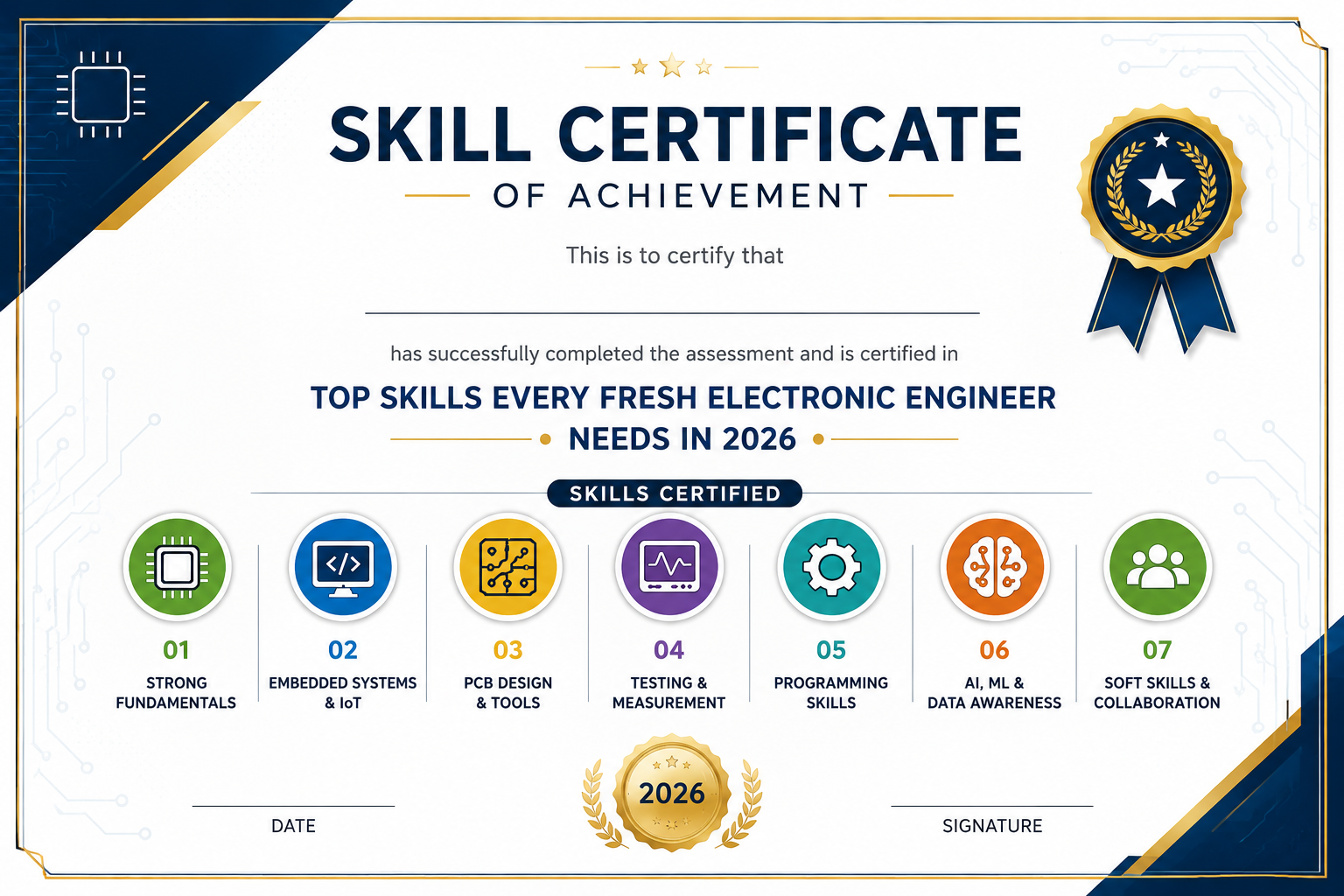
To survive and thrive in the current recruitment cycle, you must focus on these four non-negotiable domains:
- Hardware Description Architecture: Moving beyond basic Verilog into SystemVerilog and the UVM (Universal Verification Methodology) framework.
- Firmware Intelligence: Mastering Bare-metal C and RTOS (Real-Time Operating Systems) like FreeRTOS or Zephyr for deterministic execution.
- High-Speed PCB Systems: Understanding signal integrity, EMI/EMC compliance, and thermal dynamics in 6 to 12-layer board designs.
- Hardware Scripting: Using Python and Tcl to automate the "Drudgery" of hardware testing and EDA tool management.
The 2026 Engineering Readiness Audit
Before proceeding, it is vital to perform a "Skills Self-Assessment." The 2026 market is ruthless toward those with purely academic knowledge. Use this proprietary tool to calculate your current industry readiness and identify your critical gaps.
Precision Skills Audit
Rank your proficiency honestly (1 = Beginner, 5 = Industry Ready):
40%
Foundation Tier
You have strong academic roots, but the 2026 industry demands a "Project-First" portfolio. You are currently at risk of being filtered out by top product firms.
The Hidden Backdoor to Core Engineering Jobs

What do the top 1% of Electronics freshers know about "Shadow Placements" in 2026? Discover the exact roadmap to high-demand core courses and bypass the massive software crowd. Don’t miss this limited-time opportunity to learn from a mentor who has placed hundreds in top design houses.
Unlock the Mentor Secret NowMaster high-income skills, perform better & grow faster. Completely FREE for a limited time only.
The Silicon Renaissance: India’s Sovereign Chip Era
The year 2026 is defined by the physical realization of the India Semiconductor Mission. We have moved past policy-making into the "Ground-Breaking" phase of fabrication plants and OSAT (Assembly, Testing, Marking, and Packaging) centers. This geopolitical shift has turned India into a global "Fabless Design" hub. For a fresh engineer, this translates to an explosion of roles in RTL Design, Physical Design, and Pre-Silicon Verification. You are no longer just designing circuits; you are designing the brains of 6G devices, NPU (Neural Processing Unit) accelerators, and satellite communication nodes.

What this means for your career is "Localized Job Security." You don't need to move to San Jose or Hsinchu to work on 3nm nodes. The world's most complex chips are being designed in Bengaluru, Hyderabad, and Gandhinagar. However, to enter these high-security design centers, you need more than a degree—you need a "Security Clearance" of verifiable technical mastery.
The Trust Factor: Why Industry Proof Beats GPA in 2026
In 2026, the concept of E-E-A-T (Experience, Expertise, Authoritativeness, and Trustworthiness) has moved from SEO into HR. Hiring managers at Intel, NVIDIA, and Qualcomm have stopped trusting traditional resumes. They are now using "Evidence-Based Recruitment." They want to see your GitHub repositories for firmware, your verifiable testbench reports, and your public project portfolios. If you cannot provide a link to a working FPGA project or a KiCad schematic, you don't exist in the eyes of a 2026 recruiter.
Platforms like Intern2Hub, under the guidance of mentors , have become the new "Standard of Trust." When you complete a project-based course, you aren't just getting a certificate; you are building a body of work that acts as a technical passport. Industry leaders actively partner with these ecosystems because they provide a "Pre-Vetted" pool of talent. In 2026, your "Digital Footprint" as an engineer is your most valuable asset. Build it with intention, and the industry will seek you out.
The Synergy Framework: Designing in the Convergence Zone
The era of the "Pure Hardware Engineer" who never touches a keyboard is over. In 2026, the most valuable professionals operate in the "Synergy Zone"—where hardware architecture meets intelligent software. To be a top-tier engineer, you must understand the full stack of a physical product. This isn't about becoming a software developer; it's about becoming a "Hardware-Aware Programmer."
The 2026 Full-Stack Hardware Model
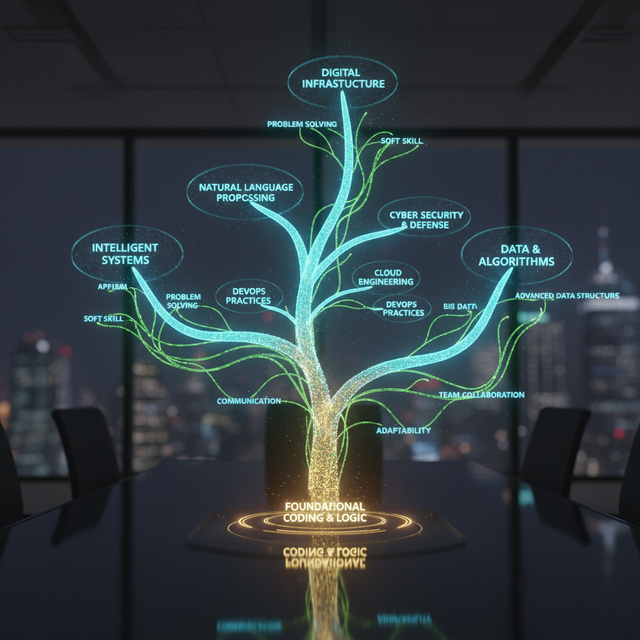
Silicon Layer: Verilog/VHDL, RTL Design, Gate-level Logic.
The Bridge (Firmware): Embedded C++, RTOS, Driver Development, Memory Mapping.
Intelligence Layer: Python, TinyML, Signal Processing, Cloud Connectivity.
Mastering this framework makes you "Indispensable." You can talk to the silicon design team about gate delays and then walk over to the software team to discuss interrupt latency. This cross-domain fluency is what allows you to architect complex systems like autonomous drones or smart medical implants. It is the ultimate shield against career stagnation.
Master Real Hardware Skills. Get Placed.
Stop wasting time on generic college tutorials. Learn exactly what product companies demand in 2026. Master high-income skills, perform better & grow faster. Access direct mentorship and project-based learning that converts to jobs.
Claim Your Free Mentor AccessDon’t miss this limited-time opportunity. Completely FREE for a limited time only.
Your 2026 Execution Blueprint
How do you transition from a confused fresher to a highly sought-after core engineer? You need a structured, 8-month roadmap that prioritizes demonstrable skill over theoretical exams. Follow this path rigorously:
- Months 1-2: Logic & Synthesis. Re-master Digital Electronics using Verilog. Focus on synthesizable code and timing closure. Build a custom ALU or SPI controller on a cloud-based FPGA tool.
- Months 3-4: The Firmware Deep-Dive. Move beyond Arduino. Learn Embedded C on ARM Cortex-M or RISC-V. Implement a multi-threaded application using an RTOS (Real-Time Operating System).
- Months 5-6: The Physical System. Design a 4-layer PCB for your firmware project. Focus on decoupling, ground planes, and signal integrity. Use KiCad or Altium.
- Months 7-8: Automation & Branding. Learn Python to automate your hardware testing. Build your GitHub portfolio and register on RequireHire to start the matching process.
This roadmap is designed to build "Cumulative Competency." Each month builds on the previous one, ensuring that by the end of month 8, you have a complete, professional-grade product portfolio to show recruiters.
Busting the "IIT-Only" Core Myth
One of the most persistent lies in the Indian engineering ecosystem is that companies like Intel or NVIDIA only hire from IITs or NITs. In 2026, this is fundamentally false. The demand for hardware talent has far outstripped the supply from premier institutes. Companies are now adopting "Merit-Based Discovery." They are looking for talent wherever it resides. The reason Tier-3 students often fail isn't their college name—it's their "Resume Thinness."
If you walk into an interview with a Tier-3 degree but can demonstrate a deep understanding of UVM testbenches or can explain the thermal dissipation strategy of your custom power board, you will get the job over an IITian with no projects. The industry is desperate for people who can "Do." Don't let your college name be your excuse. Let your portfolio be your passport. The 2026 market is the most democratic it has ever been.
Electric Vehicles: The High-Power Opportunity
While silicon design is the brain, Power Electronics is the heart of the 2026 economy. The Electric Vehicle (EV) revolution has turned the automotive industry into an "Electronics First" industry. A modern EV is essentially a giant mobile computer with a massive power plant. This has created an explosion of roles in Battery Management Systems (BMS), motor controllers, and onboard chargers. This is a field where software developers have no entry—you must understand high-voltage physics and functional safety .

Mastering Power Electronics (MOSFETs, GaN, SiC) is like owning a golden ticket. As India builds its EV infrastructure, the demand for engineers who can design efficient power converters and reliable thermal management systems is insatiable. This is a "Resilient Sector" that is immune to software-centric layoffs. It offers a career path that combines high salaries with the satisfaction of building sustainable technology for the planet.
Join 1,000+ Who Scaled Their Careers
Stop doubting your core engineering potential. You have the theoretical knowledge; now get the practical execution plan from Kumar Vimal. Master high-income skills, perform better & grow faster. Build a world-class portfolio verified by industry experts.
Start Your Success JourneyDon’t miss this limited-time opportunity. Verified by top product companies.
The Cost of the "Safe" Path: Core vs. IT Trajectory

Let's talk about the long-term math. If you choose the "Path of Least Resistance" and join a mass-recruiting IT firm in 2026, you start at 4.5 LPA. Your growth is linear, and you are constantly at risk of being replaced by cheaper freshers or automated tools. By year 5, you might be at 10 LPA, but the work is often monotonous maintenance. You are a "Commodity Engineer."
Conversely, the Core Electronics Engineer starts with a steeper learning curve, but the ROI is compounding. A specialized VLSI or Embedded engineer starts at 10-12 LPA. Because their skills are specialized and rare, their value increases every year. By year 5, a senior hardware architect can easily command 20+ LPA. More importantly, your work involves "Irreplaceable Intuition." The fear of missing out (FOMO) shouldn't be about missing a coding bootcamp; it should be about missing the once-in-a-generation semiconductor wave that is reshaping India's economy.
The Ethical Discovery Engine: RequireHire

Having the skills is only half the battle; the other half is "Verification." Traditional job portals are broken for core engineering—they rely on keyword stuffing and generic templates. This is why RequireHire has become the industry standard for 2026. It uses an "Intent-Based Matching" system designed specifically for skill-first recruitment. It evaluates your verifiable project links and hardware assessments directly.
By registering on RequireHire, you are ensuring that your deep technical knowledge in Verilog, Embedded C, or PCB design is seen by hiring managers who actually value it. It bypasses the "Noise" of generic IT recruitment and puts you in front of product-based companies looking for your specific "Hardware DNA." Don't just apply for jobs; be discovered by the innovators who are waiting for your talent.
Why AI Won't Replace the 2026 Electronics Engineer

The fear that AI will replace engineers is a "Software Dissonance." Yes, AI can write a Python script for web-scraping. But can an LLM physically debug a crosstalk issue on a 10-layer board? Can it optimize the clock-tree synthesis of a multi-core processor while managing thermal hotspots? Absolutely not. Hardware engineering is grounded in the laws of physics, material science, and real-world unpredictability. These are "Physics-Constrained" problems that require human validation.
In 2026, AI is your "Power Tool," not your "Replacement." The engineer who uses AI to automate their verification testbenches will be 10x more productive. But the "Architect" who defines the constraints and signs off on the physical tape-out will remain the most critical human element in the tech chain. Sticking to hardware provides an impenetrable moat against the automation waves hitting the software services industry.
Visualizing Your 2030: Which Path Will You Take?
Imagine two versions of yourself in the year 2030. In Scenario A, you took the "Safe IT Role" in 2026. You are now fighting for your job as AI-driven development platforms flatten the software workforce. Your skills are generic, and your growth has hit a ceiling. You are a "Service Associate" in an increasingly automated world.
In Scenario B, you specialized in Core Electronics. You are now a Lead Hardware Architect working on next-gen 6G nodes or autonomous vehicle platforms. Your expertise in physical systems is rare, global, and highly compensated. Headhunters from Tokyo, Munich, and Austin are reaching out to you because "Physical Engineering" cannot be outsourced to a chatbot. The choice you make today determines which reality you inhabit in 2030. Choose depth. Choose core.
The Power of the Hardware Community
The Indian electronics ecosystem is only as strong as its practitioners. If you found this career blueprint valuable, the most impactful thing you can do is share it with your college peers and department groups. The more students pivot back to core engineering, the stronger our domestic talent pool becomes, which in turn attracts more global hardware investments to India. We are all building this ecosystem together.
Join hardware clubs, start collaborative projects on GitHub, and stay connected with industry trends through the RequireHire YouTube Channel. We regularly post deep dives with industry that can fundamentally alter your career trajectory. Knowledge shared is progress accelerated. Let's make India the hardware capital of the world.
Your Next Move Defines Your Decade

You have read the data, visualized the trajectory, and felt the urgency of the 2026 market. Electronics Engineering is no longer just a degree; it is a premium passport to the most critical industries shaping human technology. The semiconductor boom, the EV revolution, and the rise of edge AI are creating a vacuum of talent that only dedicated, skill-focused engineers can fill. Will you be one of them?
The struggle you face today in mastering these "Hard Skills" is the price of admission to a career of immense wealth, stability, and impact. Don't settle for the mediocre path. Embrace the challenge of core engineering, seek world-class mentorship, and build a future that is "Physical, Verified, and Unstoppable." Your decade of success begins with a single click. Go ahead and take it.
Frequently Asked Questions (Electronics 2026)
Absolutely not. In fact, having a background in software logic gives you a distinct advantage in modern hardware roles like Firmware development or VLSI verification. The industry in 2026 desperately needs engineers who can write robust scripts (Python, Tcl) to automate hardware testing. If you spend 3-4 months focusing on Digital Logic and Computer Architecture, your software skills will act as a "Force Multiplier," making you a more versatile candidate than someone with zero coding knowledge. Transitioning back is about realigning your existing logic to physical systems.
AI is a tool for automation, not a replacement for engineering intuition. While AI can generate boilerplate RTL or basic drivers, it cannot physically debug a timing violation on a 5nm chip or optimize the power-grid of a complex SoC. Hardware engineering involves physical world constraints like heat, signal noise, and material defects that are beyond the scope of language models. The 2026 engineer uses AI to accelerate their workflow but provides the critical "Human Sign-off" that silicon manufacturing requires. Sticking to hardware is actually your best protection against AI displacement.
The salary gap has flipped. While mass-recruiting IT firms are still offering 4-6 LPA packages for freshers, core electronics firms (especially in VLSI, EV, and specialized design) are offering entry-level salaries between 8 LPA and 10 LPA for candidates with verified project portfolios. Furthermore, the growth trajectory in core is much steeper. Because hardware skills are rare and cumulative, your value increases significantly with every year of experience. By the 5-year mark, a skilled core engineer often earns 2x to 3x more than a generic software engineer of the same vintage.
Historically, B.Tech curriculums lacked the depth required for advanced design roles, forcing companies to look for post-graduates. However, in 2026, the adoption of "Skill-First Hiring" is changing this. If a B.Tech fresher can demonstrate practical mastery through complex, verified projects—such as a custom RISC-V implementation or a functional BMS design—companies will hire them immediately to save on training costs. Platforms like RequireHire emphasize these verifiable skills, allowing talented B.Tech freshers to bypass traditional Master's requirements and enter top product companies directly.
Embedded Systems, specifically focused on Automotive and IoT, offers the highest volume of opportunities and immense job security. Every physical device manufactured in 2026—from electric cars to smart medical implants—requires a microcontroller running deterministic firmware. The demand for engineers who understand RTOS, memory management, and hardware-software co-design is global and infinite. While VLSI offers high peak salaries, Embedded Systems provides a broader market with roles in every major industry, ensuring you are never out of work regardless of economic cycles.
The "Lab Infrastructure" excuse is dead in 2026. The democratization of engineering tools means you can run professional-grade simulations on your laptop. You can use open-source tools like KiCad for PCB design, EDA Playground for Verilog simulation, and cloud-based FPGA platforms for verification. Furthermore, investing in a 500-rupee ESP32 development board gives you a complete embedded lab in your dorm room. Combined with project-based mentorship from platforms like Intern2Hub, you can build industry-grade projects that prove your competence better than any college lab ever could.
The ISM is fueling a "Localized Talent Boom." It has incentivized global giants and domestic startups to build design centers and manufacturing units in India. For a fresher, this means you no longer have to move abroad to work on cutting-edge silicon. The ISM provides the funding and infrastructure that creates hundreds of thousands of specialized roles in design, verification, and testing. It guarantees that India will be the "Design Capital" of the world for the next decade, ensuring that your core electronics skills will be the most valuable asset in the Indian tech market.
In 2026, you must master a "Triad" of languages: Embedded C/C++ for firmware and bare-metal logic, Python for automation and hardware testing, and a Hardware Description Language (SystemVerilog or VHDL) for silicon design. Python has become the "Glue" of modern engineering; it is used to parse simulation logs, automate EDA tool flows, and manage CI/CD pipelines for hardware. Being proficient in these three languages makes you a "Polyglot Engineer" who can navigate the entire design cycle, making you significantly more attractive to product-based companies.
A core engineering resume must be "Evidence-Dense." Remove generic objectives and basic coursework. Instead, highlight specific hardware protocols (I2C, SPI, CAN), HDL verification frameworks (UVM), and microcontrollers you have mastered. Most importantly, every project must have a "Verification Link"—a GitHub repo with your code or a portfolio showing your physical PCB layouts and test results. Registering this skill-first resume on an intent-based platform like RequireHire ensures that your specific capabilities are matched accurately with the recruiters who are actively looking for them.
They form a complete "Career Acceleration Pipeline." Intern2Hub provides the project-based mentorship from industry veterans like Kumar Vimal, helping you build the "Hard Skills" and professional body of work that colleges fail to deliver. Once your skills are built and verified, RequireHire acts as the "Placement Engine," bypassing generic job boards and matching your verified talent directly with top-tier product companies. Together, they eliminate the "Visibility Gap" for Tier-3 students, ensuring that your technical competence leads directly to a high-paying, high-impact career in core electronics.
