Resume Summary for Freshers in 2026: The Formula That Gets You Shortlisted
Resume Summary for Freshers in 2026: The Formula That Gets You Shortlisted
Two lines at the top of your resume decide whether a recruiter reads the rest of it. Here's exactly how to write yours.
Most freshers either skip their resume summary or fill it with the same five tired phrases everyone else uses. This guide gives you a simple fill-in formula, 20+ real examples across 10 different fields, and the specific mistakes that quietly cost freshers interviews — so the top of your resume finally works as hard as the rest of it.
A note before you read
This guide is published by RequireHire's content team, part of Veridant AI. Every example here is written to illustrate a structure, not to be copied — a summary that actually reflects your real degree, project, and skills will always beat a perfectly worded one that isn't true to you. Use these as a starting point, then make them yours.

Why the First Two Lines Matter More Than the Rest of the Page
Recruiters skim. On a first pass through a stack of resumes, most spend only a few seconds deciding whether to keep reading or move to the next one — and increasingly, an automated system does an initial pass before a human ever sees the resume at all, scanning for relevant keywords and context. Your resume summary sits at the very top, which means it's often the only section guaranteed to actually get read in full before that decision gets made.
Why this hits freshers specifically hard
Without a work history to lean on, the summary is one of the few places on your entire resume where you get to actively frame your own story, instead of just listing facts in a timeline. Get it right, and it does real work pulling a recruiter into the rest of your resume. Get it wrong, and even a strong resume underneath it may never get read.
What a Strong Fresher Resume Summary Actually Looks Like
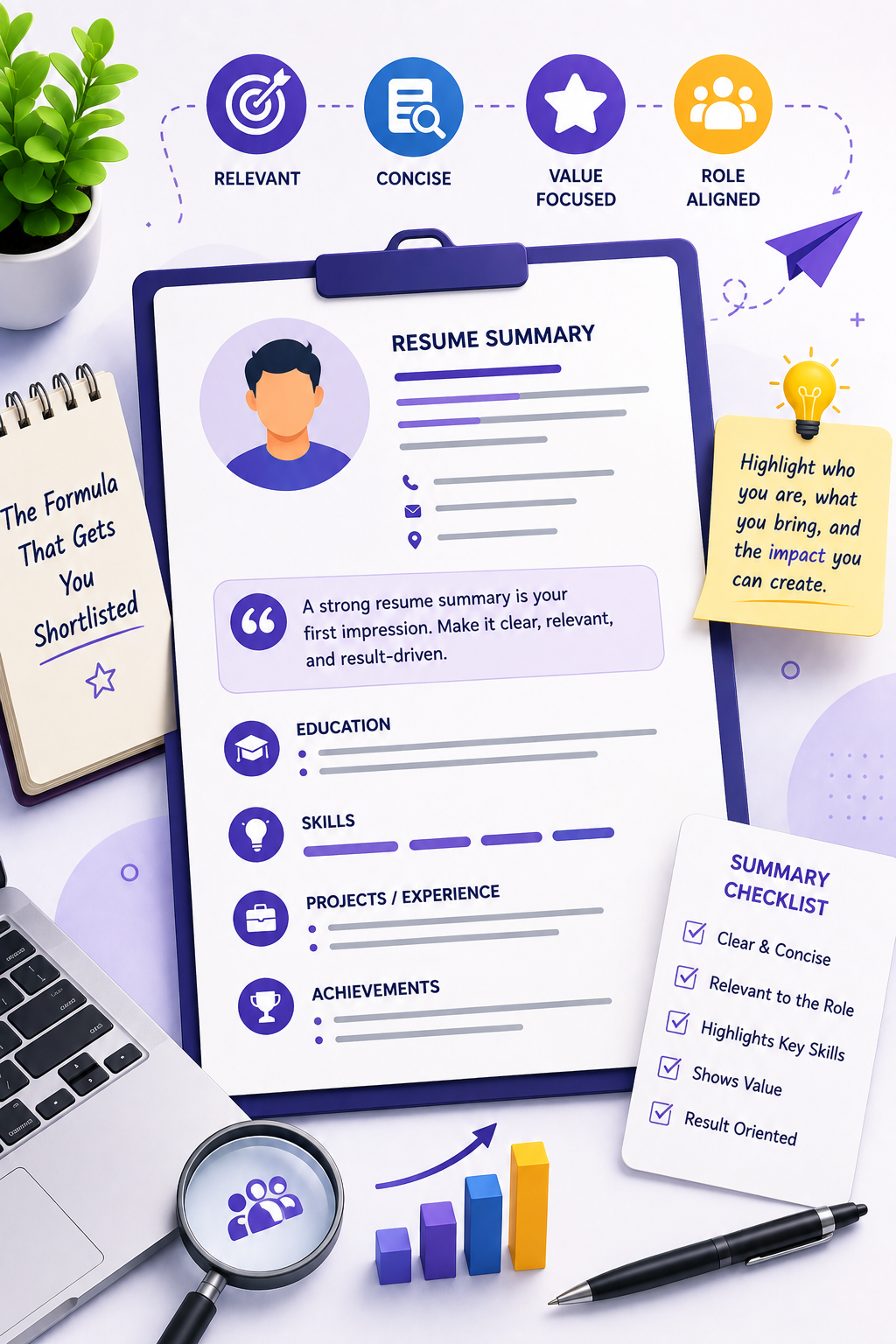
2-4 sentences. Your degree, one or two real skills, one specific detail, and what you'd bring to the role .
You don't need years of experience to write one that works. You need one real, specific thing — a project, an internship, a piece of coursework you actually did — and the discipline to leave out anything that isn't backed by something real.
Below: the formula, 20+ examples across 10 fields, and exactly what to avoid.
What Actually Goes Into a Strong Resume Summary
Length & placement
2-4 sentences, roughly 40-80 words, placed directly under your name and contact details — before education and experience, not after.
What to include
Your degree or field, one or two relevant skills, a specific project or internship if you have one, and what you'd bring to the role you're applying for.
What to leave out
Vague adjectives with nothing behind them ("hardworking," "team player"), personal details unrelated to the job, and anything you can't back up if asked.
Tone
Plain, confident, and specific — closer to how you'd actually describe yourself out loud than to a string of resume stitched together.
Resume Summary vs Career Objective — Which Should You Use?
Resume Summary
States what you offer — your skills, projects, and strengths — even with zero work experience, as long as you have something real to point to.
Career Objective
States what you want — the role or direction you're aiming for. Traditionally used when you genuinely have nothing yet to point to, or you're switching fields entirely.
The honest verdict
In 2026, a summary is the stronger default for most freshers — it demonstrates value instead of only expressing intent. Use an objective only if you truly have nothing yet to draw from. And never use both: two intro blocks crowd out space your resume needs elsewhere, and it reads as padding.
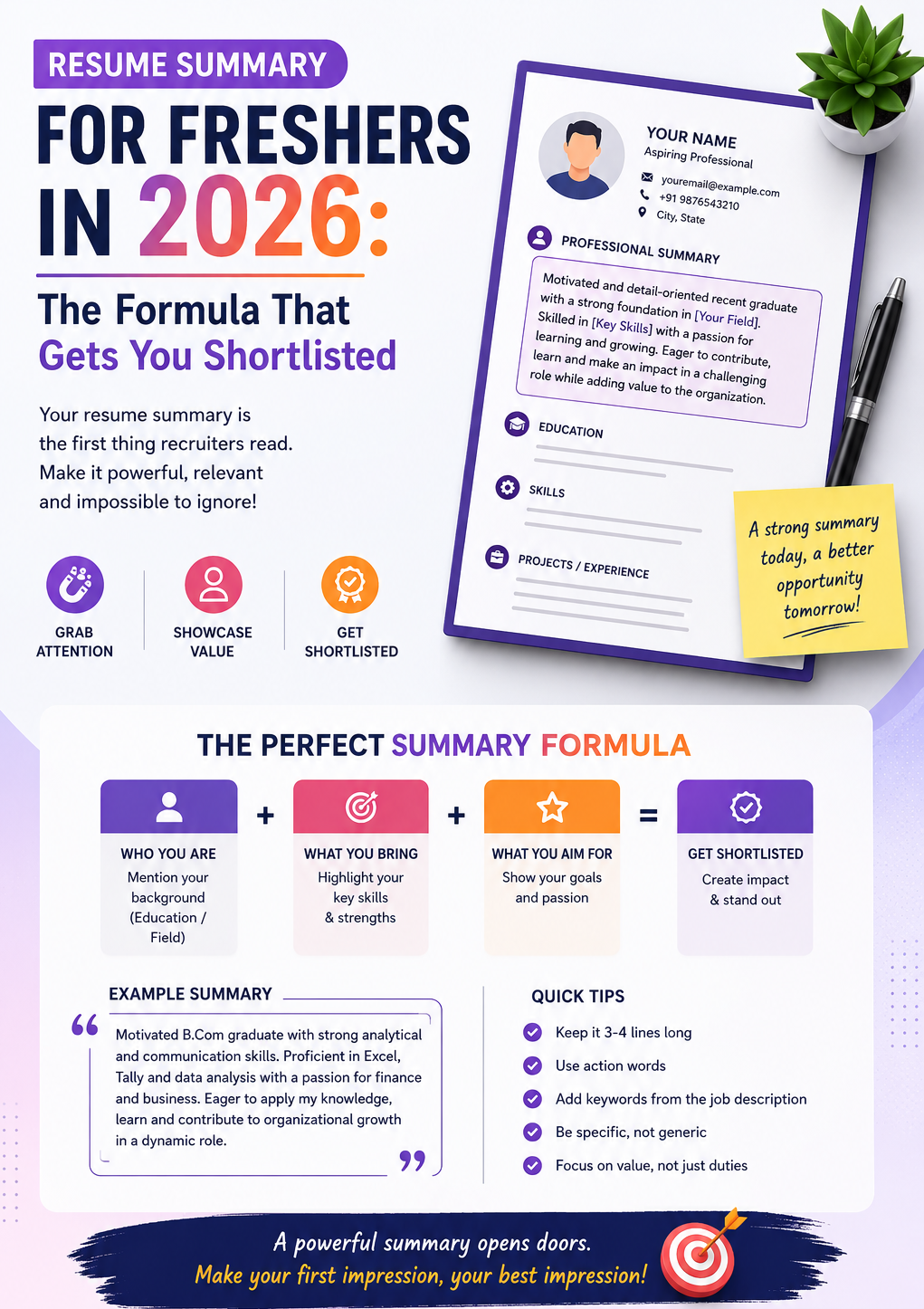
The Fill-in-the-Blank Formula
[Your degree / field] + [1-2 real skills] + [a specific project, internship, or certification] + [what you'd bring to this role]
Worked example
Degree/field: "B.Com graduate" + Skills: "with hands-on GST filing and Tally experience" + Specific proof: "from a 6-week accounting internship, where I helped reconcile ledgers for 40+ client accounts" + Value: "looking to bring the same accuracy to an entry-level finance role."
Put together: "B.Com graduate with hands-on GST filing and Tally experience from a 6-week accounting internship, where I helped reconcile ledgers for 40+ client accounts. Looking to bring the same accuracy to an entry-level finance role."
You Just Wrote a Summary That Works. Don't Let It Sit in a Word Document.
Upload your resume to RequireHire and it builds your candidate profile automatically — the work you just put into your summary starts working for you immediately.
for job seekers. No manual re-typing required.
Upload Your Resume Now
20+ Real Examples, by Field
Two examples per field — one built around an internship or project, one built around academics and activities alone.
Recent graduate with a strong academic foundation and hands-on experience through three college projects involving research, data collection, and presentation. Quick to learn new tools and comfortable working to deadlines. Looking to bring the same discipline and curiosity to an entry-level role from day one.
Graduate with consistent academic performance and active participation in a college debate society, developing strong written and verbal communication skills. Eager to apply structured thinking and a fast learning curve to a first professional role.
BCA graduate skilled in Python, Java, and SQL, with a final-year project that automated a manual data-entry process, cutting reported effort by roughly 30%. Comfortable with Git and collaborative workflows. Looking to contribute as a junior developer while continuing to build real-world coding experience.
Computer Science fresher with hands-on web development experience (HTML, CSS, JavaScript, React) through two self-built projects and a six-week internship building internal dashboard features. Comfortable debugging, reading documentation, and picking up new frameworks quickly.
B.Com graduate with practical exposure to Tally, GST filing, and basic financial reporting through a six-week internship at a local accounting firm, where I helped reconcile ledgers for 40+ client accounts. Strong attention to detail and comfortable working with spreadsheets under deadline pressure.
Commerce graduate with a solid foundation in accounting principles and taxation, plus hands-on Excel skills (VLOOKUP, pivot tables) developed through a college project analysing a mock company's cash flow. Looking to bring accuracy and consistency to an entry-level finance or accounts role.
BBA graduate with a two-month internship in business development, helping identify and reach out to 50+ prospective clients, contributing to 8 confirmed meetings. Comfortable with cold outreach, basic market research, and presenting findings clearly to a team.
Business Administration graduate with strong project coordination skills, demonstrated by leading a five-member team to a top-3 finish in a college business simulation. Interested in a management trainee or business operations role to keep building on this foundation.
BA graduate in English with a six-week content writing internship, writing and editing over 20 blog posts and social captions for a small business and improving average post engagement. Strong research skills and comfortable adapting tone across formats.
Arts graduate with a strong command of written and spoken English, developed through active participation in the college magazine. Comfortable researching a topic quickly and turning it into clear, structured writing. Looking to start a career in content, communications, or media.
More Real Examples, by Field
B.Sc graduate in Physics with hands-on lab experience and a final-year project analysing sensor data, using basic statistical tools to draw conclusions. Comfortable documenting procedures clearly and explaining technical findings to a non-specialist audience.
Science graduate with an interest in data analysis, having completed a self-directed project using Excel and basic Python to clean and analyse a public dataset. Strong analytical thinking and comfortable learning new tools on the job.
Marketing graduate with a two-month internship managing a brand's Instagram page, growing followers by 15% and improving engagement through a more consistent content calendar. Comfortable with Canva and basic performance analytics.
Fresher with a strong interest in digital marketing, backed by a self-run project promoting a college event that reached over 2,000 people through targeted social posts. Comfortable with content planning and working to a schedule.
HR fresher with a six-week internship supporting recruitment coordination, screening 100+ resumes and helping schedule interviews for a 15-person hiring drive. Strong organisational skills and comfortable communicating professionally with candidates and hiring managers alike.
Graduate with a genuine interest in human resources, developed through coursework in organisational behaviour and a college project on employee engagement. Strong interpersonal skills and comfortable handling sensitive conversations with discretion.
Mechanical Engineering graduate with hands-on experience through a final-year project designing a low-cost cooling mechanism, plus a four-week internship observing production processes on a factory floor. Comfortable reading technical drawings and working with AutoCAD.
Civil Engineering fresher with practical site exposure through a six-week internship assisting quality checks on a residential construction project. Comfortable with basic structural calculations and site documentation, eager to build deeper hands-on experience.
Education graduate with a six-week teaching internship at a secondary school, independently planning and delivering lessons for a class of 30 students and seeing a noticeable improvement in unit test scores. Strong classroom management and comfortable adapting explanations to different learning paces.
Graduate with a genuine passion for teaching, developed through informally tutoring junior students in mathematics throughout college. Patient, clear communicator, comfortable breaking down complex topics into simple explanations.
Stop Rewriting the Same Resume for Every Application
Upload it once to RequireHire, and your profile — summary included — is ready to apply with across every listing that fits.
Upload Your ResumeGeneric Claims vs Specific, Evidence-Backed Statements
"Hardworking and passionate fresher looking for growth opportunities"
Says nothing specific, could be copy-pasted onto literally any resume, and tells a recruiter nothing they can actually evaluate.
"Improved post engagement by growing a brand's Instagram following 15% during a two-month internship"
Turns the same underlying qualities — initiative, capability — into something provable, specific, and memorable.
The honest verdict
Specificity converts a claim into evidence. Even a small, honestly-described outcome does more work than five generic adjectives stacked together — and it's far harder for another candidate's resume to look identical to yours.
Too Short vs Too Long
One generic line
Reads as an afterthought, and wastes valuable space at the very top of your resume without telling a recruiter anything useful.
A six-line paragraph
Competes with your actual experience section for attention, and most of it won't even get read given how quickly recruiters scan on a first pass.
The honest verdict
2-4 sentences, roughly 40-80 words, is the sweet spot — enough room for one real detail, not so much that it drowns out the rest of your resume.
Writing for ATS Without Sounding Robotic
Many companies use automated systems to scan resumes for keywords that match a job posting before a human ever reads them. Your summary is a natural place to include a few of those terms — but stuffing it with keywords that don't read naturally usually backfires, since a human will eventually read it too.
A practical way to balance both
Pull 2-3 specific terms directly from the job posting — a tool name, a skill, the exact role title — and work them into your summary only where they're genuinely true of you. Avoid unusual formatting like tables or text boxes in this section, since some systems struggle to pass them correctly. If it reads naturally out loud, it's probably striking the right balance.
How to Customize Your Summary for Each Job
A single static summary reused for every application is better than nothing, but a slightly tailored one performs noticeably better — both with automated screening and with the human reading it afterward.
A 3-minute process worth repeating
Read the job posting once, specifically noting which 2-3 skills or tools it repeats. Then check your summary: if you genuinely have that skill and it isn't already mentioned, work it in. If your summary is emphasising something the posting doesn't care about, trim it. This small adjustment, done consistently, meaningfully changes how relevant your resume looks for each specific role.
Common Mistakes That Quietly Cost Freshers Interviews
Opening with "I am a hardworking, dedicated individual..."
A opener that a recruiter has read hundreds of times before, saying nothing that separates you from the next resume.
Including both a summary and an objective
Two intro blocks read as padding and eat into space your resume needs for the sections that actually prove your abilities.
Making it entirely about what you want
"Seeking a challenging role in a reputed company" tells the employer nothing about what you'd actually bring to the table.
Never updating it for the job at hand
A generic, one-size-fits-all summary applied to every listing quietly signals a generic, one-size-fits-all application.
One Upload. Your Whole Profile, Built.
RequireHire reads your resume and builds your candidate profile automatically — for job seekers, no manual data entry.
Upload Your Resume
The "I Have No Experience So I Can't Write a Strong Summary" Myth
Many freshers assume a strong summary requires a job history, so they either skip the section entirely or fill it with vague, unbacked adjectives instead. This assumption quietly stops people from including things that actually count.
What the myth misses
A summary doesn't require paid work experience — it requires one specific, real detail. A genuine academic project, a personal project you built on your own time, a short internship, or a well-described extracurricular responsibility can all anchor a summary that's just as strong as one built on a job history. Look at examples 1, 2, 6, 10, 12, 14, and 16 above — none of them rely on a formal job.
The Same Candidate, Two Very Different Summaries
Before
"I am a hardworking and dedicated fresher looking for a good opportunity to grow and learn in a reputed company."
After
"B.Com graduate with hands-on GST filing and Tally experience from a six-week accounting internship, where I helped reconcile ledgers for 40+ client accounts. Comfortable with Excel-based reporting and looking to bring the same accuracy to an entry-level finance role."
Same person, same degree, same internship. The only thing that changed is whether the summary actually uses what they already have.

The Three Things Your Summary Must Answer
What did you study? Your degree or field, stated clearly in the first few words.
What are you actually capable of? A skill backed by one specific piece of evidence, not just a claim.
What would you bring to this specific role? A closing line connecting your background to what the employer is actually looking for.
Your Starting Point, by Situation
No internship yet
Lean on your strongest academic project or a genuine extracurricular responsibility — leadership in a club, organising an event, or similar. It counts.
One internship completed
Build your summary directly around that specific outcome — it's the strongest, most concrete anchor you have right now.
Multiple internships or projects
Pick your most relevant one for each specific job rather than cramming all of them in — relevance beats volume in 40-80 words.
Applying outside your degree field
Lead with transferable skills — communication, analysis, organisation — and state your direction clearly rather than hoping it's implied.
Your Resume Summary Quality Score
Check everything that's true of your current summary, then calculate your score.
This Guide, in Numbers
A Great Summary Deserves a Profile That Matches It
Upload your resume to RequireHire and let it build your candidate profile automatically — for job seekers.
Upload Your ResumeTurning This Into a Plan: Before, During, After
Do: List your 2-3 strongest details first
Your best project, your most relevant skill, your clearest outcome — write these down before you try to form full sentences.
Don't: Start by copying an example word for word
Use the formula and examples as structure, not as a template to fill in with your name — it needs to reflect what's actually true of you.
Do: Write a rough version first, then trim
Get the real content down without worrying about length, then cut anything that isn't doing real work.
Don't: Try to fit everything in
One strong, specific detail beats three vague ones squeezed into the same three sentences.
Do: Read it out loud
If it sounds like a real sentence you'd actually say, it's probably working. If it sounds like a keyword list, revise it.
Don't: Leave it unreviewed before submitting
A quick second read, ideally from someone else, catches awkward phrasing you've stopped noticing after staring at it too long.
Your Final Checklist Before You Submit
Degree or field is stated clearly in the opening words.
At least one specific, real detail is included — a project, internship, or activity.
No generic without proof behind them.
Length checked: 2-4 sentences, roughly 40-80 words.
Tailored to this specific job, not a copy-pasted default.
No spelling or grammar errors — read it out loud one final time.
10 Questions Freshers Actually Ask About This
The Fresher Who Uploads Today Gets Seen Before the One Still Polishing Their Draft
You now know exactly how to write a resume summary that works. The next step is making sure it actually reaches employers — upload your resume to RequireHire and let it build your full candidate profile automatically, ready to apply with.
100% for job seekers. RequireHire is a product of Veridant AI.
Ready to Practice What You Learned?
Take a free AI mock interview and get your skill score in 15 minutes. 100% free for all candidates.
Related Posts
Practice Your Interview
Get ready for your next interview with our AI-powered mock interview tool.
Start Practice Interview