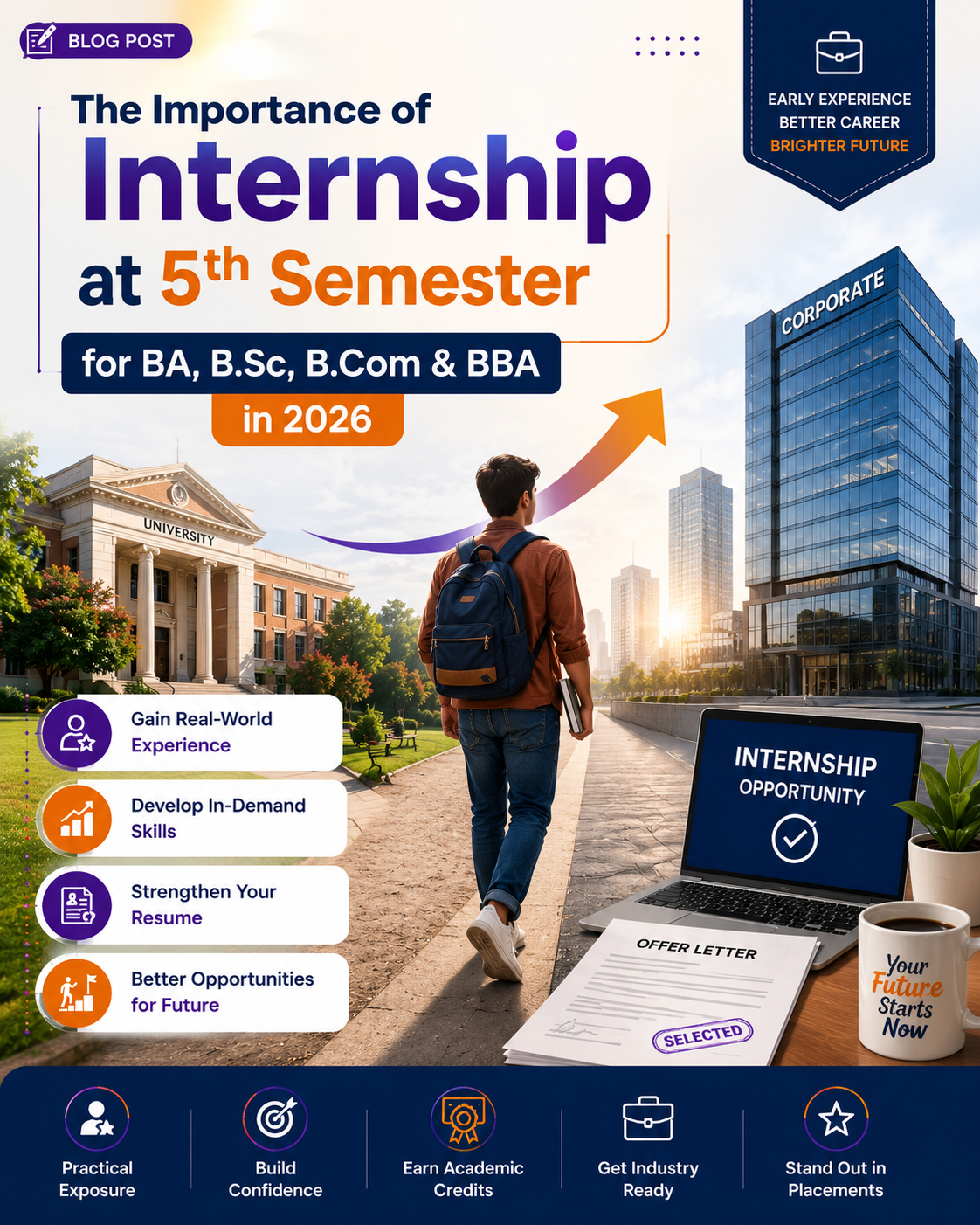
The Importance of Internship at 5th Semester for BA, B.Sc, B.Com & BBA in 2026
The Importance of Internship at 5th Semester for BA, B.Sc, B.Com & BBA in 2026
What UGC's guidelines actually require, why universities are enforcing it now, and how to turn a mandatory credit into a real skill.
Since UGC finalised its Guidelines for Internship/Research Internship for Undergraduate Students, a 60-120 hour internship worth 2-4 credits has been mandatory after the fourth semester for BA, B.Sc, B.Com and BBA students — commonly scheduled as the "5th Semester Internship." This guide breaks down exactly what the rule requires, what counts as valid proof, and how to make it genuinely useful.
A note before you read
This article is published by RequireHire's & Intern2Hub content team, — both part of Veridant AI. Every claim about the UGC requirement is sourced from UGC's official Guidelines for Internship/Research Internship for Undergraduate Students and NEP 2020, Exact implementation can vary by university, so where that's the case, we say so rather than presenting one interpretation as universal — always confirm specifics with your own internship coordinator.
Why This Is Landing on Students Right Now, in 2026
employability, 2026
India Skills Report, 2026
employability, 2026
Up from 55%, 2025
employability, 2026
India Skills Report, 2026
practical exposure
India Skills Report, 2026
UGC's internship guidelines aren't new — the final revised version was issued in October 2023, built on NEP 2020's push for practical, applied learning across every discipline, not just engineering. What's new is enforcement. Most students admitted under NEP-aligned four-year undergraduate programmes in 2022-23 are only now reaching their fifth semester, which is exactly why a rule finalised years ago is suddenly showing up as a real requirement on real students' timetables in 2026. Universities across states, including in Bihar, have begun formally activating "5th Semester Internship Programme" mandates this year.
The pattern this reveals
This isn't a one-off circular from a single college — it's a national credit requirement working its way through the system as the first NEP-aligned cohorts reach their third year. Treating it as a passing formality misses that it's now embedded in the same credit structure as your major and minor subjects, and it lands at a point in the degree — after foundational coursework, before final placements — that UGC designed deliberately.
The Short Answer, Upfront
Yes — UGC has made a 60-120 hour internship, worth 2-4 credits, mandatory after the fourth semester for BA, B.Sc, B.Com and BBA students, and most universities now schedule and enforce it within the fifth semester.
It sits inside the same credit structure as any other paper — which means it can affect your semester result the way a missed course would. Treated seriously rather than as paperwork to clear, it's also one of the more direct ways to close the exact employability gap national surveys keep naming.
The rest of this guide breaks that down by credit math, by documentation, and by stream — and ends with a personal readiness score so you know exactly where to start.

What "Mandatory" Actually Means Under UGC's Guidelines
UGC's Guidelines for Internship/Research Internship for Undergraduate Students state that an internship of 60 to 120 hours is mandatory after the fourth semester for students enrolled in UG degree programmes, sitting within the wider 120-160 total credit structure of a three-year or four-year degree under the National Higher Education Qualifications Framework and the Curriculum and Credit Framework for Undergraduate Programmes.
Why this is a credit-bearing course, not an optional add-on
The internship is assigned 2 to 4 credits, exactly like a Major, Minor, or Ability Enhancement course on your timetable. That's the detail students most often miss: it isn't a resume-building suggestion sitting outside your degree, it's a course you need to clear, with hours, evaluation, and documentation attached to it, the same as any paper you sit an exam for.
Why the 5th-Semester Timing Genuinely Works
Foundational subject knowledge already exists
By the fifth semester, a B.Com student has covered core accounting and finance papers, a BBA student has covered management fundamentals, and a BA or B.Sc student has a settled major — enough grounding to make an internship placement genuinely useful rather than purely observational.
Three semesters remain to apply what's learned
Completing the internship in the fifth semester, rather than the sixth or later, leaves three more semesters to build on what it taught — a skill gap identified in a fifth-semester internship can still be closed before final placements begin.
It lines up with when placement cells get active
Many colleges' placement and internship cells begin building employer relationships around this stage of the programme, so a well-completed internship can influence the references and recommendations available by final year.
Individual or group options add flexibility
UGC's guidelines allow individual or group internships, with a group assigned a shared theme under one industry or institution supervisor — useful for colleges with a limited pool of local industry partners to place every student individually.
What Happens When It's Treated as a Formality
A stamped certificate proves nothing in an interview
An internship completed only to get a signature, with no real task attached, leaves nothing to describe when a future employer asks what you actually did — the credit clears, but the resume line stays empty of substance.
Missing documentation can delay your result
Because the internship carries credits, incomplete or late paperwork — a missing certificate, an unsigned evaluation — can hold up your semester result the same way an incomplete paper would.
A mismatched internship wastes the opportunity
Taking whatever placement is easiest to arrange, regardless of fit with your subject or interest, uses up the credit without building evidence relevant to the career you're actually aiming for.
Slow college follow-through leaves students Helpless
Where a college's nodal-officer process is new or under-resourced, students who wait to be assigned a placement can find themselves short on time close to the deadline — a self-sourced, verified option is a reasonable backup in that situation.
Don't Wait on a Placement That Might Not Come
Internships on Intern2Hub cover Business Development, Accounts & Finance, HR, Content & Digital Marketing, and Education & Teaching — built for BA, B.Sc, B.Com and BBA students, no coding required.
Register. Verified employers. A dated certificate at the end.
Explore InternshipsCollege-Arranged vs Self-Sourced — Which Satisfies the Requirement?
College-arranged, via the nodal officer
Placements organised through your university's MOUs are pre-vetted and the paperwork is usually already in a format your college accepts, which lowers the risk of a certificate being rejected on a technicality.
Self-sourced, including platform-based
Finding your own placement, including through a verified internship platform, lets you match the internship to your actual interest and start on your own timeline rather than waiting on a limited local MOU network.
The honest verdict
Check your specific college's documentation requirements first — most internship coordinators care about the certificate, the hours, and a supervisor evaluation more than they care who found the placement. A self-sourced internship from a verified platform, in the right domain, satisfies the requirement as well as a college-arranged one, provided the paperwork matches what your coordinator asks for.
On Time vs Delayed — Why the 5th-Semester Window Matters
Completing it as scheduled
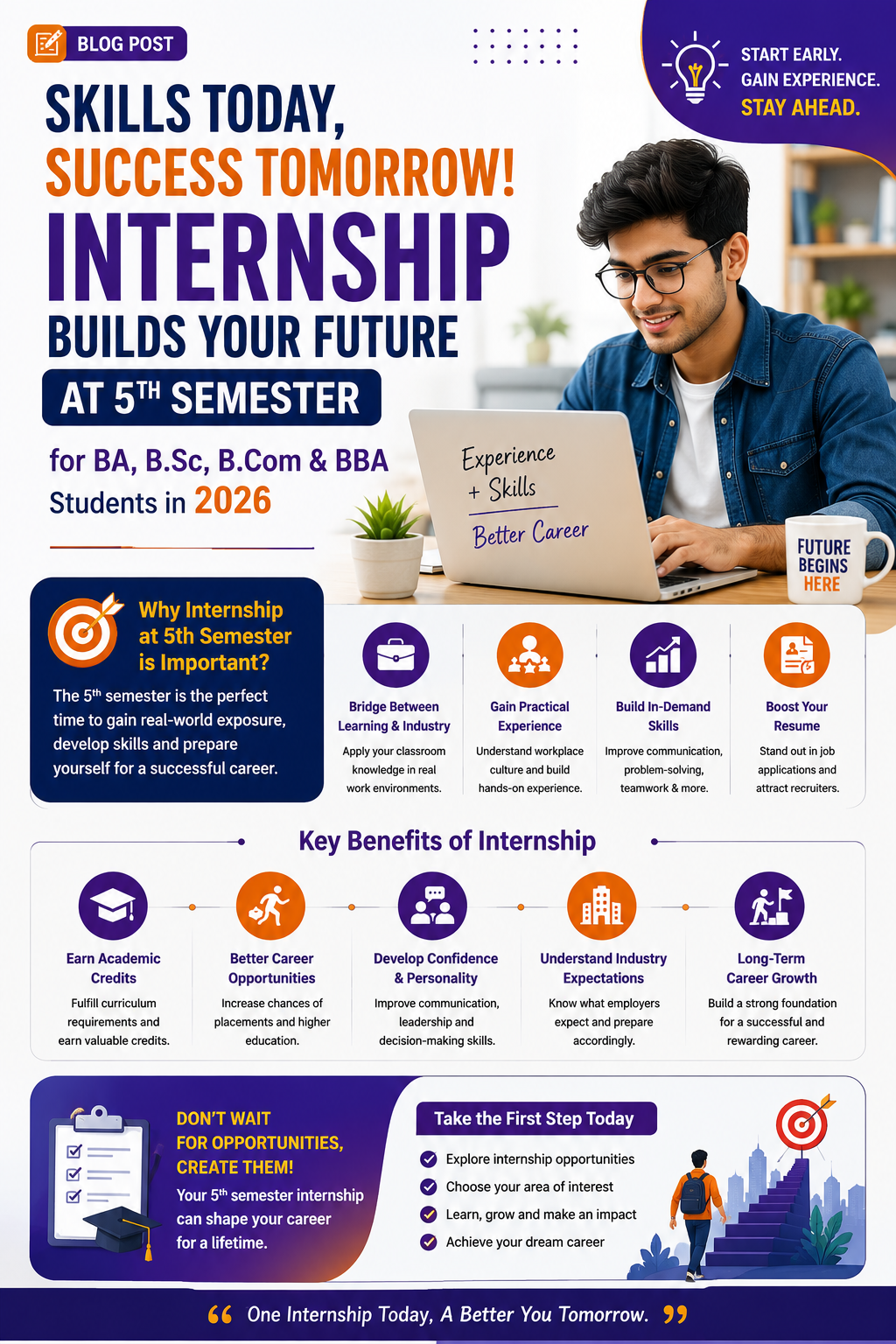
Doing the internship in the fifth semester, as UGC's timing intends, keeps it separate from exam-heavy final semesters and leaves the credit cleanly closed before placement season begins.
Pushing it to the sixth semester or later
Delaying compresses an already busy final year, risks clashing with placement interviews or board exams, and can leave a credit-bearing requirement unresolved right when you have the least slack to fix it.
The honest verdict
UGC placed the requirement deliberately after the fourth semester so both the credit and the skill-building land while there's still runway left in the degree. There's rarely a good reason to push it later, and several good reasons — timetable pressure, placement prep — not to.
Standard Internship vs Research Internship — Which Track Fits You?
UGC's guidelines describe two related but distinct tracks. The standard internship — 60 to 120 hours with an industry, business, or organisation — is what most BA, B.Sc, B.Com and BBA students complete after the fourth semester. A research internship, working alongside faculty or researchers on a project, sits closer to the four-year Honours with Research pathway, where the eighth and final semester separately carries a 360-hour, 12-credit dissertation or research project.
Which one applies to you
If you're on the standard three-year degree or the four-year Honours (without research) track, the fifth-semester industry or organisation internship is the one that counts. The research track is a separate, later-stage requirement specific to students pursuing the Honours with Research degree — don't confuse the two when planning your semester.
See What Non-Tech Internships Are Open Right Now
Browse verified internships across Business, Finance, HR, Marketing and Teaching instead of waiting on a college placement.
Browse Non-Tech InternshipsThe 5th-Semester Internship vs the Early UG-Certificate Internship
The early-exit internship
Some university syllabus under the NEP framework also reference a shorter work-based internship — around four weeks — tied to students who exit after the first year with a UG Certificate, a much smaller commitment aimed at students leaving the programme early.
The 5th-semester internship
This is the 60-120 hour, 2-4 credit requirement for students continuing through to a full degree, positioned after the fourth semester — a materially larger and more central part of your final credit total.
The honest verdict
If you're not planning to exit early, the fifth-semester internship is the one that actually counts toward your final degree. Don't assume an internship you completed in first year, or heard mentioned for early-exit students, already satisfies this later, larger requirement — check with your coordinator if you're ever unsure which one applies.
BBA vs BA / B.Sc / B.Com — Does the Requirement Differ?
The core UGC credit requirement — 2 to 4 credits, 60 to 120 hours, after the fourth semester — applies broadly across undergraduate programmes, including BBA, since BBA sits within the same NHEQF and Curriculum and Credit Framework structure at most universities. University BBA syllabus commonly list "Internships and Community Service based projects" as a required course category alongside Major, Minor, and Multidisciplinary courses, the same structure BA, B.Sc, and B.Com programmes follow.
What actually differs is domain fit, not the credit mechanics
A BBA student's internship will typically map directly to a management or business function — business development, HR, operations — while BA, B.Sc and B.Com students often have wider latitude to match the internship to their specific major, whether that's finance, content, education, or another discipline entirely.

Understanding the Credit Math — How Hours Become Credits
UGC's guidelines define one credit of internship as two hours of engagement per week. Across a standard 15-week semester, that works out to 30 hours per credit — which is exactly why the mandated 2 to 4 credits translates to a 60 to 120 hour internship.
What this means for planning your internship
In practice, a focused 3-4 week full-time internship (roughly 5-6 hours a day) or a longer part-time arrangement spread across several weeks both land comfortably inside the 60-120 hour range. Confirm the exact credit count — 2, 3, or 4 — your specific college has assigned before you commit to a placement, since that determines the minimum hours you actually need logged.
Which Domains Fit BA, B.Sc, B.Com and BBA Students Best
UGC's guidelines list local industry, business organisations, government offices, media, and community organisations as valid internship hosts — a wide net. In practice, five domains map cleanly onto these four streams:
Accounts & Finance: the natural fit for B.Com students, building directly on core accounting and taxation papers.
Business Development: the closest match for BBA students, applying management fundamentals to real client or market work.
Human Resources: a strong option for BBA and BA students with an interest in organisational behaviour or psychology.
Content & Digital Marketing: a natural fit for BA students in language, media, or communication-adjacent majors.
Education & Teaching: relevant for B.Sc and BA students considering education, tutoring, or subject-specific teaching roles.
The Role of Your College's Nodal Officer & Industry MOUs
UGC's guidelines direct every university to appoint a nodal officer, preferably from the research and development cell, specifically responsible for organising internship opportunities. That officer's job includes reaching out to other institutions, research organisations, corporates, industry bodies and government offices, and signing Memoranda of Understanding on the university's behalf, ideally backed by a local market survey of what companies actually need and what students expect.
A practical way to use this information
If your college's nodal-officer process is well established, that's usually the most convenient route — the paperwork is pre-aligned to what your university accepts. If it's slow, unclear, or still being set up, a verified platform-based internship with proper certificate and evaluation documentation is a reasonable, legitimate backup so you're not left scrambling close to the deadline.
The "It's Just a Formality" Myth
Because the internship shows up on the timetable as a course with a credit value, a common assumption is that it exists purely to be cleared — something to get signed off quickly, not something that needs to be taken seriously the way a major subject would.
What that assumption misses
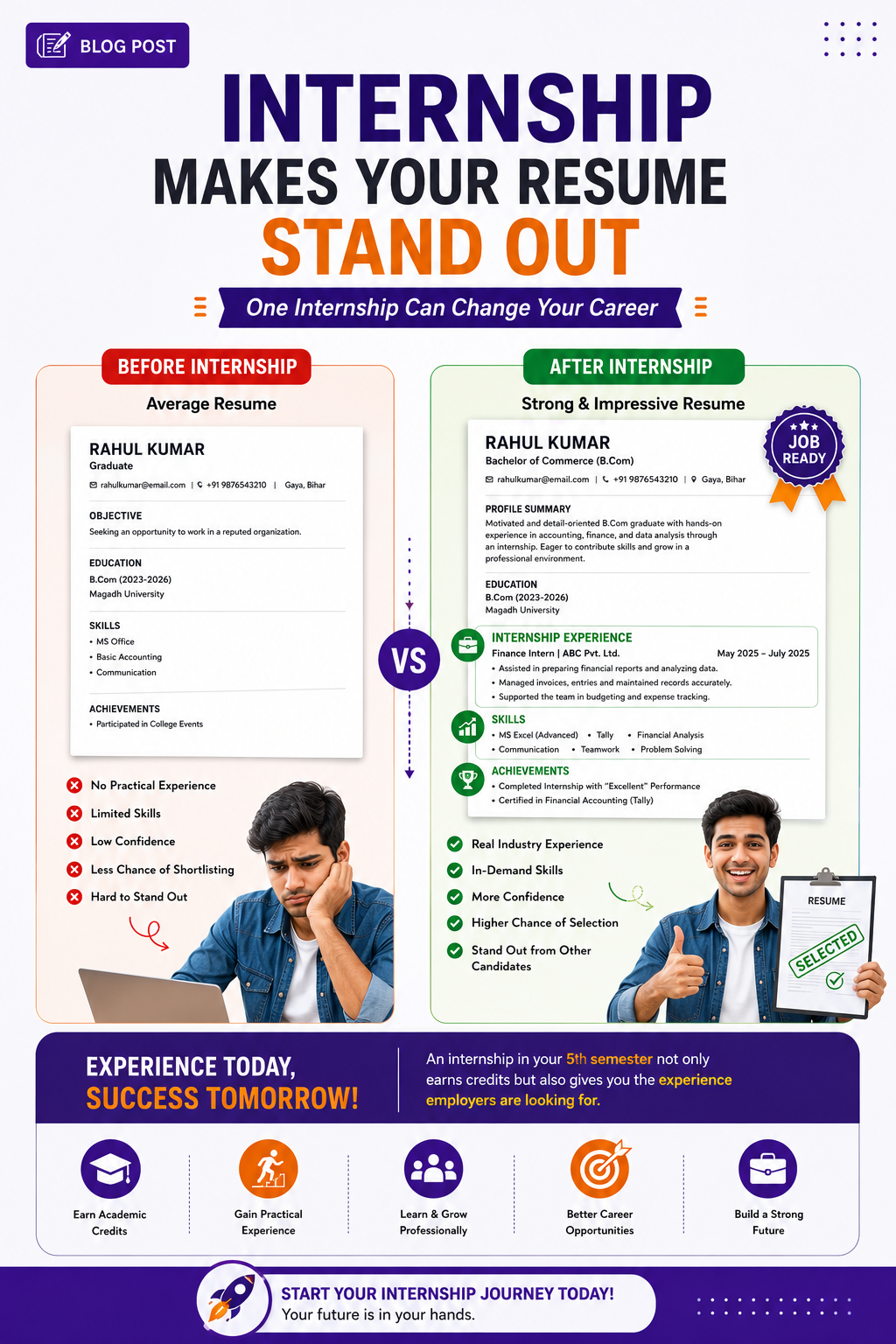
Treated as a formality, the internship produces exactly what the label suggests — a certificate and nothing else to discuss in an interview. Treated as real work, the same 60-120 hours produces a specific project you can describe in detail, a supervisor willing to answer a reference call, and the kind of applied evidence the 2026 India Skills Report shows employers weighting more heavily than degree pedigree alone. The credit clears either way; only one version actually helps you afterward.
The Real Impact — What the Data Shows
The pattern the numbers show
Commerce graduates posted the sharpest employability gain of any stream in 2026, and the India Skills Report ties it directly to more applied, industry-relevant exposure. That's the same mechanism UGC's fifth-semester requirement is designed to create at scale — structured, credit-backed practical exposure for every BA, B.Sc, B.Com and BBA student, not just those who happened to arrange one on their own.

Start Building That Proof This Semester
Registration for students. A one-time enrollment secures your placement and unlocks a certificate track once you're selected.
Register on Intern2Hub
What Counts as Valid Proof for Your UGC Internship Credit
Exact evaluation formats vary by university, but most internship coordinators ask for some combination of the following before awarding the credit:
Offer or confirmation letter: from the host organisation, stating the role and duration.
Attendance or hours record: showing the internship met the minimum hours for your assigned credits.
Completion certificate: dated, with the organisation's details and the internship period clearly stated.
Supervisor evaluation: a short assessment or feedback form from whoever directly supervised your work.
A short report or presentation: summarising what you did, in line with UGC's suggested internship activities.
Always confirm the exact list and submission deadline with your own internship coordinator — this is the single most common source of last-minute stress, and it's avoidable by asking early.
Your Internship Roadmap, by Stream
B.Com Students
Prioritise an Accounts & Finance internship involving real reconciliation or reporting work — it builds directly on your core papers and is the strongest evidence for BFSI-track roles after graduation.
BBA Students
A Business Development or HR internship applies management theory to real client, market, or people-management work — pick whichever matches the specialisation you're leaning toward.
BA Students
Content & Digital Marketing or HR internships suit language, media, and social-science majors well, letting you build a real portfolio alongside the mandatory credit.
B.Sc Students
An Education & Teaching internship is a strong, accessible option if you're weighing a teaching or tutoring path, and it satisfies the UGC hours requirement just as well as a lab-based placement.
Your 5th-Semester Internship Readiness Score
Check everything that's true for you right now, then calculate your score.

The 2026 Landscape, in Numbers
Numbers Are Useful. Starting Is Better.
See exactly which non-tech internships are open in your domain, right now, on Intern2Hub.
Explore Non-Tech InternshipsTurning This Into a Plan: Before, During, Documentation
Do: Confirm your college's exact credit and hour requirement
2, 3, or 4 credits changes your minimum hours from 60 to 120 — get this number from your coordinator before committing to a placement's duration.
Don't: Assume any internship automatically qualifies
Some colleges restrict eligible hosts or require a minimum notice period for approval — check before you accept an offer, not after.
Do: Keep your own hours log from day one
Don't rely solely on the host organisation to track this — a simple personal log protects you if their paperwork is delayed or incomplete.
Don't: Let it become passive shadowing
Ask for one task you own outright in the first week — it's what makes the eventual report and interview answer worth writing.
Do: Collect your certificate and evaluation before your last day
It's far easier to get a supervisor's signature while you're still there than to chase it weeks later by email.
Don't: Submit paperwork at the last possible moment
Since this is a credit-bearing course, late submission can delay your result the same way a late assignment would — submit early where your college allows it.
10 Questions Students Actually Ask About This
Your 5th-Semester Credit Can Also Be Your First Real Career Evidence
Whatever your readiness score came out to, the next step is the same: browse real non-tech internships across Business Development, Finance, HR, Content and Teaching, and turn a mandatory requirement into proof a resume alone can't provide.
Registration for students. Intern2Hub is a product of Veridant AI.
Ready to Practice What You Learned?
Take a free AI mock interview and get your skill score in 15 minutes. 100% free for all candidates.
Related Posts
Practice Your Interview
Get ready for your next interview with our AI-powered mock interview tool.
Start Practice Interview