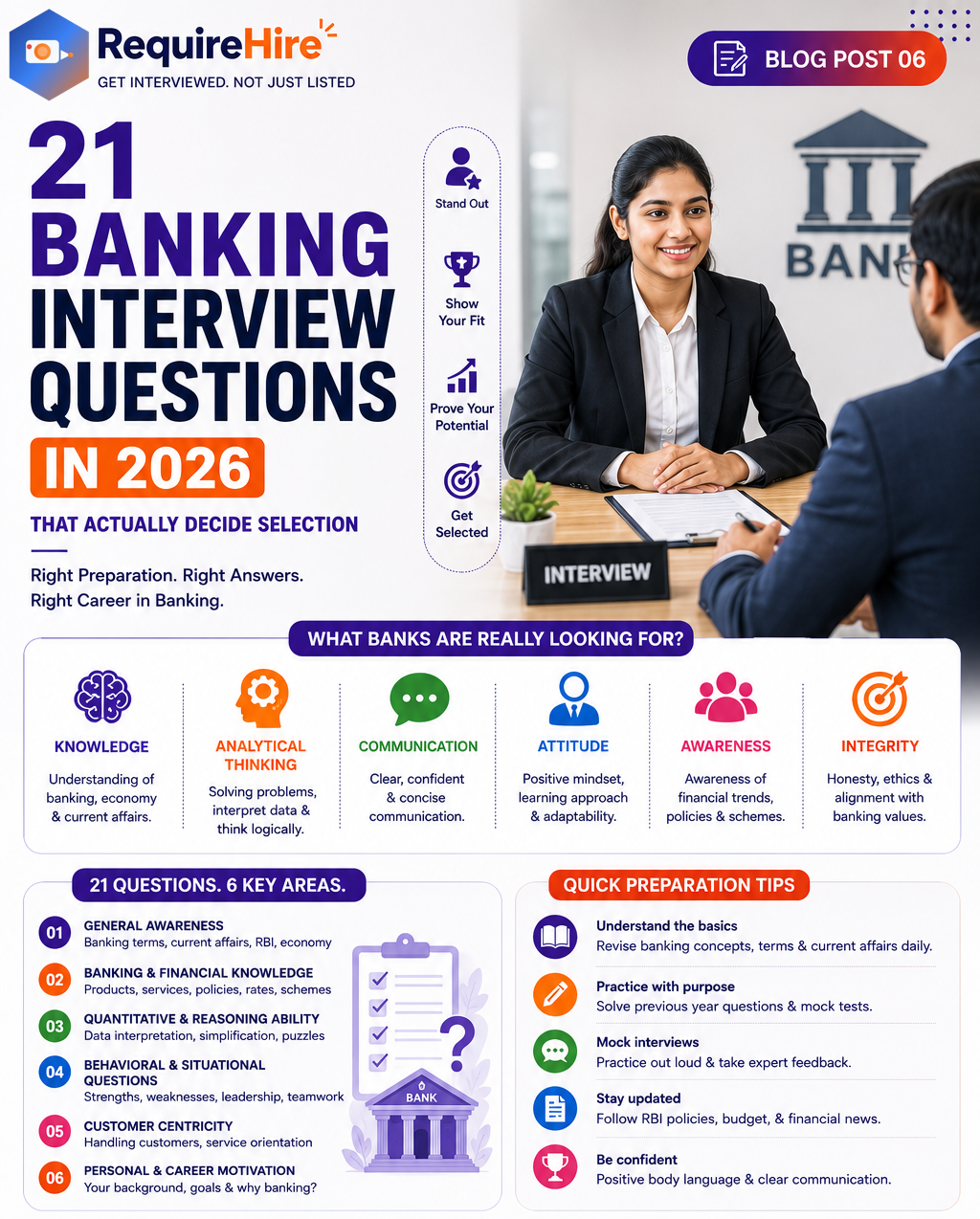
21 Banking Interview Questions in 2026 That Actually Decide Selection
21 Banking Interview Questions in 2026 That Actually Decide Selection
Basic to advanced — with clear model answers, current repo rate and CRR/SLR figures, and a plan for your final days of prep.
Most candidates walk into a bank interview with memorized definitions and no real plan for the questions that actually separate a selected candidate from a rejected one. This guide breaks down 21 real questions across three tiers — personal and HR basics, core banking awareness, and advanced concepts — each with a clear answer you can actually use, not just recite.
A note before you read
This guide is published by RequireHire's content team, part of Veridant AI. The answers here are meant to help you build your own response, not scripts to recite word for word — panels can tell the difference, and a memorized answer rarely survives a genuine follow-up question. Rate figures (repo rate, CRR, SLR) reflect the RBI's Monetary Policy Committee decision from its August 2026 review; since these are revised roughly every two months, always check for the latest figure closer to your actual interview date.

Why Banking Interviews Reward a Different Kind of Prep
A bank interview panel isn't just checking whether you're personable and well-spoken — it's checking whether you'd be trustworthy handling other people's money and comfortable discussing the mechanics of the institution you'd represent. That's why banking interviews blend standard HR questions with genuine subject-matter checks: current rates, core banking terms, and how well you can reason through a situation, not just recite one.
The pattern worth understanding early
Public sector banks have posted record profits in recent years and continue active hiring, which means the demand side isn't the bottleneck — the interview stage is where a large applicant pool gets narrowed down. That makes clarity, reasoning, and genuine understanding the real differentiators, far more than which coaching institute's question bank you memorized from.
What Actually Gets You Selected
Understanding a concept well enough to explain it in your own words beats memorizing a textbook definition, every time.
Panels ask follow-up questions specifically to test whether you actually understand what you just said. The 21 questions below are organized from basic to advanced so you can build understanding in layers — use the model answers as a starting structure, then practice explaining each one in your own words until it feels natural, not rehearsed.
Further down, you'll also find a current-rates cheat-sheet, the most common mistakes that cost candidates selection, and an interactive readiness score to check where you stand.

What a Bank Interview Panel Actually Evaluates
Banking & financial awareness
Core terms, current rates, recent policy moves, and whether you understand why they matter, not just what they're called.
Communication & composure
Can you explain something clearly under mild pressure, without rambling or freezing when a follow-up question arrives?
Situational judgment
How you'd handle a real scenario — an upset customer, a policy conflict, a mistake — matters as much as textbook knowledge.
Genuine motivation
Panels can usually tell a rehearsed "banking is a stable career" line from an answer that reflects real thought about the role.
Basic Questions: Personal & Foundational Awareness
These open almost every bank interview. Getting them right builds panel confidence early.
Tell us about yourself.
Keep it under a minute and structure it in three parts: where you are now (education/current role), one relevant strength or experience worth highlighting, and a bridge into why banking interests you specifically. Avoid reading your resume aloud — the panel already has it. End on something that naturally invites a follow-up question.
Why do you want to join the banking sector?
Go beyond "job security and stability" — panels hear that from nearly every candidate. Connect your answer to something specific: an interest in financial inclusion, comfort working with numbers and people, or an internship or personal experience that shaped your interest in how banks actually help people and businesses.
What is a bank, and what are its main functions?
A bank is a financial institution licensed to accept deposits from the public and lend money. Its core functions are accepting deposits (savings, current, fixed), lending (loans, advances, overdrafts), and facilitating payments and remittances. Modern banks also handle foreign exchange, offer investment and insurance products, and increasingly serve as the backbone of digital payments.
What's the difference between a savings account and a current account?
A savings account is meant for individuals, earns interest on the balance, and typically limits free transactions per month. A current account is mainly for businesses and traders, generally earns no interest, allows unlimited transactions, and often comes with an overdraft facility — built for frequent operational use rather than saving.
What is KYC, and why is it required?
KYC stands for Know Your Customer — the process banks use to verify a customer's identity and address before opening an account, typically through documents like Aadhaar, PAN, and address proof. It's required to prevent money laundering, fraud, and misuse of banking channels for illegal financial activity, and it's mandated under RBI guidelines linked to the Prevention of Money Laundering Act.
What's the difference between NEFT, RTGS, and IMPS?
NEFT settles transfers in batches with no minimum or maximum limit, and has run 24x7 since December 2019. RTGS is for high-value transfers (minimum ₹2 lakh), settles individually in real time, and has also run 24x7 since December 2020. IMPS is instant and mobile-friendly, typically used for smaller, urgent transfers — the fastest of the three for everyday use.
What's the difference between a debit card and a credit card?
A debit card draws directly from money already in your account, so you can only spend what you have. A credit card lets you borrow up to a pre-approved limit, which you repay later, usually with interest if the full amount isn't cleared by the due date. Responsible credit card use also helps build a credit history, which a debit card doesn't.
Reading These Answers Isn't the Same as Being Ready to Say Them
RequireHire's AI voice mock interview covers banking as one of its dedicated categories — practice these exact question types out loud and get instant, structured feedback.
Voice-powered. India-focused questions. For candidates.
Try Voice Interview Now
Intermediate Questions: Core Banking Awareness
Where panels start separating candidates who studied from candidates who understand.
What are the repo rate and reverse repo rate? What's the current rate?
The repo rate is what the RBI charges commercial banks for short-term loans against government securities; the reverse repo is what RBI pays banks to park surplus funds with it. Repo rate is RBI's primary tool for controlling inflation and liquidity — raising it makes borrowing costlier and cools spending, cutting it does the opposite. As of the RBI's August 2026 policy review under Governor Sanjay Malhotra, the repo rate stands unchanged at 5.25%, with a neutral policy stance.
What are CRR and SLR?
CRR (Cash Reserve Ratio) is the percentage of a bank's total deposits it must hold as cash reserves with the RBI — currently 3.00%. SLR (Statutory Liquidity Ratio) is the percentage of deposits banks must hold in liquid assets like government securities, cash, or gold — currently 18.00%. Both help RBI manage money supply and keep the banking system liquid and stable.
What is an NPA (Non-Performing Asset)?
An NPA is a loan or advance where the borrower hasn't paid interest or principal for more than 90 days. NPAs are a key indicator of a bank's asset quality — high NPAs signal stressed lending and reduce both profitability and the bank's capacity to lend further, which is why Gross and Net NPA ratios are closely tracked.
What's the difference between a cheque and a demand draft?
A cheque is an instruction to your bank to pay a specified amount, and it can bounce if there aren't sufficient funds. A demand draft is pre-paid — the issuing bank guarantees payment because the amount is already deducted from the purchaser's account at issue, which makes it more secure for the person receiving it.
What is inflation, and how does RBI try to control it?
Inflation is a sustained rise in the general price level, which reduces the purchasing power of money over time. RBI primarily manages inflation through monetary policy — mainly the repo rate, alongside CRR, SLR, and open market operations — guided by an inflation target of 4%, with a tolerance band of plus or minus 2%.
What are the main functions of the RBI?
RBI is India's central bank. Its core functions include issuing currency, acting as banker to the government and to commercial banks, regulating and supervising the banking system, managing monetary policy to balance inflation and growth, managing foreign exchange reserves, and overseeing the country's payment and settlement systems.
What is the CASA ratio, and why does it matter to a bank?
CASA ratio is the proportion of a bank's total deposits held in current and savings accounts, rather than term or fixed deposits. Since current and savings accounts pay little or no interest, a higher CASA ratio means access to more low-cost funds — which improves a bank's net interest margin and overall profitability.
Advanced Questions: Deeper Concepts & Situational Judgment
These come up more often for PO and specialist roles, and in the closing minutes of most interviews.
What is Priority Sector Lending (PSL)?
PSL is an RBI mandate requiring banks to direct a portion of their lending — 40% of Adjusted Net Bank Credit for domestic scheduled commercial banks — toward sectors considered priorities for inclusive growth: agriculture, micro/small/medium enterprises, export credit, education, housing, and lending to weaker sections of society.
What's the difference between monetary policy and fiscal policy?
Monetary policy is managed by the RBI, using interest rates, money supply, and credit control to manage inflation and growth. Fiscal policy is managed by the government through the Union Budget, using taxation and public spending to influence the economy. In short: RBI controls the cost and availability of money; the government controls what it collects and spends.
What do you understand by Basel III / capital adequacy norms?
Basel III is a global regulatory framework built after the 2008 financial crisis, requiring banks to hold enough capital to absorb losses without collapsing. It's measured through the Capital Adequacy Ratio (CRAR) — while Basel III's global minimum is 8%, RBI requires Indian banks to maintain at least 9%, effectively 11.5% including the capital conservation buffer, reflecting a deliberately more conservative approach given the sector's history of stressed assets.
What's the difference between a merger and an acquisition? Can you name a recent one in Indian banking?
In a merger, two banks combine into a single new or continuing entity, typically by mutual agreement. In an acquisition, one bank takes over another, which then ceases to exist independently — often used to rescue a weaker or stressed institution. India's biggest wave of consolidation ran 2017-2020, reducing public sector banks from 27 to 12, including SBI absorbing its associate banks in 2017 and PNB merging with Oriental Bank of Commerce and United Bank of India in 2019. Further consolidation has been discussed in 2026, though nothing formal has been confirmed as of this writing.
What is UPI, and how has digital banking changed the sector?
UPI (Unified Payments Interface), developed by NPCI, lets users link multiple bank accounts to a single mobile app for instant transfers. It has transformed Indian banking by making peer-to-peer and merchant payments nearly instant and largely cashless, pushing banks to compete on digital experience and driving major gains in financial inclusion, including in rural and semi-urban areas.
Situational: How would you handle an angry customer at your branch counter?
Stay calm and let the customer fully express their frustration without interrupting — most people just want to feel heard first. Acknowledge the issue genuinely rather than getting defensive, explain clearly what you can do within your authority, and escalate to a senior if it's beyond what you can resolve. The goal is making the customer feel handled with care, not just processed.
Closing: Where do you see yourself in five years? / Why should we hire you?
For "five years," connect your answer to genuine growth within the bank — promotions, certifications like JAIIB or CAIIB, or specialization — rather than vague ambition. For "why hire me," tie your answer to something specific about your preparation, background, or approach, rather than generic traits like "hardworking" and "honest" on their own.
Get Instant Feedback on How You'd Actually Answer
RequireHire's AI Interview Prep tool scores your communication, structure, and confidence — so you know exactly what to fix before the real panel does.
Start AI Interview Prep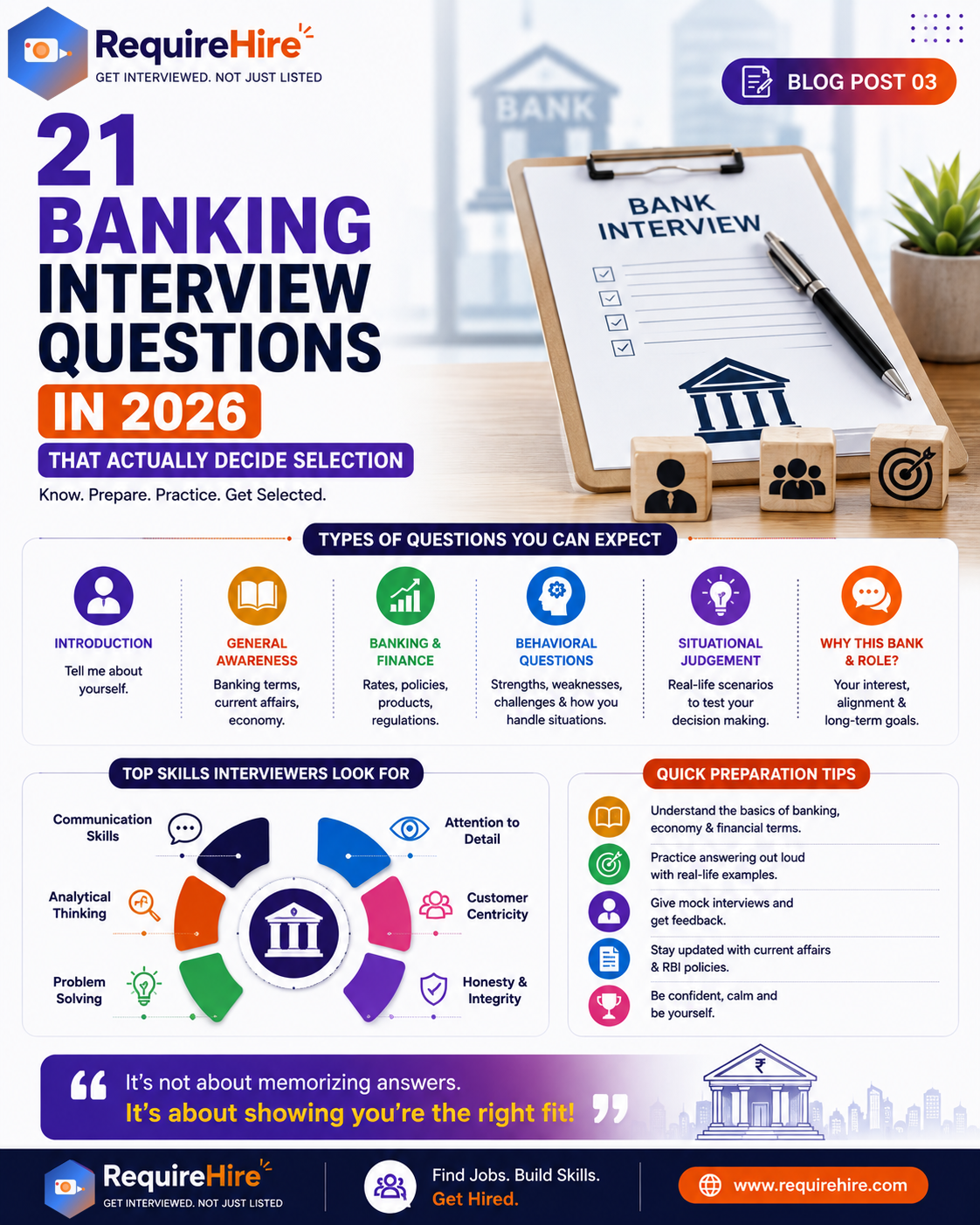
Memorized Answers vs Understood Concepts
Memorized definitions
Sound polished on the first pass, but fall apart the moment a panel asks "why does that matter?" or applies it to a slightly different scenario than the one you rehearsed.
Genuinely understood concepts
Might sound slightly less polished on the first try, but hold up under follow-up questions because you can rebuild the explanation from first principles, not from memory of a specific sentence.
The honest verdict
Use the model answers in this guide as a starting structure, then close the article and try explaining each concept out loud in your own words. If you can do that for all 21, you're actually prepared — not just rehearsed.
Generic Answers vs Personalized, Specific Answers
"Banking offers stability and growth"
Technically true, said by nearly every candidate in the room, and forgettable within minutes of the interview ending.
"I want to work in retail banking because..."
A specific reason, experience, or observation attached to your answer gives the panel something to remember you by, and something genuine to ask a follow-up question about.
The honest verdict
Specificity is one of the cheapest ways to stand out in a room full of qualified candidates saying similar things — it costs nothing extra to prepare, and it's the difference between being remembered and being forgotten.

HR Questions vs Technical Banking Questions — How Prep Differs
HR & personal questions
Prep here means reflection, not memorization — knowing your own story well enough to tell it naturally, with a structure in mind rather than a script.
Technical banking questions
Prep here means genuine understanding of the mechanics, plus knowing current figures well enough that a rate change in the news doesn't catch you off guard.
The honest verdict
Treating both categories the same way — either over-rehearsing the personal questions or under-preparing the technical ones — is one of the most common gaps between candidates who clear the interview and those who don't.
Freshers vs Experienced Candidates — What Actually Changes
Freshers
Panels expect strong fundamentals and genuine enthusiasm rather than experience — lean on academic projects, internships, or general life examples to answer situational questions.
Experienced / lateral candidates
Panels expect you to connect fundamentals to real situations you've actually handled, and will probe deeper into how your past experience applies specifically to banking.
The honest verdict
The 21 questions in this guide apply to both groups — what changes is the depth panels expect in your answers and how much they'll lean on your past experience versus your potential.
Current RBI Rates Cheat-Sheet (August 2026)
Know these cold — they're the single most commonly asked current-affairs check in banking interviews.
| Rate | Current Value |
|---|---|
| Repo Rate | 5.25% |
| Reverse Repo Rate | 3.35% |
| Cash Reserve Ratio (CRR) | 3.00% |
| Statutory Liquidity Ratio (SLR) | 18.00% |
| Marginal Standing Facility (MSF) | 5.50% |
| Bank Rate | 5.50% |
| Standing Deposit Facility (SDF) | 5.00% |
| RBI Governor | Sanjay Malhotra |
| Next MPC Meeting | 5-7 Oct 2026 |
Rates last confirmed at the RBI's August 3-5, 2026 MPC review, which kept the repo rate unchanged with a neutral stance. Since these are reviewed roughly every two months, verify the latest figure on rbi.org.in closer to your interview date.
Common Mistakes That Cost Candidates Selection
Rambling on "tell me about yourself"
A two-minute unstructured answer to the very first question sets a scattered tone for the rest of the interview — keep it tight and purposeful.
Guessing confidently instead of admitting uncertainty
A wrong answer said with total confidence often lands worse than an honest "I'm not fully sure, but here's my reasoning" — panels notice the difference.
Contradicting your own resume
Mismatched details between what you wrote and what you say out loud raise doubts about everything else in your application, not just that one detail.
Skipping current-affairs prep entirely
Assuming static definitions are enough, without checking recent rate changes or banking-sector news, is one of the most avoidable gaps in otherwise solid preparation.
Beyond the Answers: What Else the Panel Notices
Correct answers matter, but they're not the whole picture. Panels are also reading how you carry yourself while giving them.
Quick, practical checks
Sit upright without looking stiff, maintain natural eye contact across the whole panel rather than just the person who asked, and pause briefly before answering rather than filling silence with "um" — a short pause reads as composure, not hesitation. Dress formally and conservatively, arrive early enough to settle your nerves, and greet the panel with a simple, confident handshake and introduction if that's the local custom.
One New Interview Question, Every Day
Build a daily prep habit with RequireHire's Interview Question of the Day — answer, get AI feedback, and build a streak leading up to your interview.
Take Today's ChallengeThe "One Right Answer" Myth
For factual questions like "what is CRR," there genuinely is a correct definition. But for opinion-based, situational, or "why banking" style questions, many candidates assume the panel has one ideal answer in mind and try to guess it — which usually produces a generic, hedge-everything response.
What panels are actually listening for
For situational and opinion-based questions, panels are typically evaluating your reasoning process far more than a single "correct" conclusion. A well-reasoned answer that isn't the exact one they imagined usually scores better than a vague, safe answer designed to avoid disagreement.
Why the Interview Stage Matters More Than Ever
What this means for you as a candidate
India's public sector banks are financially healthier than they've been in years, with rising profits, falling bad-loan ratios, and continued active hiring. That means the interview isn't a formality standing between you and a shrinking opportunity — it's a genuinely open door, and the quality of your preparation is what decides whether you walk through it.

How to Prepare in Your Final Days
Verify current rates: check rbi.org.in or a reliable financial news source for the latest repo rate, CRR, and SLR the night before, in case anything changed since this guide was published.
Practice all 21 questions out loud: silently reading an answer feels very different from saying it under mild pressure — practice bridges that gap.
Scan a week of banking news: recent RBI announcements, government financial schemes, or major bank news are common current-affairs prompts.
Prepare 2-3 questions to ask the panel: a thoughtful question at the end signals genuine interest, far more than "no, I don't have any questions."
Do one full mock run: with a friend, a mirror, or an AI mock interview tool — a full run-through catches gaps that reviewing notes alone won't.
Your Focus, by Candidate Type
PO / Officer Aspirants
Weight your prep toward Tier 3 — Basel III, policy tools, and situational judgment — since PO interviews probe leadership potential more deeply.
Clerk-Level Aspirants
Focus on Tier 1 and Tier 2 — fundamentals, communication, and customer-facing scenarios — which typically carry more weight than deep policy analysis.
Specialist Officer (SO) Roles
Expect domain-specific technical questions on top of these 21 — treat this guide as your general banking-awareness base, not your complete prep.
Lateral / Experienced Candidates
Prepare to connect each concept to a real situation you've handled — panels will expect depth beyond textbook definitions given your experience level.
First-Time Interviewees
Prioritize the presentation basics in Section 14 alongside the questions — composure often matters as much as content when it's your first panel interview.
Your Banking Interview Readiness Score
Check everything that's true for you right now, then calculate your score.
This Guide, in Numbers
Reading Is Preparation. Practicing Is Readiness.
Take these 21 questions from something you've read to something you can say confidently, out loud, under pressure.
Try Voice Interview Now
Interview Day: Before, During, After
Do: Arrive with time to spare
Reaching 20-30 minutes early gives you time to settle your nerves, review your documents, and skim any last-minute current-affairs notes.
Don't: Cram new concepts at the last minute
Trying to learn something entirely new an hour before your interview usually adds nervous energy rather than genuine readiness.
Do: Pause before answering
A brief pause to organize your thoughts reads as composure, not uncertainty — it's almost always better than an instant, unstructured answer.
Don't: Argue if a panelist disagrees
If challenged on an answer, calmly explain your reasoning rather than getting defensive — panels are often testing how you handle disagreement, not just the answer itself.
Do: Note what tripped you up
Write down any question you struggled with immediately afterward — it's valuable prep material whether or not this particular interview goes your way.
Don't: Assume one interview defines your prospects
Banking recruitment runs multiple cycles a year — treat each interview as a rep that sharpens the next one, not a single make-or-break event.
10 Questions Candidates Actually Ask About the Process
You've Read the Answers. Now Say Them Out Loud.
Knowledge that only lives in your head doesn't help you in the interview room. RequireHire's AI voice mock interview covers banking as a dedicated category, with instant, structured feedback so you know exactly where you stand before the real panel does.
100% for job seekers. RequireHire is a product of Veridant AI.
Ready to Practice What You Learned?
Take a free AI mock interview and get your skill score in 15 minutes. 100% free for all candidates.
Related Posts
Practice Your Interview
Get ready for your next interview with our AI-powered mock interview tool.
Start Practice Interview